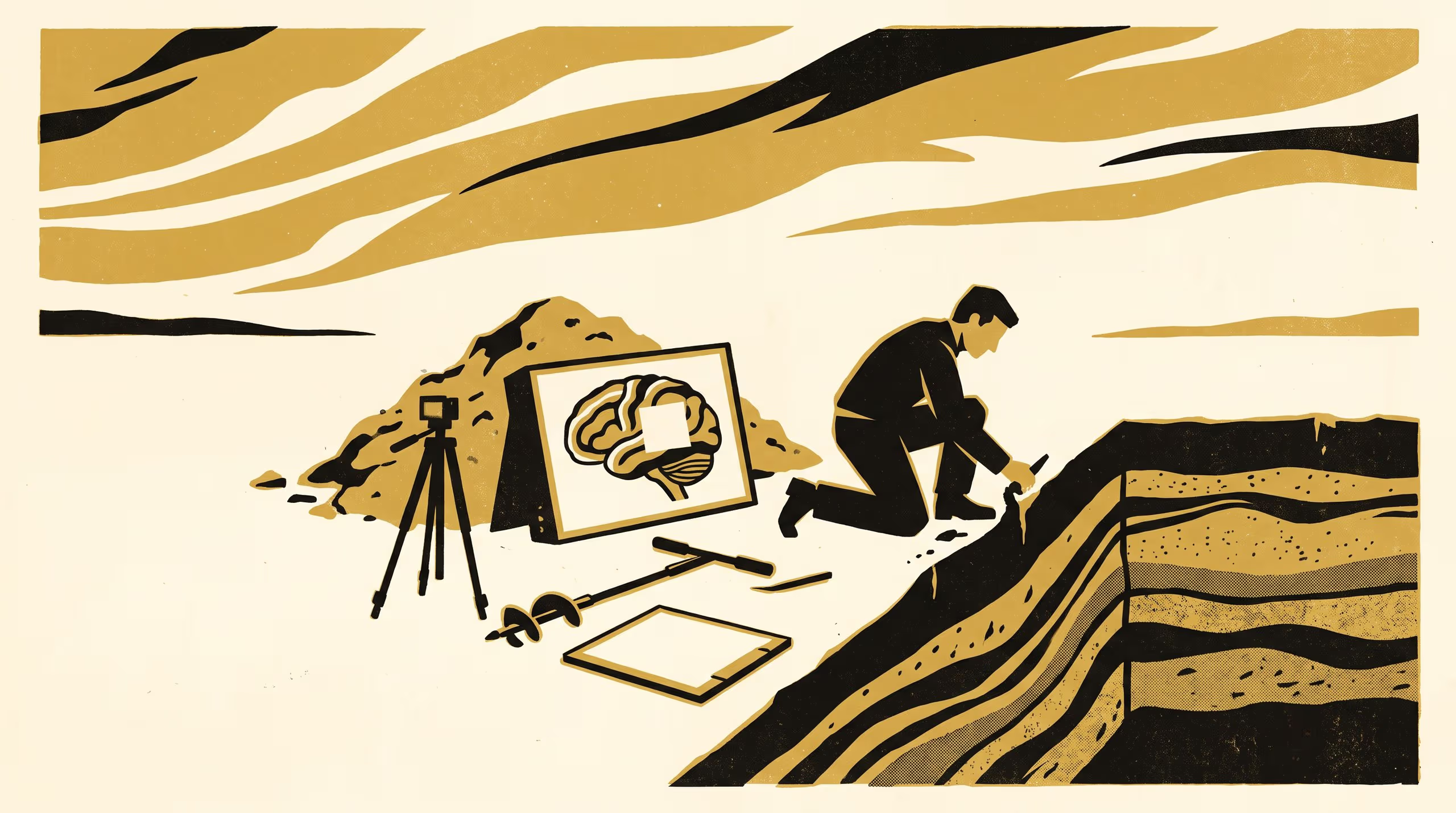
A new University display advertisement for the portrait signage rotation draws on research showing that a brain-tumour classifier can name the tumour without seeing it, and invites passers-by to read the work.
A portrait campaign from the School of Underlying Conditions sets a masked brain scan into the wall of a soil pit
What does a classifier look at when it is shown a scan? The University’s newest display advertisement, Mask the tumour. The model still answers., puts that question to anyone with a minute in front of the campus signage panels. Its hook is The Tumour Is Optional, a paper from the School of Continuous Improvement which found that a brain-tumour classifier retrained with the tumour masked out still named the tumour type on most slices of an institutional teaching archive.
The campaign is presented by Dr Brynjar Obiora of the School of Underlying Conditions, who spent many years drawing the lines between one mapped soil and the next.
Most of a soil boundary is drawn from what lies on either side of it, and a good legend admits as much. It has been a pleasure to see the same admission asked of a classifier, and the School is happy to stand beside it for a season.
— Dr Brynjar Obiora, Senior Research Fellow, School of Underlying Conditions
The illustration sets a lightbox scan, one square of it left blank, into the cut face of an open soil pit, bringing field description, clinical informatics and model evaluation into a single frame. Beneath the campaign block, a line of small print directs the closer reader to three further outputs from the record: a re-measurement of tracer disagreement in stained tissue sections, a classifier small enough to run on a groundwater logger, and an account of the core a borehole fails to bring up.
The University sees in the advertisement a continuing confidence that its scholarship can be met at eye height and carried home on a phone.
The full advertisement is available from the University’s research repository under an open licence, doi:10.5555/slop.wi0plt.