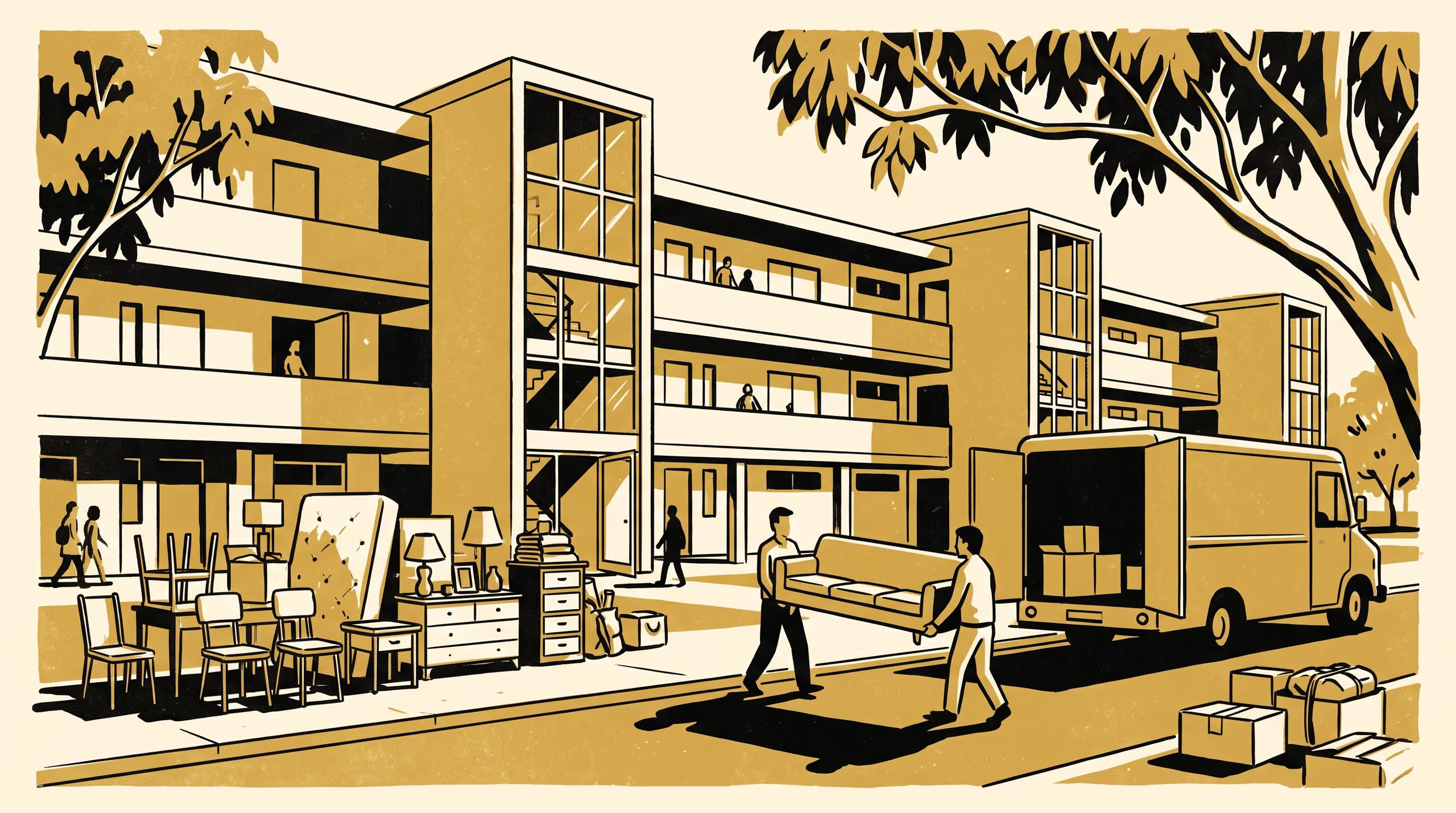
A new research poster follows a housing authority's relocation team through six waves of clearing an estate for renewal and finds its officers came to move neighbours in pairs, a practice no version of the procedure describes.
A research poster follows six waves of relocation from one walk-up estate, and an offer routine that changed while its procedure did not
A lecturer in land law and two doctoral candidates who came to the University from relocation coordination and residential property management have together produced Moved by the Landing, a new research poster from the School of Settled Matters. Dr Clemency Tredinnick, Hedvig Anyanwu and Ylva Ogunbanjo followed a housing authority’s relocation team as it cleared one walk-up estate for renewal across six waves of moves.
The team’s written procedure stayed the same from the first wave to the last. What changed was the work of making offers. From the third wave, officers began holding neighbouring vacancies in the receiving buildings and offering them to households in pairs. Requests to stay beside a named neighbour, met in 9% of cases in the first wave, were met in 61% by the sixth.
Most of my working life has been spent at the moment a place changes hands, and I had assumed I knew what people carry out of one. The School is glad to have been shown otherwise, and is still working out what it was shown.
— Dr Clemency Tredinnick, Lecturer, School of Settled Matters
The poster pairs close reading of case files with observation of the offer meeting itself, bringing routine dynamics, tenancy practice and place attachment into a single frame for understanding how a public organisation carries what its residents value through a period of change.
The University counts the work among the first fruits of its newest School’s turn from the law reports toward the offices where rules are applied every day. Ms Anyanwu said the fieldwork “felt less like observation than a very long handover, and the University is better for having been in the room.”
The full poster is available from the University’s research repository under an open licence, doi:10.5555/slop.zwpi2e.