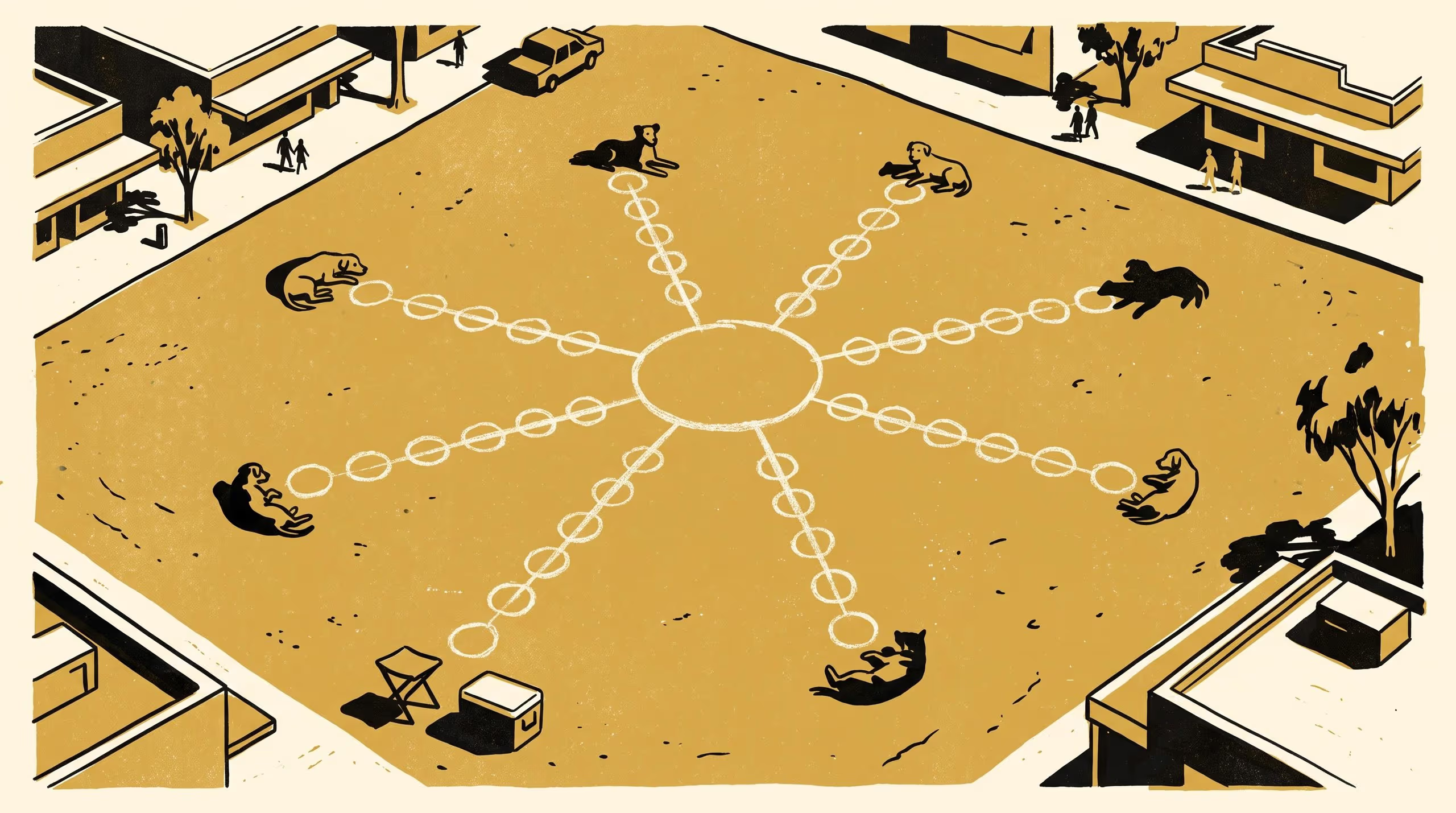
A new research poster recasts canine rabies control as a turn-based firefighting game on a contact network and shows what a defender loses by seeing each infection late, trading every round of delay for roughly one more defender per round.
A School of Continuous Improvement poster plays the firefighter game on synthetic dog-contact graphs, with a defender who learns of each fire rounds after it starts
One round of delay, one more defender per round. That is the exchange rate at the centre of Fighting Fires You Cannot See, a new research poster from the School of Continuous Improvement by Dr Thandiwe Solberg, Senior Lecturer and Convenor, Demo Quarter, with doctoral candidates Gunnhild Ekwueme and Eskil Nwabueze.
The team brings the formal toolkit of theoretical computer science to the operational landscape of canine rabies control, recasting the vaccination round as a turn-based game on a contact network and establishing performance guarantees for a defender who works from an out-of-date picture. Proofs on trees are paired with simulation across 200 synthetic contact graphs to chart the trade-off between response capacity and observation latency, and the poster closes with a set of open problems for the field.
The work extends the School’s standing interest in what a team can know at the moment it is asked to act, and the University is glad to see that interest reach a branch of mathematics that has been asking the same question for some time.
A demonstration always happens a little after the work it shows. It has been a pleasure to spend a year with a body of theory that takes the delay as seriously as we do.
— Dr Thandiwe Solberg, Senior Lecturer and Convenor, Demo Quarter
Ms Ekwueme said the project had changed how she reads a diagram: “You stop looking at where the fire is and start looking at where it will have been.”
The full poster is available from the University’s research repository under an open licence, doi:10.5555/slop.ekbgab.