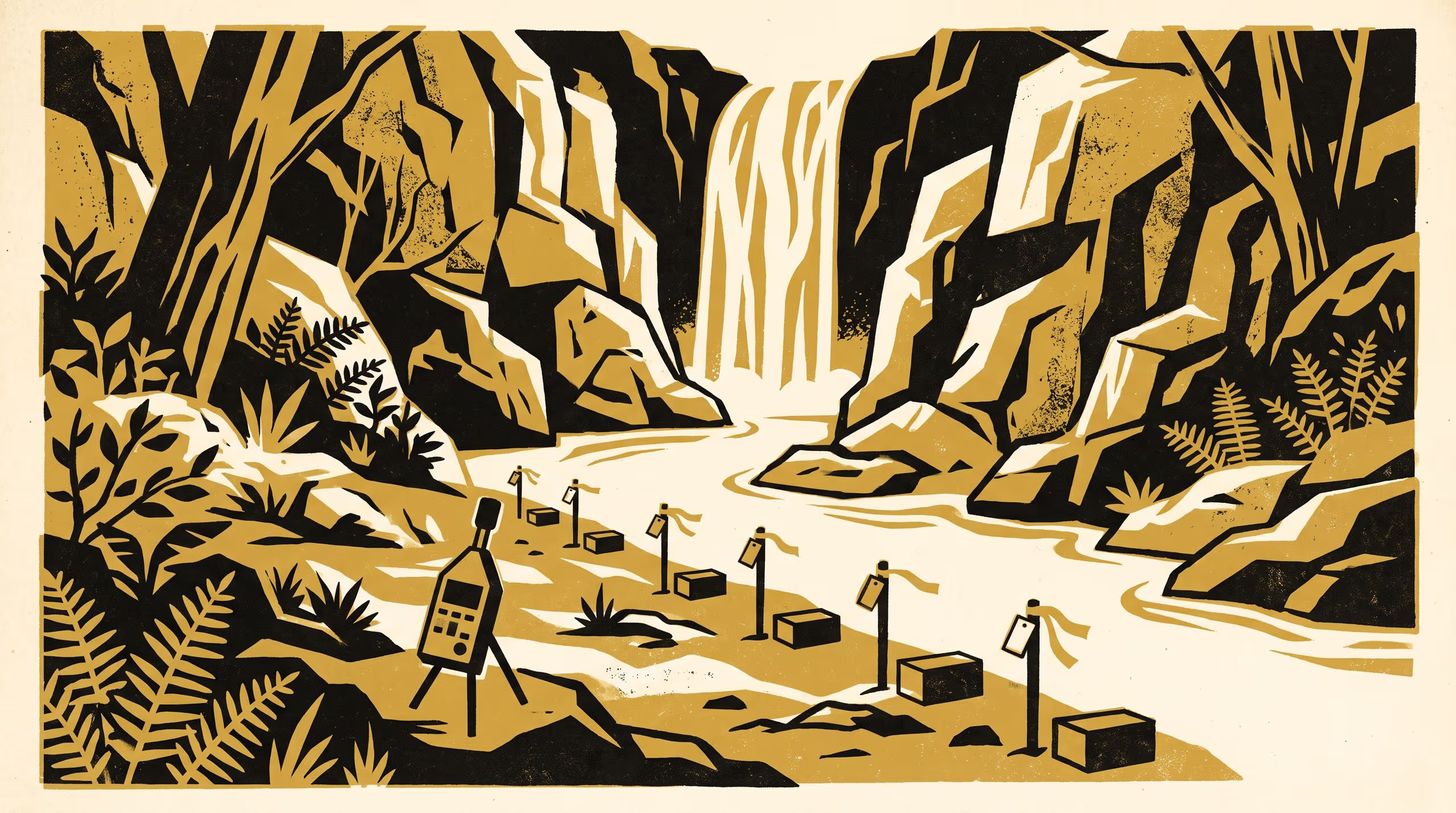
A new research poster from the School of Settled Matters follows a small riparian rodent down a kilometre of creek below a waterfall, and finds a hair-cell allele common at the falls and scarce beyond them, in a cline that did not move across three seasons of trapping.
A three-autumn trapping study finds a hearing-linked allele thinning with distance from the falls, and a boundary that has stayed put
How far does the sound of a waterfall reach into the lives of the animals that live below it? According to Where the Falls Stop Being Heard, a new research poster by Dr Odalys Penhallow, Senior Lecturer and Lead, Received Readings Group in the School of Settled Matters, and Dr Vigdis Emenike, Senior Lecturer in the School of Underlying Conditions, it reaches about four hundred metres, and it has stopped there.
A court registry teaches you that most questions close well before anyone announces it. We went down to the creek expecting an argument still in progress, and found instead a question the creek had long since settled. We are content to have been told.
— Dr Odalys Penhallow, Senior Lecturer and Lead, Received Readings Group, School of Settled Matters
Over three autumns the team worked a line of trapping stations down one creek bank, pairing an acoustic profile of each station with a hearing assessment and a genetic sample from every resident animal, and reading the whole as a single landscape-scale picture of exposure, inheritance and settlement. The result is a gradient-informed account of where one population’s hearing changes, and of a boundary that held its position from the first season to the last.
It is a matter of quiet satisfaction to the University that its scholars of precedent have proved as much at home beside a live trap as beside a law report, and that the School’s interest in the closed question has found a population willing to answer it. Dr Emenike credited the walkers and swimmers of the gorge, “who stepped around our stakes all three seasons and never once moved one.”
The full poster is available from the University’s research repository under an open licence, doi:10.5555/slop.5fbyq1.