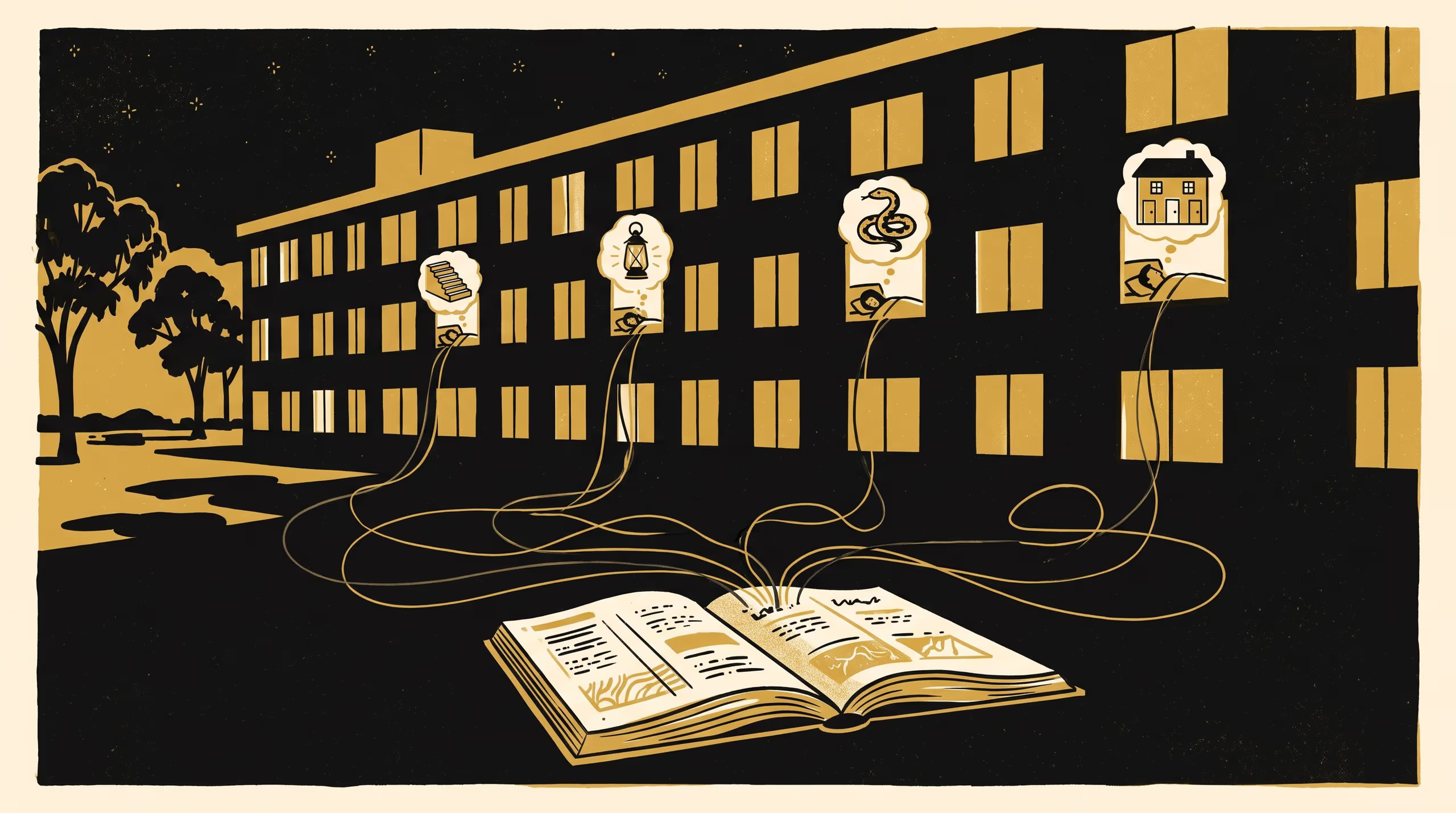
A new research poster from the School of Continuous Improvement trains a next-dream model on the paired waking and dream diaries of 214 volunteers and finds the dreams answer the day only once the model has read enough of them.
A sequence model trained on paired day and night diaries favours continuity over short runs of dreams and Jung's compensation over long ones
For up to eighteen months, 214 volunteers kept two diaries side by side, one for the day and one for the night. The School of Continuous Improvement has now put the pair to work on one of the oldest open questions in the psychology of dreams: does tonight’s dream carry today forward, or does it push back against it?
Learning the Compensatory Dream, a new research poster by Dr Thandiwe Solberg, Dr Dagny Okafor and Eskil Nwabueze, suggests that the answer depends on how long you are prepared to listen. Read a few nights at a time, the dreams continue the day. Read some forty or more, and the pattern Jung called compensation begins to show through.
We have only read the opening chapters of a very long series. The School intends to keep turning the pages, and to see what the series has to say about the reader.
— Dr Dagny Okafor, Lecturer and Convenor, Evaluation of Evaluation
The team brought a contrastive, sequence-aware modelling framework to bear on a large longitudinal diary resource, positioning two competing accounts of dreaming within a single, capacity-matched predictive architecture and aligning both with a pre-registered evaluation pathway.
The University sees in the poster a fitting meeting of two of its quieter habits: keeping careful records over a long period, and declining to decide anything from a single night’s evidence. Mr Nwabueze said the work had reshaped his view of a results table: “The bottom row is only the last thing that happened. It is not always the thing the series is about.”
The full poster is available from the University’s research repository under an open licence, doi:10.5555/slop.5y4ka4.