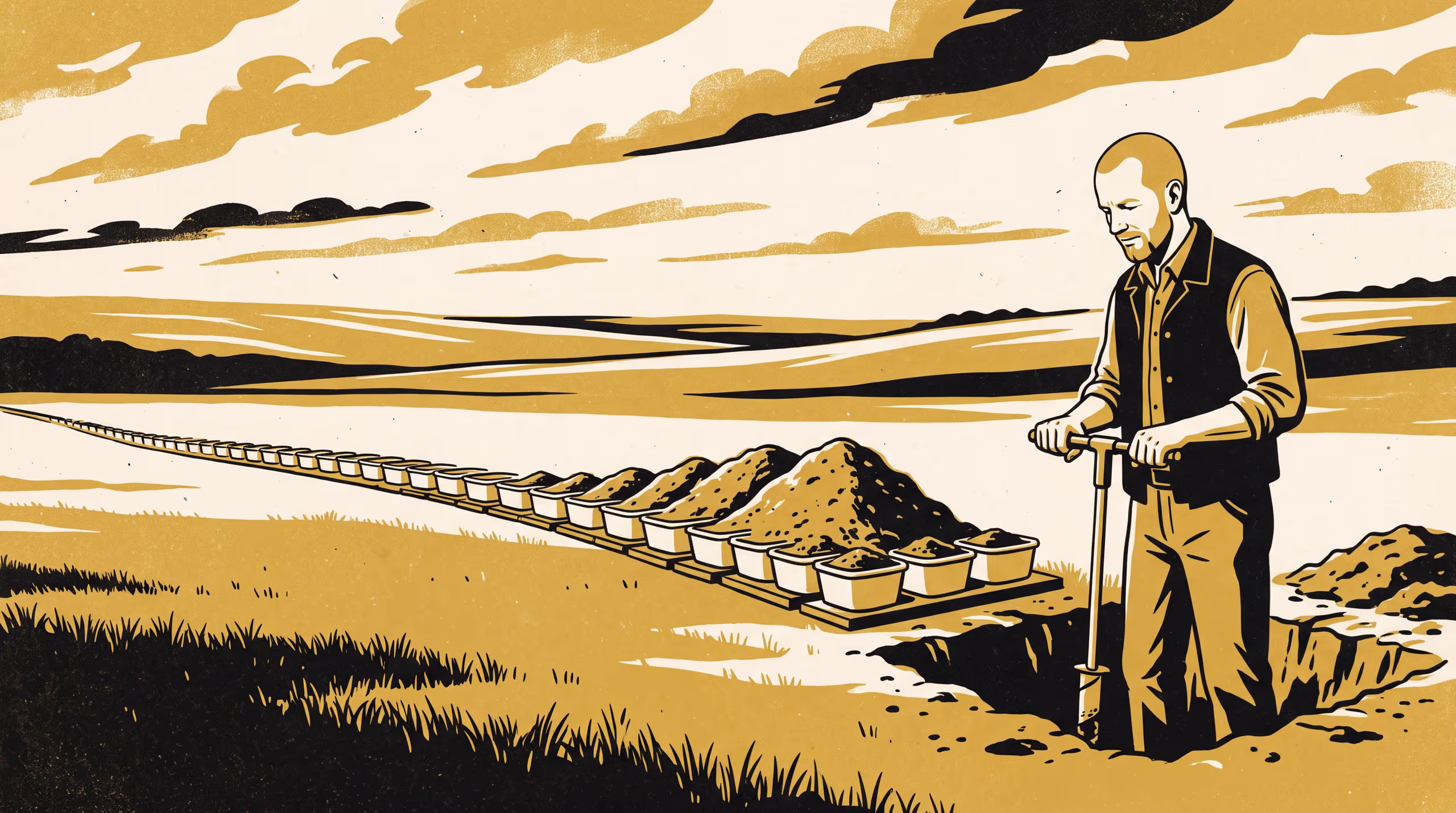
The School of Underlying Conditions brings a soil surveyor and a row of sample tubs to the University's landscape panels, with a line about averages and what they leave out.
A landscape advertisement fronted by Dr Brynjar Obiora of the School of Underlying Conditions sets a soil pit beside a long tail of sample tubs
A man stands waist-deep in a soil pit with a hand auger, and beside him a row of sample tubs rises to a heap and then thins away toward the horizon. That is the picture the School of Underlying Conditions has chosen for its newest campaign on the University’s landscape panels, Map the Spread, Not the Average.
The advertisement is fronted by Dr Brynjar Obiora, Senior Research Fellow, whose work in the School’s soil survey turns on how much a single name on a soil map is asked to hold. Its supporting line puts the case plainly: one soil on the map is many in the ground.
I would be glad if someone waiting for a bus looked at the tubs at the far end before the heap in the middle. The heap is where people expect us to be. The far end is where the work is.
— Dr Brynjar Obiora, Senior Research Fellow, School of Underlying Conditions
Behind the image sits a body of practice the School describes as distribution-first: sampling a mapped unit pit by pit, then characterising the whole range of what turns up, rather than anchoring the unit to one representative value. The campaign carries that posture to display scale, and its small print directs passers-by to three of the University’s published studies, among them the School’s own recent work on how soil boundaries come to be drawn.
The University counts the campaign among its clearest statements yet of how it would prefer to be read: in full, tails included.
The full advertisement is available from the University’s research repository under an open licence, doi:10.5555/slop.hpwxja.