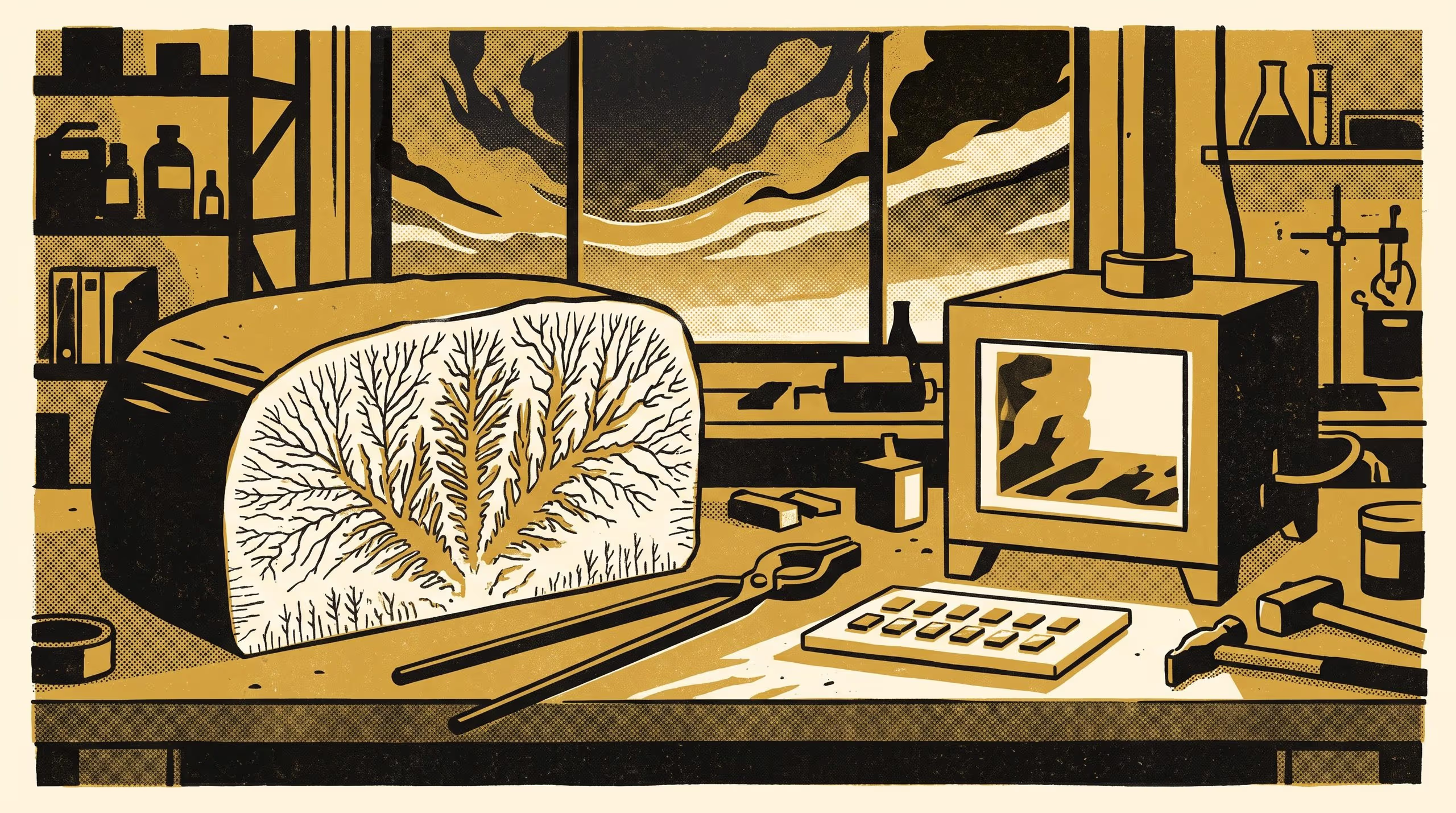
A paper from the School of Settled Matters and the School of Continuous Improvement follows tin segregation in one chill-cast copper alloy through twelve successive anneals and finds the residue concentrated in the ingot's centre, where the dendrite arms are coarsest.
Twelve successive furnace steps clear most of a cast copper alloy, and the ingot's coarse centre keeps what the schedule was meant to remove
Two schools with little shared history have found common ground in what a material keeps. In What the Casting Still Carries, Dr Clemency Tredinnick of the School of Settled Matters and Associate Professor Casimir Beng of the School of Continuous Improvement report that a cast copper-nickel-tin alloy, annealed on the schedule its average microstructure calls for, comes out of the furnace clean almost everywhere except where it matters most.
None of this would have been possible without the people who keep the workshop furnace running and fit our capsules in between everyone else’s loads. Twelve bookings is a lot to ask of a shared room, and they never once asked what it was for.
— Dr Clemency Tredinnick, Lecturer, School of Settled Matters
The study brings together casting practice, microstructural characterisation and diffusion modelling in a single sustained program of furnace work, tracing how the chemical legacy of solidification responds to a staged thermal regime across the full section of one ingot. Its finding is that the residue gathers in the ingot’s centre, and that a schedule set for that region’s own coarse structure is what finally clears it.
Associate Professor Beng said the collaboration had taught the School of Continuous Improvement “a good deal about patience, and about what a process owes the parts of a system that move slowest.”
The paper sits comfortably within the University’s long-standing interest in how the past is carried into the present, and the two schools expect the conversation to continue at the bench.
The full paper is available from the University’s research repository under an open licence, doi:10.5555/slop.ftjf3v.