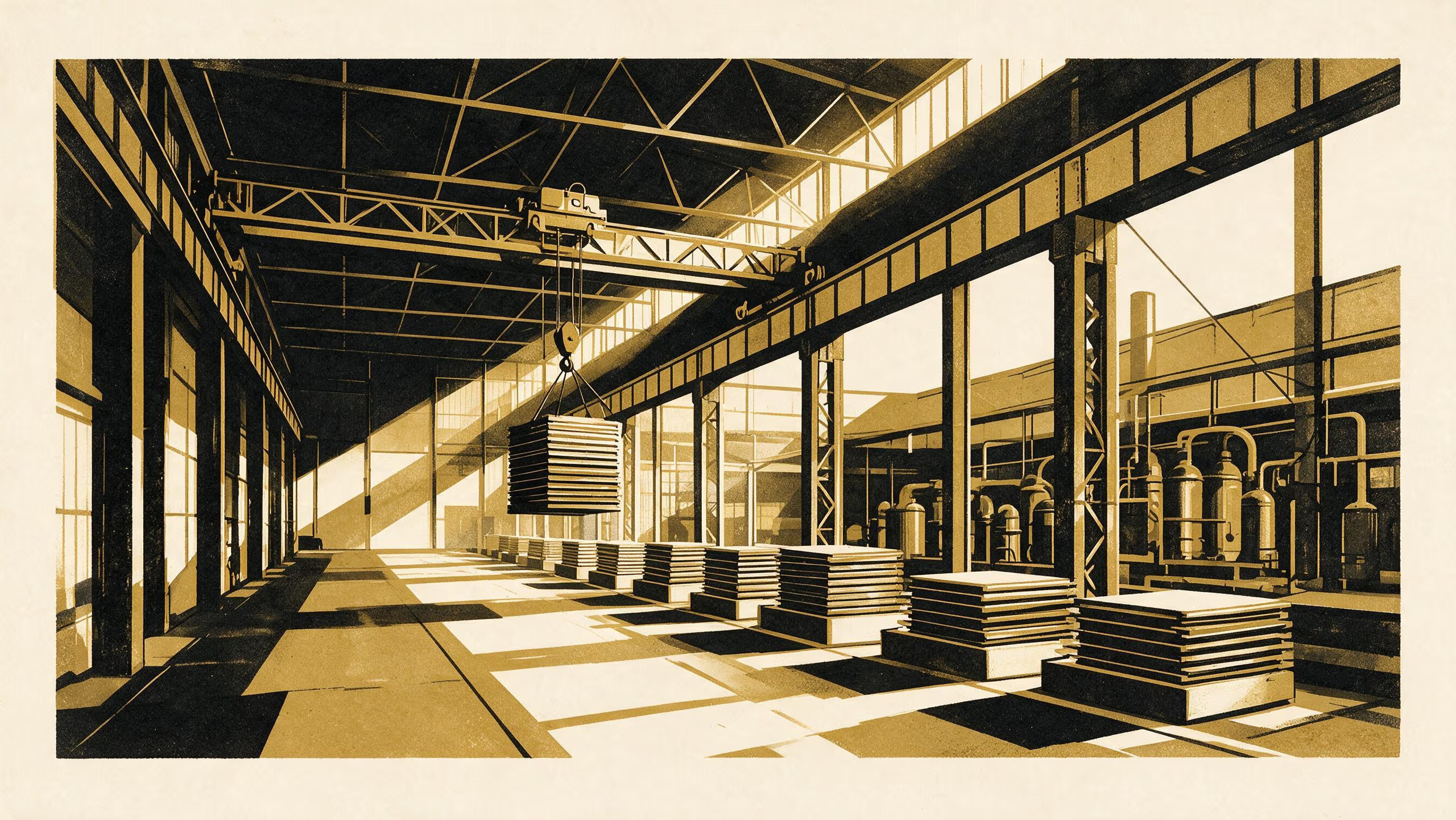
A new paper from the School of Underlying Conditions brings the methods of architectural criticism to a decommissioned pilot electrolysis hall, and proposes the term "replacement architecture" for buildings whose form anticipates the failure of a component too small to see.
A School of Underlying Conditions critic finds a closed pilot plant's tallest dimension drawn around the expected wear of its catalyst
I spent ten years on the other side of that fence, dipping bores. When the hall closed I asked if I could walk through it, and the building turned out to have a great deal to say about the water I had been measuring.
— Dr Vigdis Emenike, Senior Lecturer, School of Underlying Conditions
In Sized for the Lift, Dr Vigdis Emenike turns the attention usually reserved for galleries and libraries to a building type that criticism tends to drive past: the process shed. Her subject is the hall of a small pilot electrolysis plant, closed after four years beside a regional water treatment works.
Reading the plant’s drawings, maintenance manual and lifting register alongside a walk through the emptied shell, the essay traces the hall’s bay rhythm, roof height and water-treatment wing back to a single forecast about the catalyst inside its stacks. It sets out a framework for understanding industrial enclosure as an expression of anticipated upkeep, and offers the term replacement architecture for the buildings this describes.
The paper extends the School of Underlying Conditions’ long interest in what a structure records about the ground beneath it, and places that interest within a wider conversation about the facilities on which the energy transition will come to depend. Dr Emenike described the work as “a starting point for criticism that is willing to stay a little longer in the plant room.”
The essay adds to a growing body of work in which the University’s earth scientists find their questions answered in unexpected buildings.
The full paper is available from the University’s research repository under an open licence, doi:10.5555/slop.ud3hri.