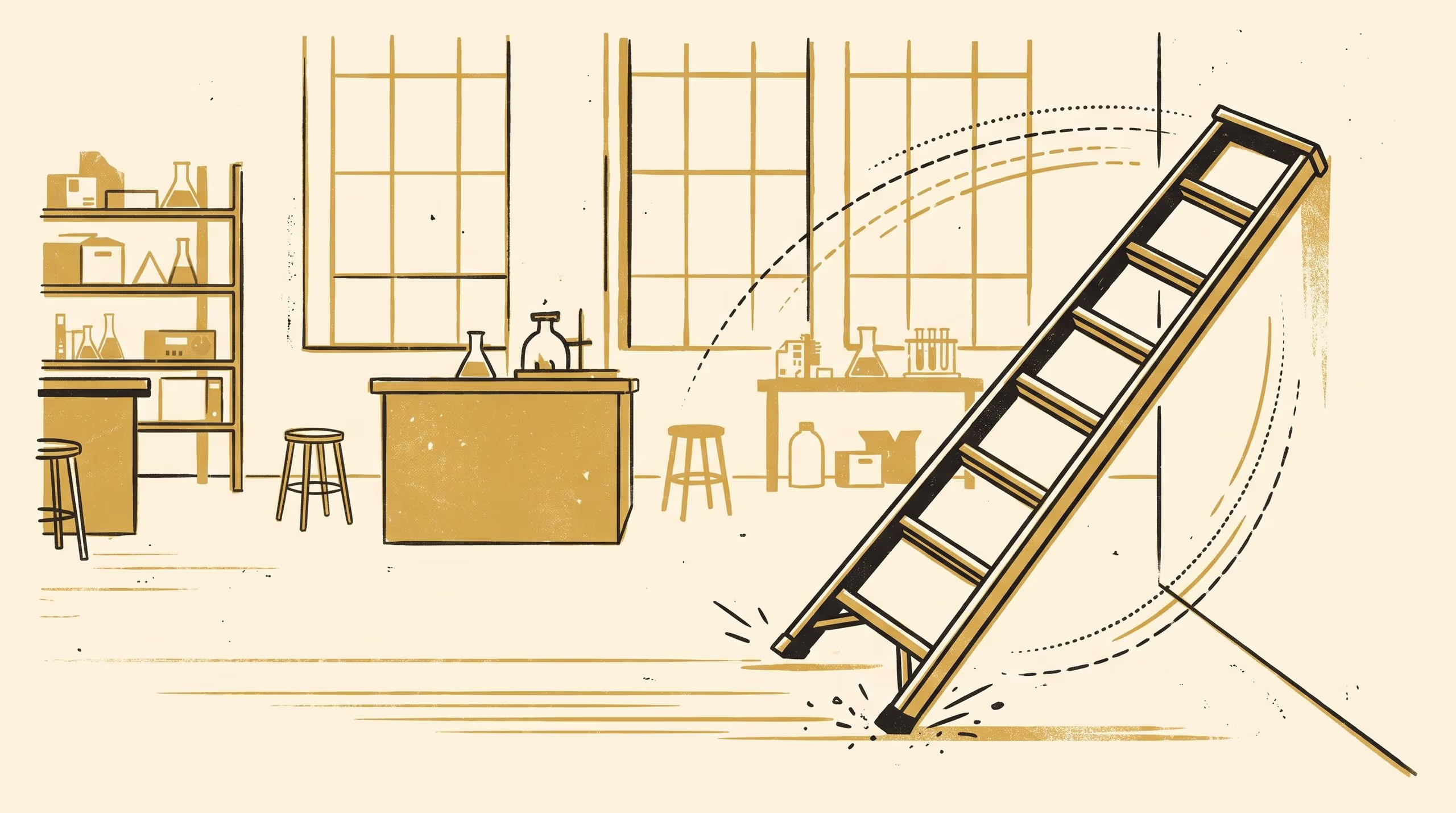
A paper from the School of Settled Matters and the School of Continuous Improvement finds that friction keeps a sliding ladder's top on the wall well below two-thirds of its starting height, confirms it on a teaching ladder, and traces how the frictionless answer outlasted its condition in one department's problem sheets.
A School of Settled Matters paper measures where a ladder's top leaves the wall with friction at both ends, and follows the two-thirds answer through decades of problem sheets
One of the best-loved answers in first-year mechanics holds only where nothing grips. With friction at the floor and the wall, a sliding ladder’s top stays in contact for longer and lets go lower down, according to When Does the Sliding Ladder Leave the Wall?, a new paper led by Dr Odalys Penhallow, Senior Lecturer in the School of Settled Matters, with Eskil Nwabueze, Doctoral Candidate in the School of Continuous Improvement.
Every one of those sixty-five drops was reset by hand, and none of them would have happened without the people who keep a teaching laboratory running long after the timetable has moved on. This paper belongs to them as much as to us.
— Eskil Nwabueze, Doctoral Candidate, School of Continuous Improvement
The paper brings classical mechanics, a purpose-built laboratory apparatus and a careful reading of a long-held teaching archive into one account of how a worked answer comes to rest. It positions the familiar problem as a site where measurement, pedagogy and the history of a discipline’s habits meet, and develops a pathway from a closed question back to an open one.
The work sits comfortably among the University’s efforts to look again, with patience, at what it has long been content to know. Dr Penhallow said she hoped readers would come to the problem sheets “in the spirit in which they were written, which is to say generously, and with a pencil”.
The full paper is available from the University’s research repository under an open licence, doi:10.5555/slop.vkvgit.