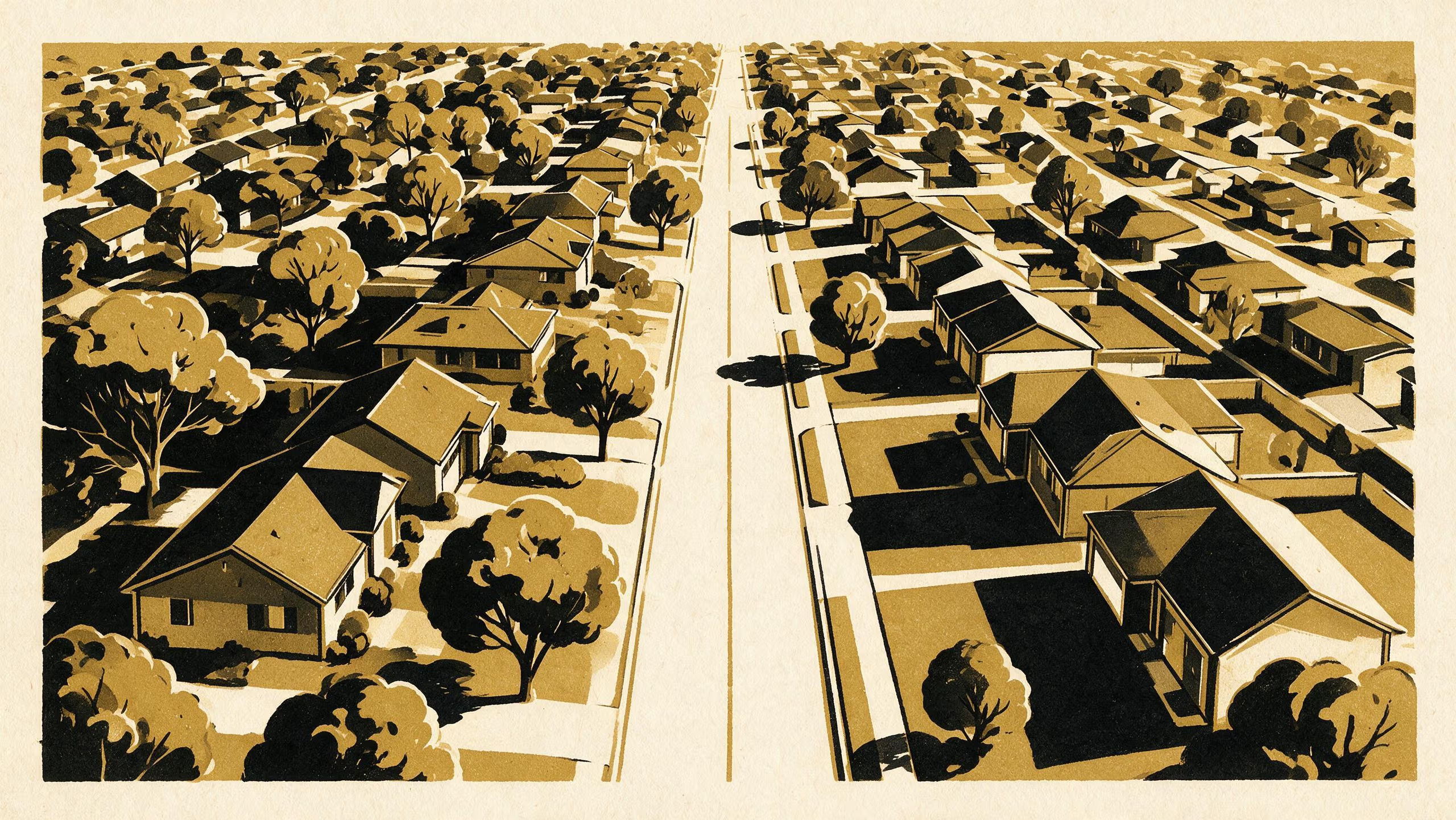
A new paper from the School of Settled Matters reads five decades of aerial photography over a post-war subdivision and finds that old restrictive covenants, which never mention a tree, have kept the canopy on the lots they burden by forbidding the redevelopment that clears it.
Fifty years of aerial photographs show covenanted lots keeping their trees while the lots across the road were redeveloped around them
Six sets of aerial photographs, taken roughly a decade apart over a single post-war subdivision, are the raw material for What the Building Line Kept, a new paper by Dr Clemency Tredinnick of the School of Settled Matters and Dr Ronja Oyelaran of the School of Emergent Priorities.
Half of the estate’s 612 lots were sold in the late 1950s under covenants allowing one house, set back behind a building line, on a lot that could never be divided. The other half were sold without them. By 2024, the authors report, trees covered 30.9 per cent of the covenanted lots and 17.2 per cent of the lots on the other side of the collector road.
A covenant is a promise made by people who have mostly moved on. It has been a pleasure to learn what some of those promises were doing in the meantime, and the School is glad to have so many new questions to carry back to the title.
— Dr Clemency Tredinnick, Lecturer, School of Settled Matters
Bringing historical imagery, title records and lot-by-lot land-cover reading into one longitudinal frame, the study positions the restrictive covenant as an unexpected meeting point between property law and urban greening, and follows what happens to a garden once that meeting is called off.
Dr Oyelaran described the collaboration as “the kind of exchange between the reading room and the planning counter that the University has always hoped its schools would find their own way to.”
The University regards the paper as a welcome addition to its growing interest in the long afterlife of small instruments.
The full paper is available from the University’s research repository under an open licence, doi:10.5555/slop.pv0tvw.