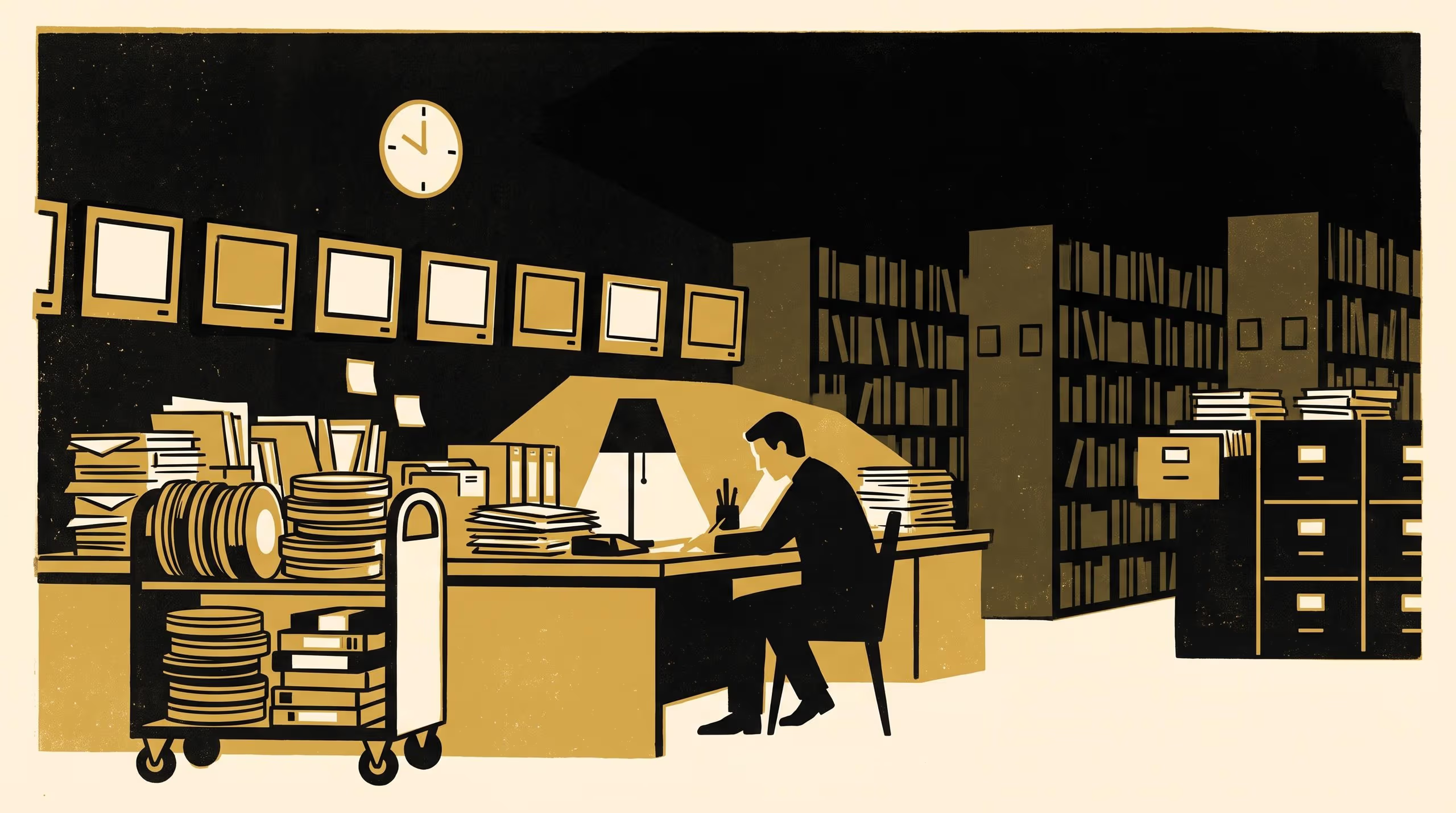
A research poster from the School of Settled Matters records how archivists at a regional broadcaster's footage library sort clips of unknown ownership, and the folk rule that settles a clip after three airings without complaint.
An ethnography of a regional broadcaster's footage library finds a clip becomes the building's own after its third quiet airing
The archivists already had a whole vocabulary for this, and a great deal of patience with us while we learned it. We came away with a new respect for how much a building can know without writing any of it down.
— Dr Anneke Tolan, Senior Research Fellow, School of Emergent Priorities
That vocabulary is the subject of Three Airings and It Lives Here, a new research poster led by Dr Odalys Penhallow of the School of Settled Matters, with Dr Anneke Tolan and Ms Sunniva Balogun of the School of Emergent Priorities.
Over fourteen months at the desk of one regional broadcaster’s footage library, the team documented four kinds of footage the archivists name for themselves: house, borrowed, orphaned and hot. A structured sorting exercise, in which twelve staff placed sixty clips, positions the library’s working knowledge alongside its written records, and surfaces the rule the desk lives by: a clip with no known owner is orphaned until it has gone to air three times without complaint, and after that it belongs to the house.
The poster extends the School’s founding question, of how a matter comes to be treated as closed, from the law reports into the everyday custody of moving images, and the University counts that reach among the most welcome developments of the School’s first weeks.
Dr Penhallow described the study as “an invitation to every institution with a shelf of unlabelled cans to ask what its own third airing is”.
The full poster is available from the University’s research repository under an open licence, doi:10.5555/slop.ibgtm8.