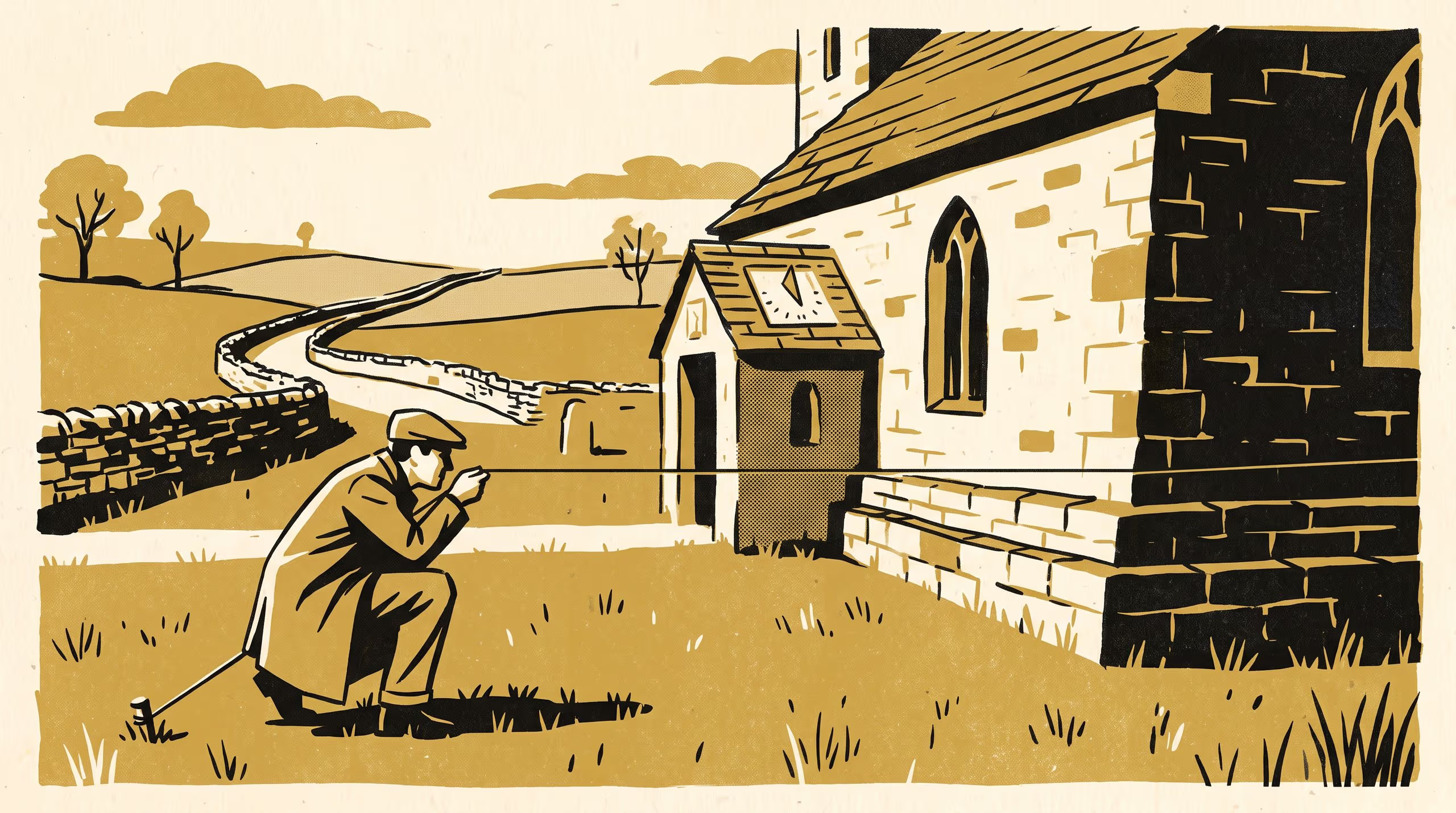
A School of Settled Matters poster reads the excavated footings beneath thirty-eight rebuilt parish churches and finds that a rebuild tends to keep the axis of whatever it stands on.
A research poster re-surveys the footings beneath thirty-eight upland parish churches and finds that rebuilds on old foundations followed the axis of the church below
Thirty-eight parish churches, ninety-seven building phases and several decades of trenches dug by other people sit behind The Axis Stays with the Footing, a new research poster from the School of Settled Matters by Dr Odalys Penhallow, Dr Clemency Tredinnick and Ms Sunniva Balogun.
The team asked a question familiar to anyone who has stood in an old church and wondered why it does not quite face east: when a church is rebuilt, whose decision does its alignment record? Where builders reused even one course of the earlier foundation, the answer was almost always the earlier builders’. In 44 of 47 such rebuilds the new axis stayed within two degrees of the old. The twelve churches raised on clear ground all turned towards east.
Every parish we visited had someone who knew where the old drawings were kept, and usually where the key to that cupboard was as well. The poster owes them a great deal, and we hope it finds its way back to them.
— Dr Odalys Penhallow, Senior Lecturer, School of Settled Matters
The study brings archival excavation records, renewed survey and careful sequencing into a single framework for reading a building’s alignment across its successive lives, and positions the phase rather than the standing fabric as the unit of record. Ms Balogun, a doctoral candidate, described the archive work as “a long correspondence with excavators who never expected the question”.
The University regards the poster as a fine instance of its patience with the long afterlife of early decisions, now carried into the stone of the parish church.
The full poster is available from the University’s research repository under an open licence, doi:10.5555/slop.vy2qud.