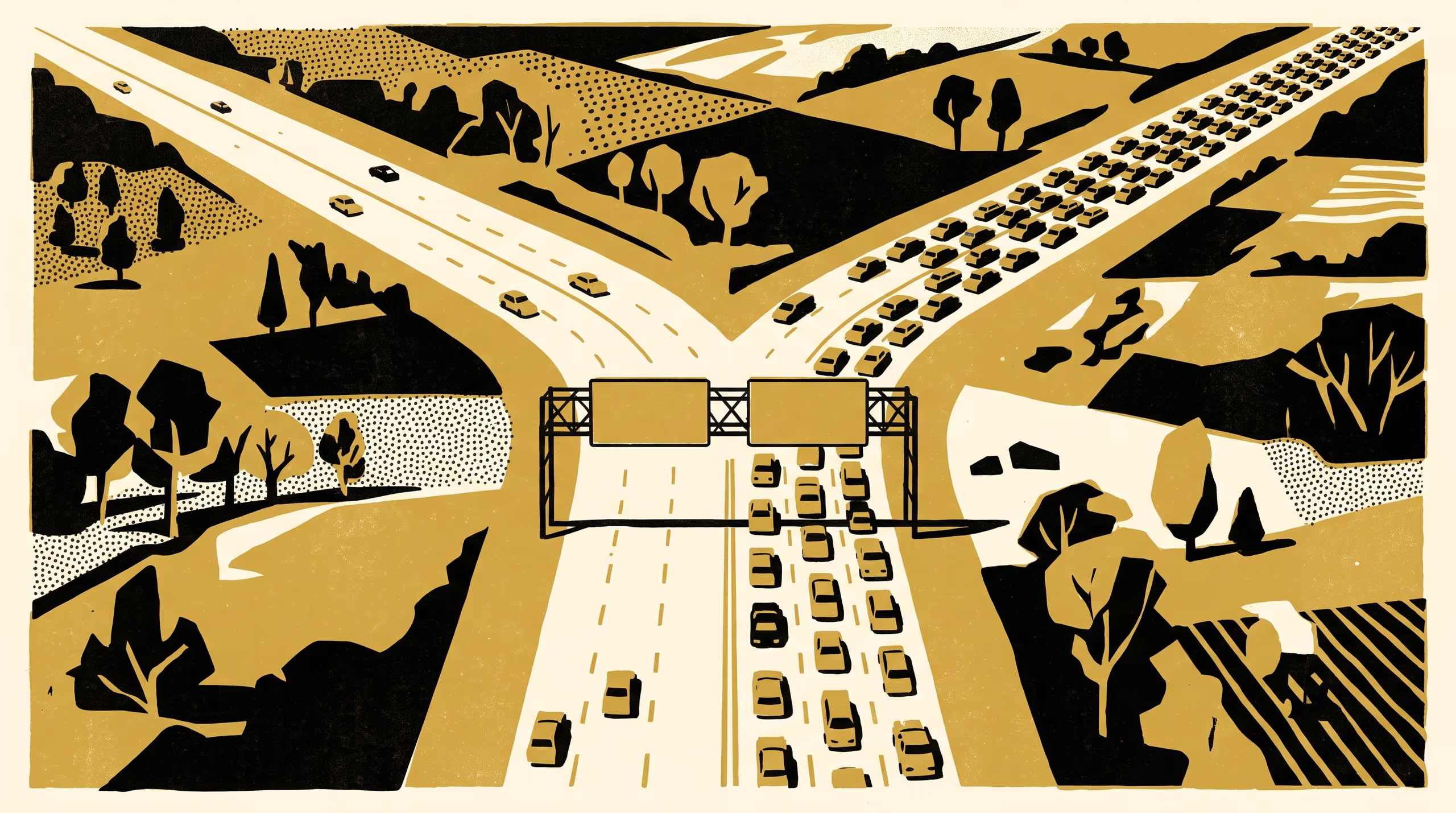
A research poster from the School of Underlying Conditions proves a contraction bound for repeated travel-time forecasting when drivers follow the forecast, and shows what the loop does once the bound fails.
A new theorem gives the point past which a broadcast travel-time forecast, retrained on the traffic it moved, can only swing between two answers
The School of Underlying Conditions has long asked what a reading is made to say about the ground beneath it. With The Forecast That Moves the Traffic, a new research poster, the School puts the same question to the road, where the reading is a published travel time and the ground is the traffic that reads it back.
The poster is the work of Dr Vigdis Emenike and Dr Fenna Okoro. Its two theorems set out when a forecaster that keeps learning from the traffic it has already redirected will come to rest on a single answer, and show that on the simplest networks, once that condition fails, the loop does not wander but flips steadily between two. A simulation study of 4,200 synthetic networks underwrites the analysis.
A bore and a broadcast have more in common than either discipline tends to admit. In both, the instrument is part of what it measures, and it has been rewarding to sit with that at the scale of a whole road network.
— Dr Vigdis Emenike, Senior Lecturer, School of Underlying Conditions
The work brings the School’s long-standing attention to monitoring practice into conversation with forecasting infrastructure and network theory, and reflects a University that is comfortable letting a groundwater question travel. Dr Okoro described the collaboration as “a chance to look at a forecast from the far side of the people who act on it.”
The full poster is available from the University’s research repository under an open licence, doi:10.5555/slop.rjfsu7.