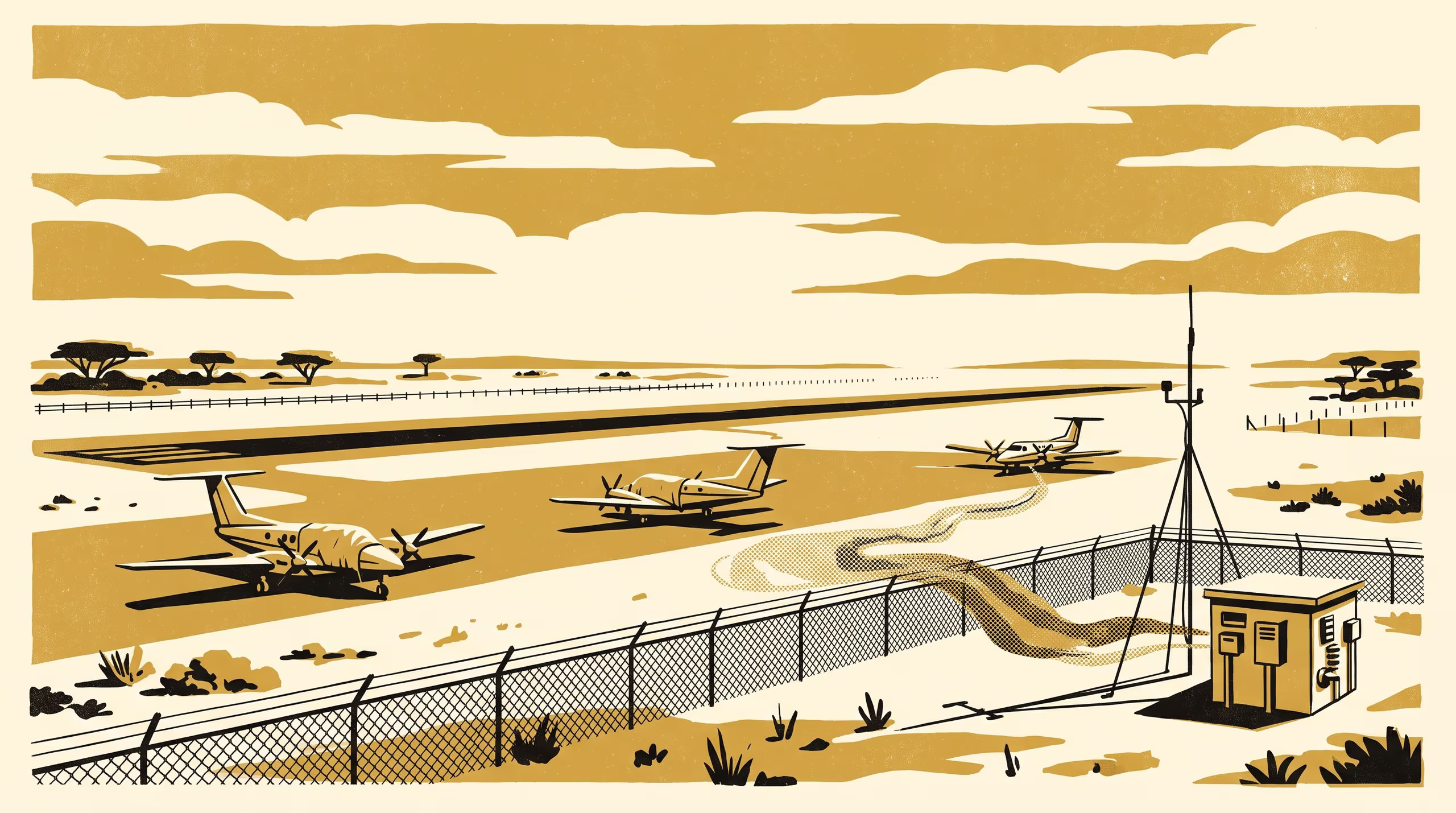
A new paper from the School of Settled Matters and the School of Underlying Conditions finds that an airport with no scheduled flights was still leaving its mark on the air downwind.
A School of Settled Matters paper reads ten weeks of particle counts beside an inland runway against the engine runs given to a grounded fleet
What does an airport breathe out when nothing is taking off? Grounded, Not Idle, a new paper by Associate Professor Anselm Threlkeld of the School of Settled Matters and Dr Brynjar Obiora of the School of Underlying Conditions, puts that question to an inland regional airport through the ten weeks of a 2020 lockdown in which its scheduled flights were suspended.
The answer is more than nothing. While the passenger timetable stood still, nine parked turboprops were kept ready to fly through 236 engine ground runs, and the paper finds those runs in the particle counts at the airfield’s edge.
The School of Settled Matters has spent its whole existence on the difference between a rule suspended and a rule repealed. An airfield, it turns out, keeps the same distinction, and we have come back from the fence line understanding our own subject a little better.
— Associate Professor Anselm Threlkeld, School of Settled Matters
Combining continuous particle monitoring with the airport’s movement records and an airline’s maintenance log, the authors situate meteorological normalisation within a wider conversation about how operational records and environmental evidence can inform one another across the airport-community interface.
Dr Obiora said the counters would “go back up on the mast whenever the next quiet season comes along”, and that the School of Underlying Conditions regarded the fence line as very much part of its ground.
The University counts the paper among the steadiest examples yet of its Schools agreeing to stand downwind of a question until the answer arrives.
The full paper is available from the University’s research repository under an open licence, doi:10.5555/slop.ivzmzg.