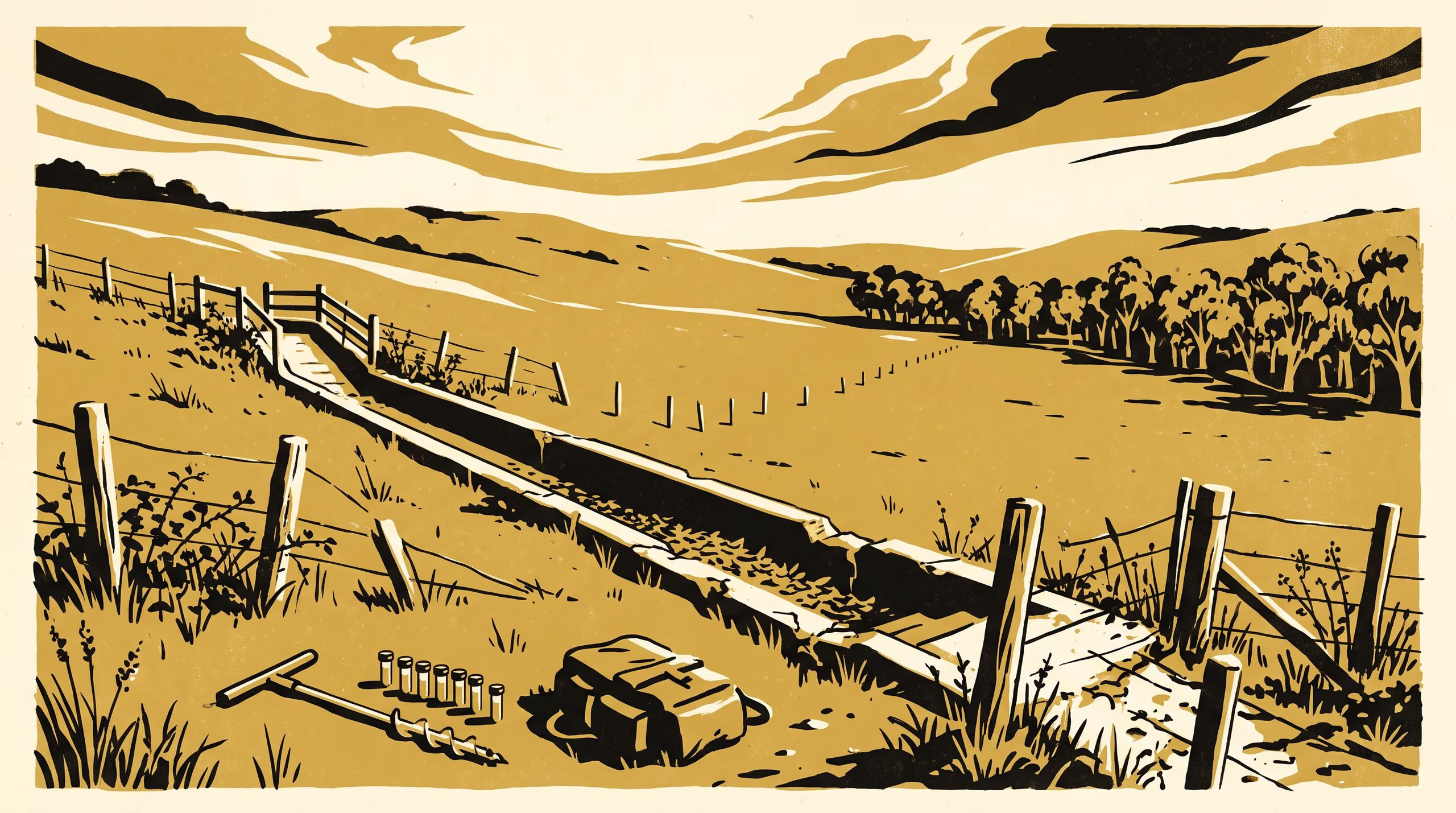
A new paper from the School of Settled Matters samples soil downslope of a long-disused livestock dip, setting the arsenic in each core beside the microbial genes that reduce, oxidise and methylate it.
A paddock transect finds an arsenic-resistance gene still elevated where the arsenic itself has fallen back to background
Two hundred metres down a grazing paddock from a plunge dip that has not held a sheep in decades, the soil’s arsenic is back at the level found upslope. The bacteria living in that soil have not quite caught up. That is the central observation of Further Than the Arsenic, a new paper led by Dr Clemency Tredinnick of the School of Settled Matters with Dr Brynjar Obiora of the School of Underlying Conditions.
A good deal of what a paddock carries was put there for reasons nobody now recalls. We set out to read one such inheritance slowly, and we expect to be reading it for some time yet.
— Dr Clemency Tredinnick, Lecturer, School of Settled Matters
Working along a single surveyed line from the dip’s old draining pen to the creek flats, the team paired a chemical reading of every soil core with a count of the microbial genes that act on arsenic and a census of the communities that carry them, building an integrated picture of how a legacy of land use is held in the ground by chemistry and biology together.
Dr Obiora, Senior Research Fellow, described the line as “a long walk with an auger that kept giving us more to think about the further we went”, and said the two Schools had found a shared working rhythm on it.
The University counts the paper among a widening body of work in which its Schools read the same ground through different instruments, and it welcomes the School of Settled Matters’ first contribution to environmental molecular science.
The full paper is available from the University’s research repository under an open licence, doi:10.5555/slop.r6cd3c.