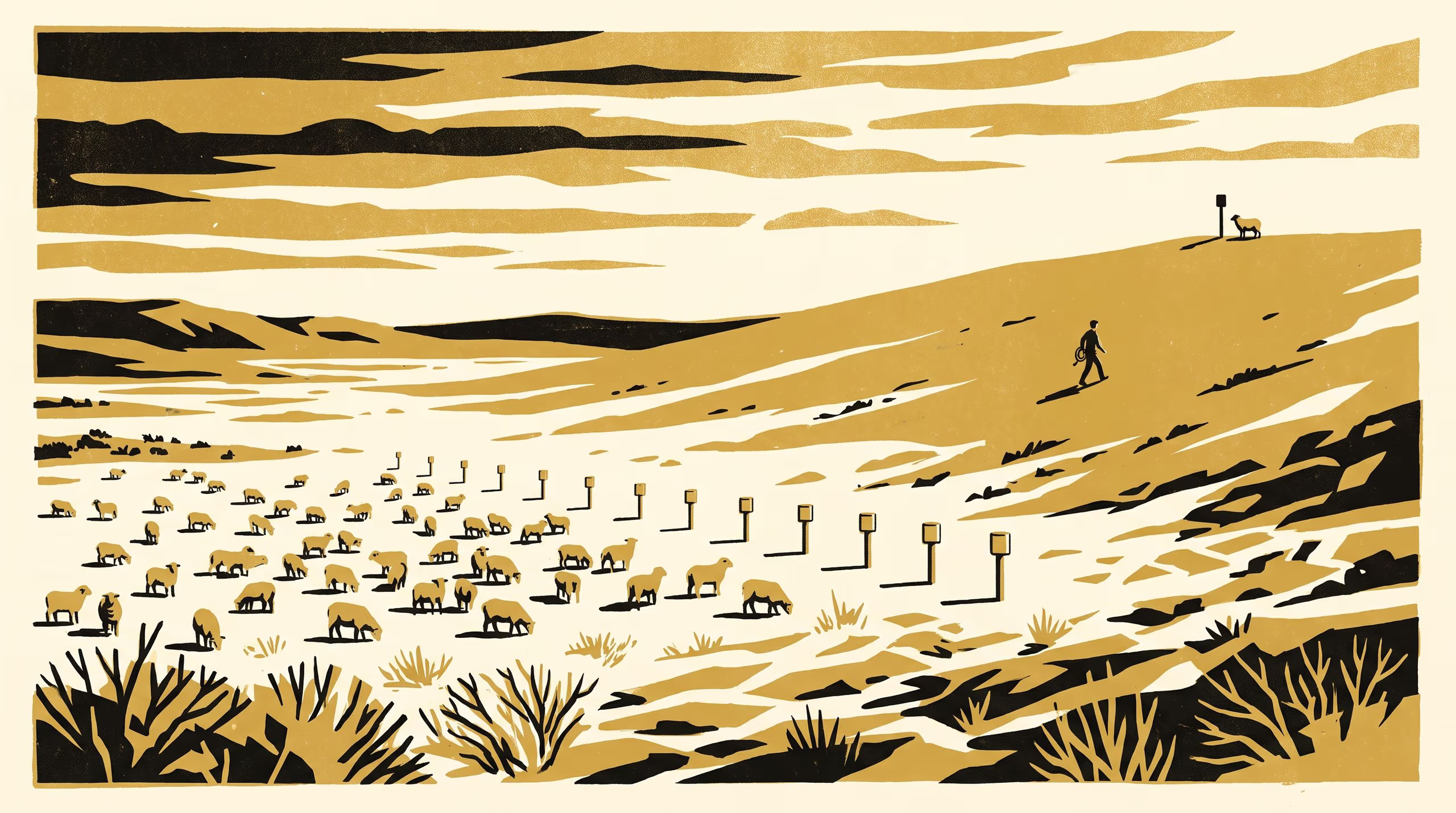
A new essay from the School of Underlying Conditions sets the statistics of the stray observation beside the parable of the lost sheep, and asks what a careful estimate owes the reading it sets aside.
A hundred monitoring bores, one that would not fall, and the shepherd who left the ninety-nine
The School of Underlying Conditions has made the single reading its business: what one measurement taken down a pipe can be asked to say, and what it is owed when it says something else. In Until He Finds It, Dr Vigdis Emenike brings that question to an older text about one in a hundred.
A monitoring network learns most of what it knows from the bores that agree with it. The School has spent seventeen years being politely disagreed with by one of them, and is the better for the education.
— Dr Vigdis Emenike, Senior Lecturer, School of Underlying Conditions
The essay places the instruments of robust estimation, built to keep a single stray value from carrying a result away with it, alongside the parable’s three surviving tellings. It brings the vocabularies of exegesis and estimation into conversation across a single hundred-bore network, attending to the distinction between setting a reading aside and leaving it behind, and to the different shapes of seeking the Gospel writers preserve.
The publication extends a strand of interdisciplinary inquiry the School regards as increasingly central to how it understands its own fieldwork. Dr Emenike describes the essay as “an account of what the field crews have always known, set down in a form the rest of us can cite.”
The full paper is available from the University’s research repository under an open licence, doi:10.5555/slop.l6ylr9.