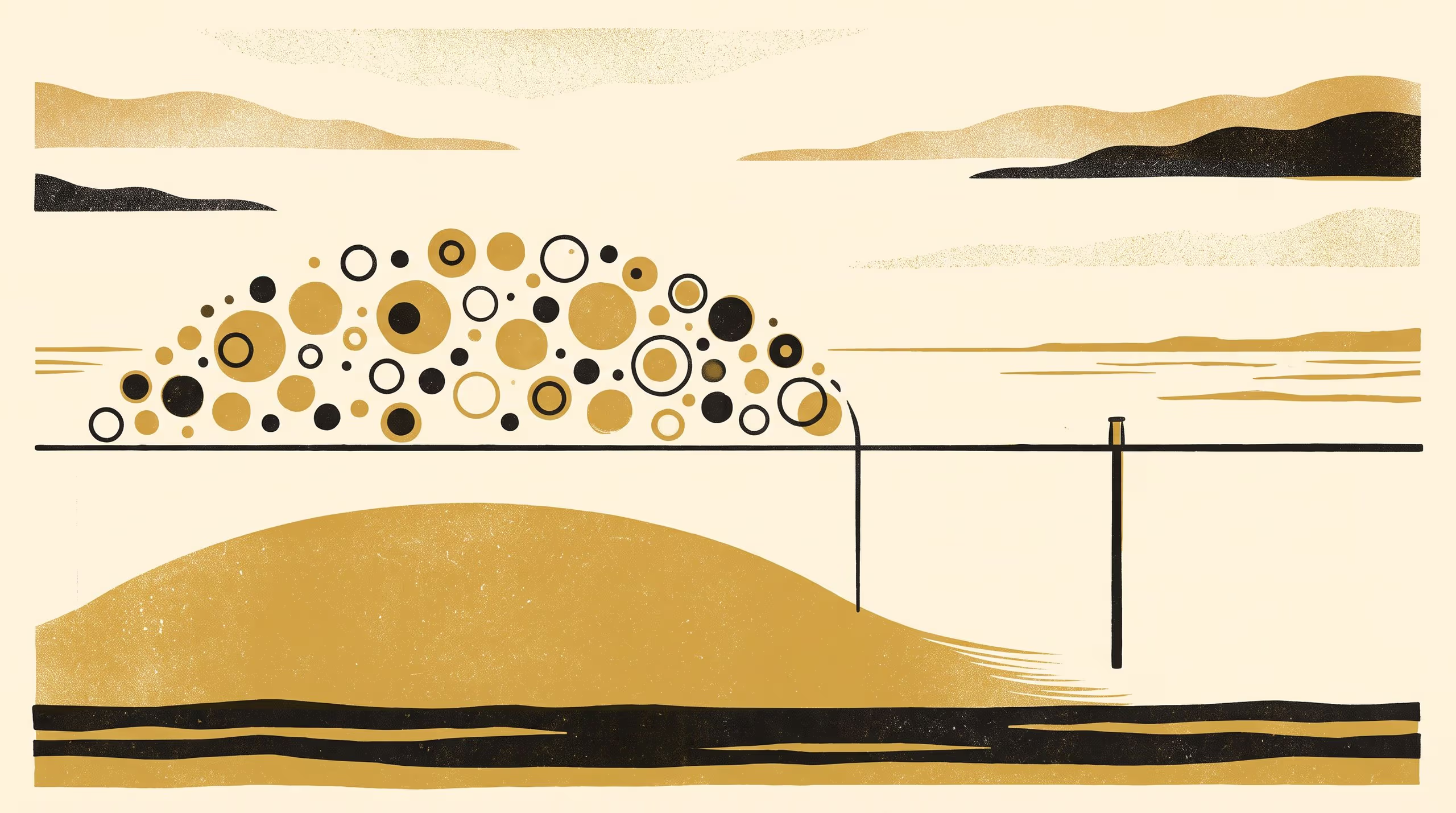
A new paper from the School of Underlying Conditions proves that the edge of a modelled tumour can wait before it advances, and finds that growth behind it shortens the wait without ending it.
A groundwater scientist carries the mathematics of a spreading water mound into a model of tumour growth
Groundwater and tumour biology rarely share a page at Slop University, though they have long shared an equation. In How Long the Margin Waits, Dr Vigdis Emenike of the School of Underlying Conditions follows the mathematics that describes a mound of water spreading over dry ground into a model of a growing population of cells, and asks how long its edge can stay where it is.
Every School eventually discovers that its methods have travelled further than its fieldwork. This paper is one of the places ours have arrived, and the University has been generous in letting them settle in.
— Dr Vigdis Emenike, Senior Lecturer, School of Underlying Conditions
The paper aligns classical free-boundary theory with a contemporary modelling framework, translating the patience of a water table’s edge into a guarantee about a population’s margin. It establishes that proliferation behind the edge brings its departure forward but cannot remove the wait altogether, and that a flatter edge earns a longer wait more slowly than the groundwater case would suggest. A programme of numerical experiments places every computed waiting time between 2 and 25 per cent above the paper’s bound.
The University counts the work among the steadier signs that its Schools have begun to read one another’s equations, and that a method learned at the top of a monitoring bore can be trusted some distance from home.
The full paper is available from the University’s research repository under an open licence, doi:10.5555/slop.u1e8t8.