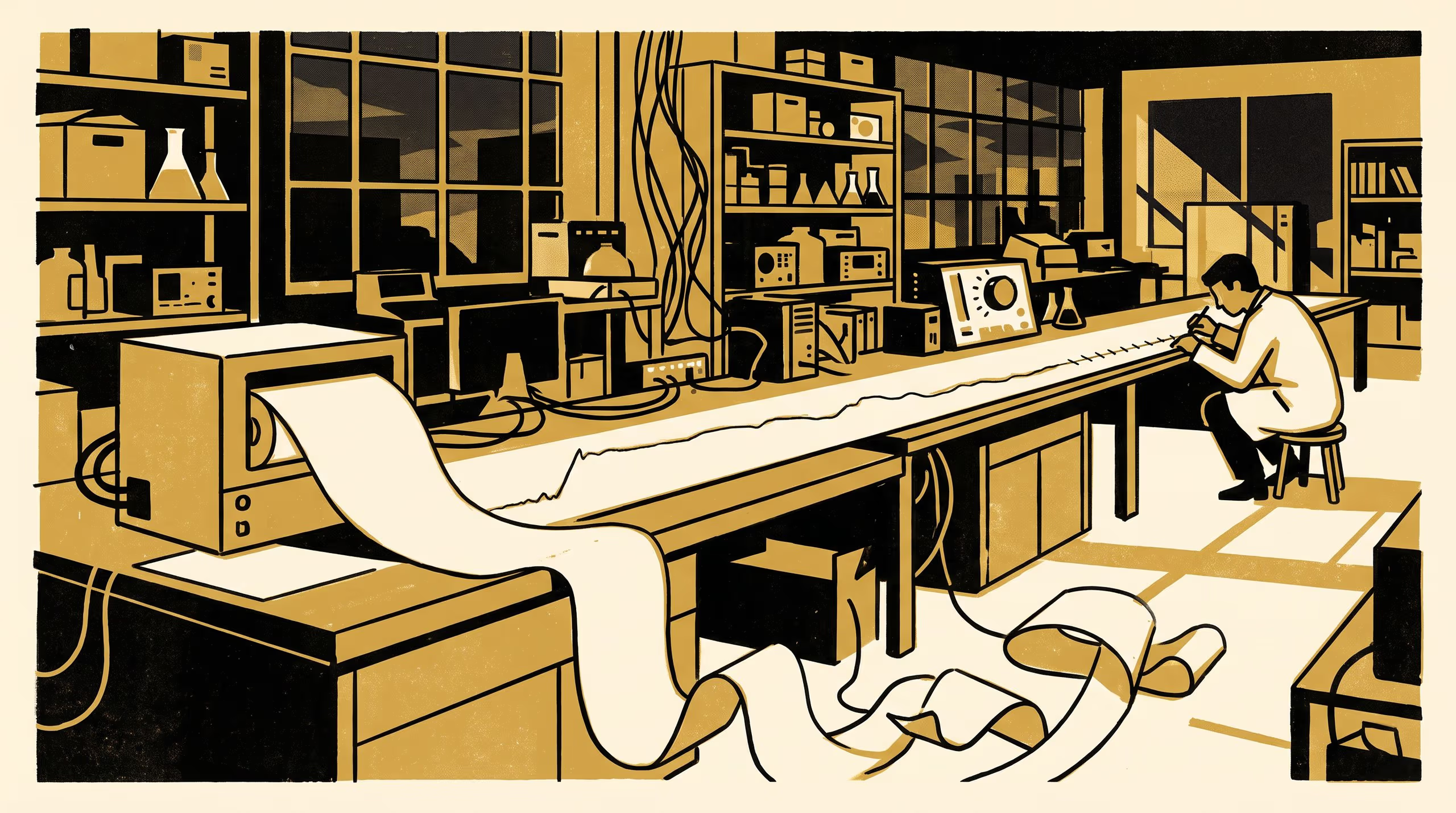
A paper from the School of Settled Matters and the School of Continuous Improvement uses a computational model of the inflammatory response to test how many consecutive falls in a circulating marker a rule should require before it calls a response resolved.
Two thousand simulated immune responses show a run of falling readings can close a question the response itself never left
Two thousand immune responses, none of which ever happened, were watched for three weeks each by a team from two of the University’s Schools, and every one was asked the same question at every reading: is it over yet? Called While Still Open, published this week, reports how often the answer came back yes too soon.
The paper is led by Dr Odalys Penhallow of the School of Settled Matters, with Associate Professor Casimir Beng of the School of Continuous Improvement and Dr Clemency Tredinnick. Pairing the law school’s long interest in closure with an engineer’s sense of stability, the team built a computational model of the inflammatory response, observed it through a single simulated marker, and set it against a family of rules for declaring the matter resolved. The study finds that a response which has stopped moving will, given enough readings, appear to fall several times in a row, and that the rules strict enough to resist this leave many genuine recoveries uncalled.
A control engineer is trained to ask how long a system takes to settle, and rather less often who decides that it has. It has been a real pleasure to spend the year on the second question in such good legal company.
— Associate Professor Casimir Beng, Lead, Adaptive Metrics Lab
Dr Penhallow welcomed the questions the paper leaves open, “which, in our School, is generally where the interesting work begins”.
The paper takes its place in the University’s growing body of work on when a question may be considered closed, a body the University is pleased to see extending well beyond the law library.
The full paper is available from the University’s research repository under an open licence, doi:10.5555/slop.n0diyp.