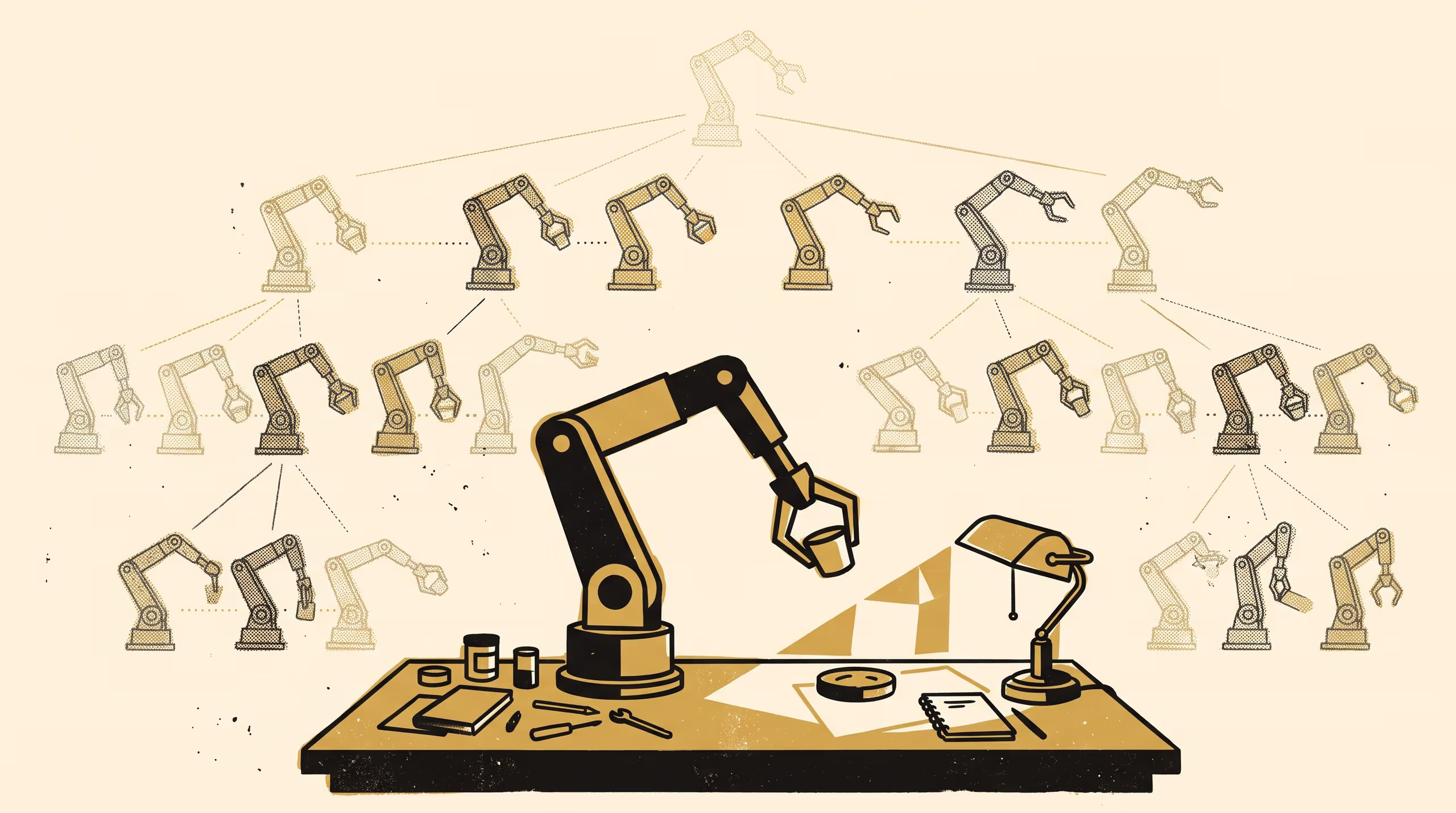
A new paper from the School of Underlying Conditions applies the methods of the critical edition to a robot-learning laboratory's recorded demonstrations, and finds that most of them descend from one demonstration that no longer survives.
Forty recorded pick-and-place episodes, most of them replayed and amended copies, are edited as a manuscript tradition
Methods long used to edit ancient texts have found a new tradition to work on in a robot-learning laboratory. In Which Grasp Became the Other, Dr Brynjar Obiora of the School of Underlying Conditions brings the critical edition to forty recorded demonstrations of a single task, a cup lifted from a rack and set down in a tray, and finds that most of them were copied from one another.
The School keeps a shelf of soil profiles, each described by someone, at some point, for a reason of their own. A laboratory’s recordings turn out to be a shelf of the same kind, and we expect to be reading this one for some time.
— Dr Brynjar Obiora, Senior Research Fellow, School of Underlying Conditions
Pairing established textual scholarship with close attention to the laboratory’s own recording practice, the edition sorts the corpus into independent performances and copies, arranges the copies into families, and reconstructs the demonstration from which they descend. Among its findings is that the earliest demonstration in the tradition took the cup twice, first by the rim and then by the handle, and that the tidier single grasp most of the corpus now shows was introduced later, by an operator improving a replay.
The paper sits at exactly the kind of crossing between disciplines that the University has made room for, and its arrival in the robotics laboratory by way of the philologist’s apparatus is a development the University is content to let speak for itself.
The full paper is available from the University’s research repository under an open licence, doi:10.5555/slop.ihd4ot.