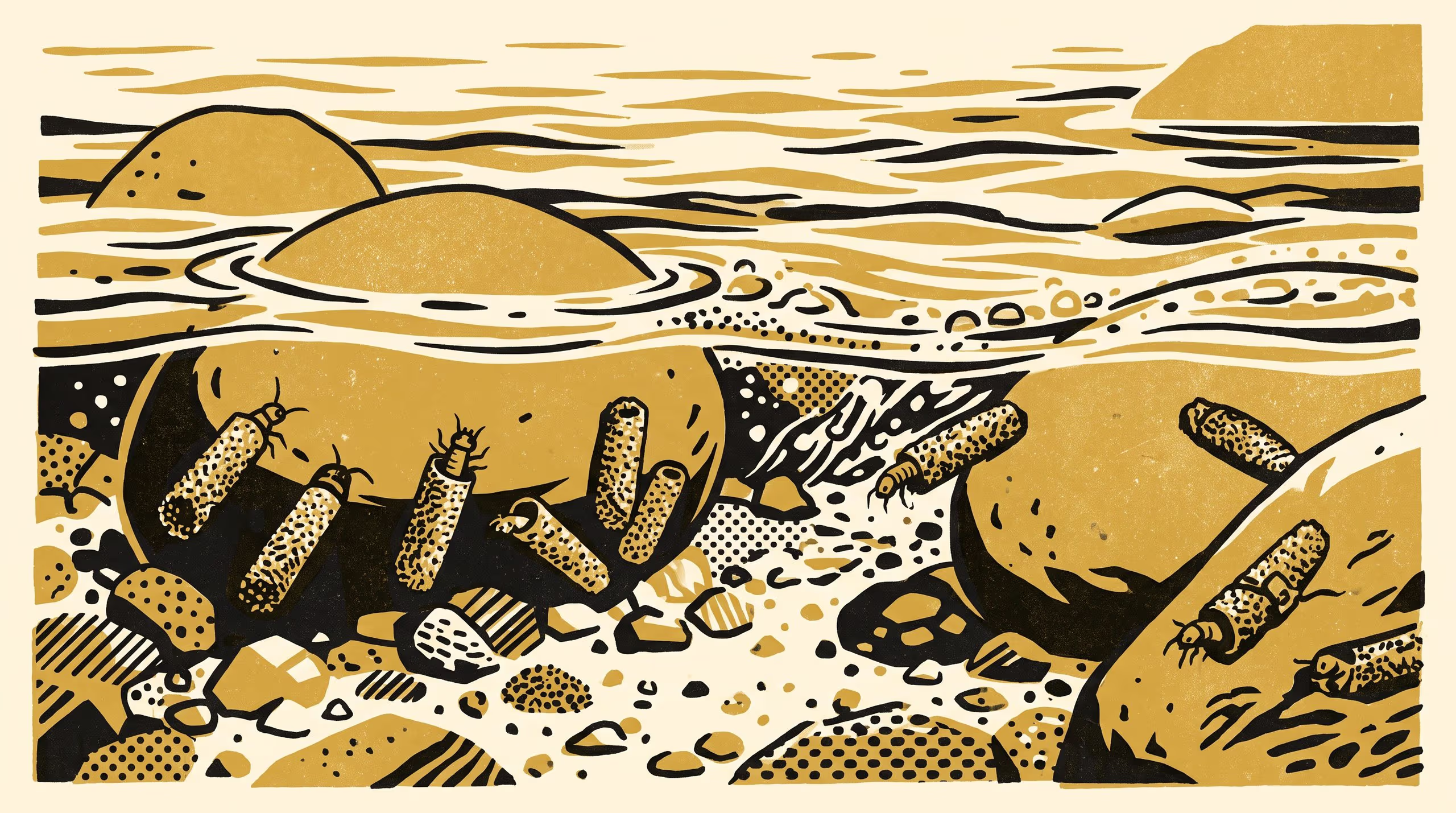
A new paper from the School of Continuous Improvement and the School of Underlying Conditions adds the sand in caddisfly cases to a stream riffle's sediment budget, and finds that it fills and empties on the insects' calendar rather than the river's.
Larval caddisfly cases on one upland riffle filled through spring and emptied with the summer emergence, on a calendar of their own
At the height of an upland summer, the larvae of a small case-building insect were found to be holding about as much sand as their stretch of stream had carried away in the month before. Held in the Case, a new paper led by Dr Ingeborg Nwachukwu of the School of Continuous Improvement with Associate Professor Ragnhild Uzoma of the School of Underlying Conditions, sets that sand alongside the stream’s own accounts across a whole emergence season.
The School spends most of its time asking what people keep once a course is over. It has been a pleasure to ask the same of a stream for a season, and to learn how much the answer depends on the week you ask it.
— Dr Ingeborg Nwachukwu, Lecturer and Convenor, Capability Sprints, School of Continuous Improvement
Working at both ends of a single riffle from early spring to late summer, the team brought continuous sediment capture together with regular surveys of the streambed, building a season-long account that places the stream’s smallest builders beside its freshets and storms. The result is a sediment budget with a third store in it, and a clearer view of when the coarser sand leaves the reach.
Associate Professor Uzoma said the collaboration had been “a reminder that every deposit keeps its own time, and that some of them are good enough to let us watch”.
The University counts the paper among a widening body of work in which its Schools lend their methods to one another’s questions, and expects the conversation between them to continue downstream.
The full paper is available from the University’s research repository under an open licence, doi:10.5555/slop.k4tq2m.