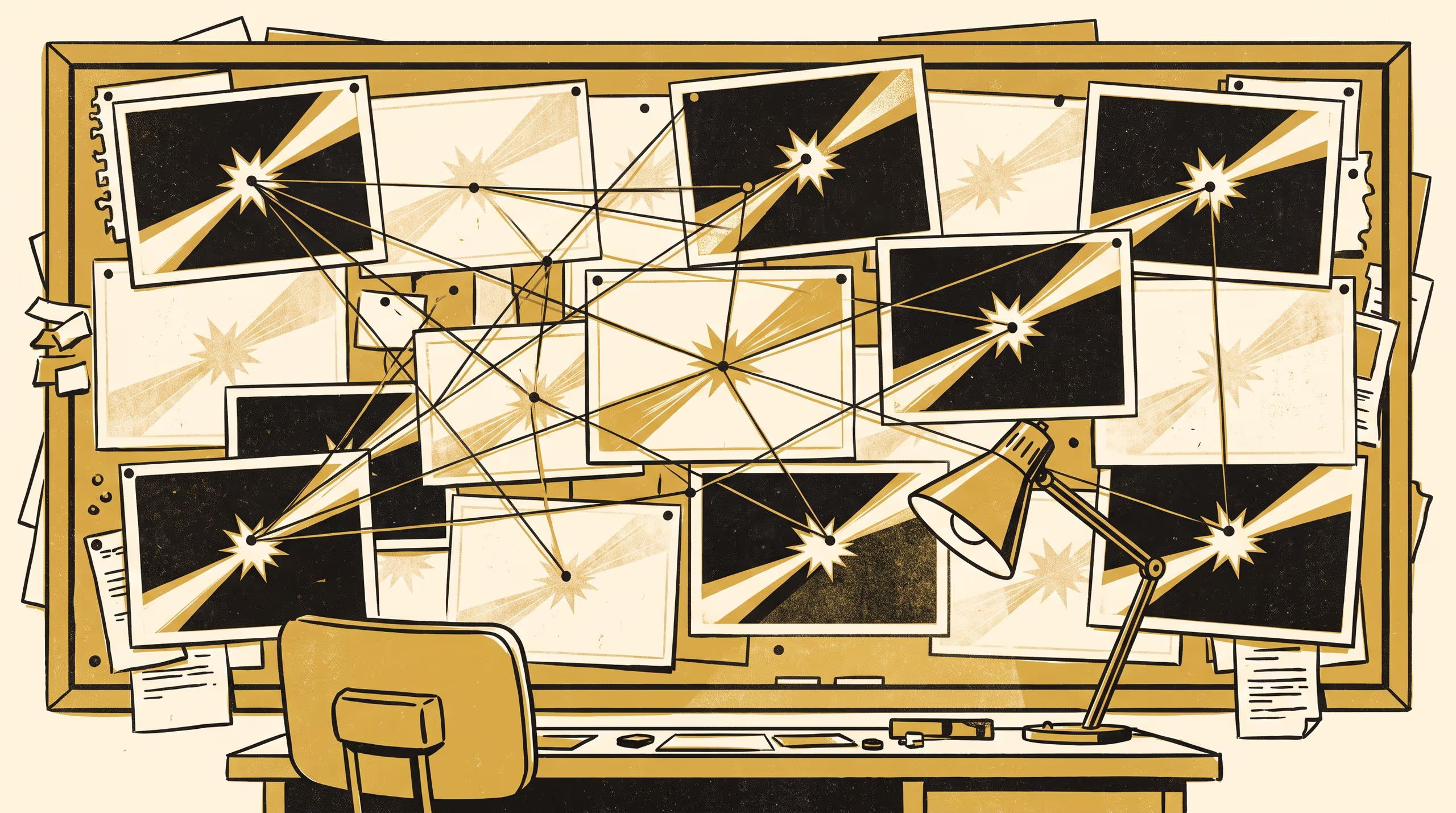
A new research poster from the School of Settled Matters reads the artist's impressions that accompany announcements of gamma-ray bursts and supernovae, and finds a handful of compositions illustrating most of them.
A research poster codes 352 artist's impressions from two decades of gamma-ray burst and supernova announcements
Slop University’s interest in how research reaches the public has turned, this spring, to the night sky. Any Burst Will Do, a new research poster led by Dr Clemency Tredinnick of the School of Settled Matters, with Dr Thandiwe Solberg of the School of Continuous Improvement and Ms Sunniva Balogun of the School of Emergent Priorities, looks closely at the illustrations that travel with news of gamma-ray bursts and supernovae.
The University has spent this year learning to answer the sky at short notice. It seemed only right that one of its Schools should spend part of that year looking at how the sky is shown to everyone else.
— Dr Clemency Tredinnick, Lecturer, School of Settled Matters
Bringing together two decades of public announcements from observatory, mission and university communications offices, the team developed a structured approach to the imagery around each event, situating every picture within a wider landscape of composition, reuse and attribution. Across 352 artist’s impressions, the poster finds that four compositions carry most of the visual load, and that a single picture can accompany many announcements.
Dr Solberg said the project had given the School of Continuous Improvement “a new appreciation of everything that happens to a result before it reaches a screen”.
The University welcomes the poster as part of a widening conversation between its Schools about how evidence is presented, and as a sign of the range its newest School is already prepared to take on.
The full poster is available from the University’s research repository under an open licence, doi:10.5555/slop.kav3ds.