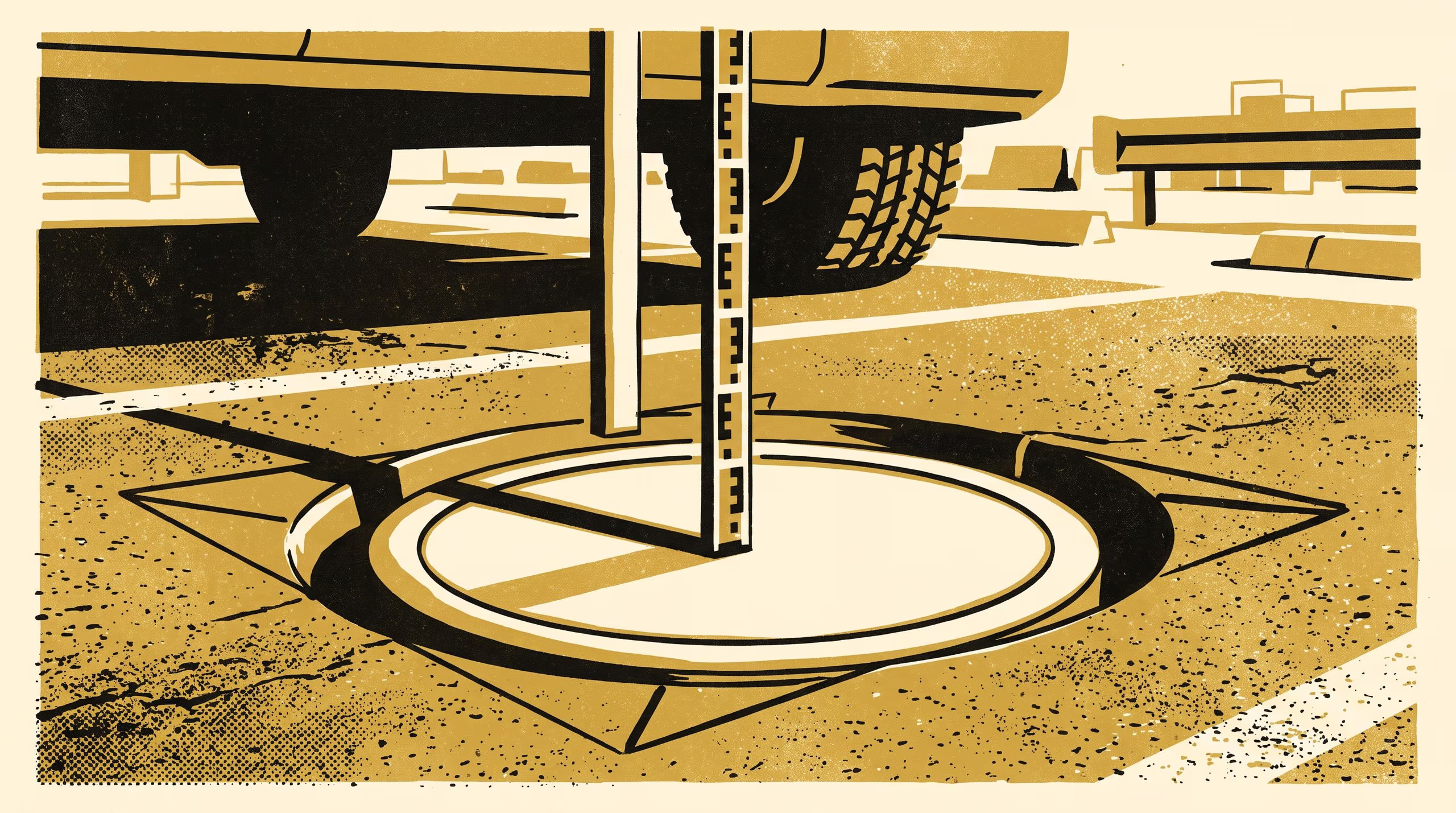
A new engineering paper from the School of Settled Matters and the School of Underlying Conditions asks what a wireless charging pad set into a car park should be tuned for, once the ground around it has had years to move.
Five years of surveys at one depot follow six in-ground charging pads as the pavement settles beneath them
Six wireless charging pads set flush into a depot car park have been sinking, slowly and unevenly, since the day they were laid, and one of them has now sunk far enough to matter. Commissioned for the Gap It Will Have, a new paper by Associate Professor Anselm Threlkeld and Dr Clemency Tredinnick of the School of Settled Matters, with Dr Vigdis Emenike of the School of Underlying Conditions, sets out what that means for how such pads are tuned on their first day.
Each of those pads went into the ground with a sheet of figures written for whoever would open it next. All we have really done is ask the sheet to carry one more line.
— Associate Professor Anselm Threlkeld, School of Settled Matters
The work couples five years of annual ground surveys with a model of the charging link, translating the patient movement of a pavement into the vocabulary of electrical headroom. It proposes that the remedy for a drifting pad belongs at the pad rather than across the fleet, and that a charger’s commissioning record should anticipate its later readers as carefully as it describes its present state.
Dr Emenike, Senior Lecturer, described the surveying as the study’s quiet backbone. “The levelling itself was straightforward,” she said. “The harder discipline was trusting the same kerb for five years.”
The publication extends the University’s growing record of attention to infrastructure in the years after the ribbon has been cut.
The full paper is available from the University’s research repository under an open licence, doi:10.5555/slop.q816eg.