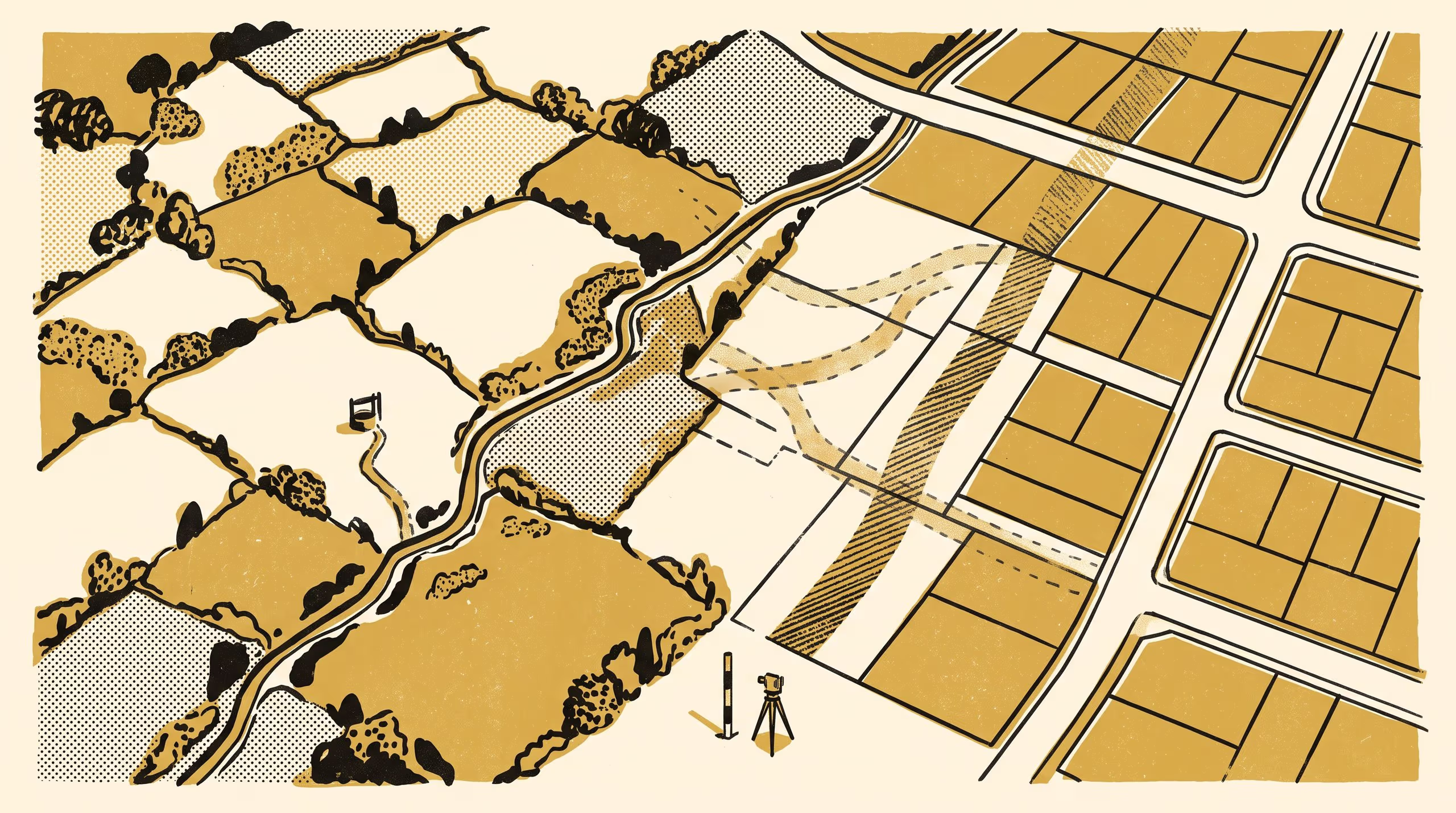
A new paper from the School of Settled Matters and the School of Emergent Priorities brings the rights of way, drainage easements and covenants on a district's fields into the mathematics that decides who receives which plot when those fields are redrawn as streets.
A replotting study prices each easement and covenant a pooled district carries into its new street grid
When the fields on a city’s edge are pooled and handed back as serviced house plots, the rights and restrictions written against them have to land somewhere. Every Burden Needs a Plot, a new paper by Dr Clemency Tredinnick of the School of Settled Matters and Dr Ronja Oyelaran of the School of Emergent Priorities, builds them into the assignment of owners to plots, and asks what each one costs to keep.
A law school does not often expect to be taught its own subject by a solver. We were, and we have taken notes.
— Dr Clemency Tredinnick, Lecturer
Working across 296 parcels and the 94 encumbrances registered against them, the study reframes replotting as a site where title, geometry and owner consent meet, and sets out a structured pathway for deciding which burdens travel with an owner and which are settled when the old ground disappears. Its central finding is that 18 of the 25 location-bound burdens can be carried at modest cost, while the final seven, most of them covenants whose beneficiaries the new street grid has absorbed, account for four-fifths of the displacement.
“Every district that agrees to be redrawn is also deciding what it wants to remember about itself,” said Dr Oyelaran, Senior Lecturer and Deputy Convenor of the Strategic Drift Survey. “The University expects to be part of that decision for some time.”
The paper adds to a widening body of University work on what a register keeps once the circumstances that wrote it have moved on.
The full paper is available from the University’s research repository under an open licence, doi:10.5555/slop.tpl5jq.