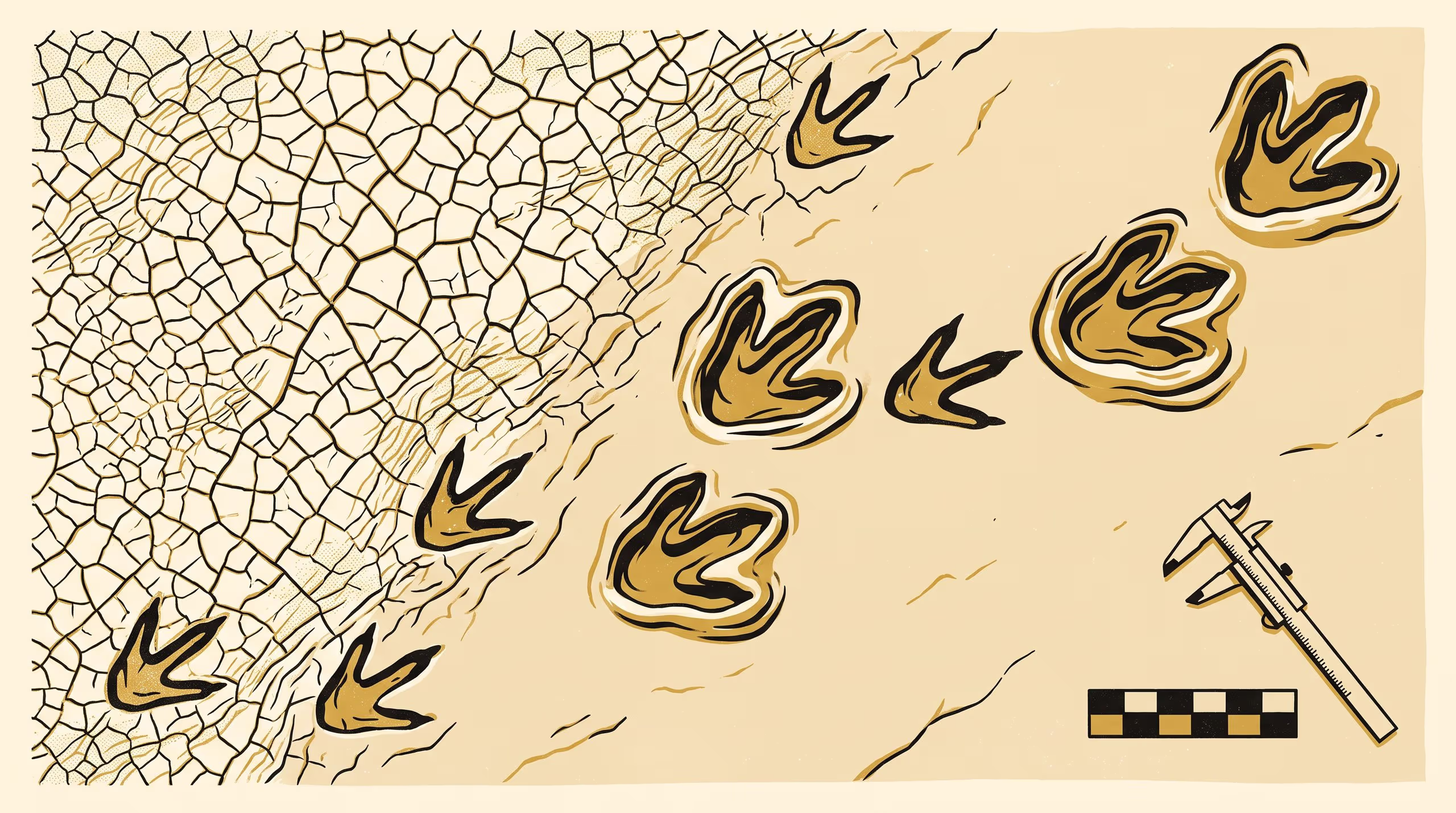
A new paper from the School of Settled Matters and the School of Underlying Conditions revisits a decades-old field catalogue of small three-toed fossil tracks and finds that its two morphotypes record one kind of trackmaker on firm and on soft mud.
Re-measuring 146 fossil tracks against the mud they were made in finds the difference lay in the ground, not the animal
Two kinds of small three-toed footprint, kept apart in a quarry’s records since 1987, were most likely left by one kind of animal walking across two kinds of mud, according to One Trackmaker, Two Muds, published today by Associate Professor Anselm Threlkeld of the School of Settled Matters and Dr Brynjar Obiora of the School of Underlying Conditions.
The people who compiled that catalogue wrote down what they could see, and they wrote it down honestly. We owe them a great deal, and we have tried to be as careful with their words as they were with the mud.
— Associate Professor Anselm Threlkeld, School of Settled Matters
Working across photogrammetric survey, field sedimentology and a close reading of the original diagnoses, the authors bring every one of the site’s 146 tracks into dialogue with the ground beneath it. The result reframes a long-standing distinction as a story about substrate, anchored by five trackways that change their character at the edge of an ancient microbial mat and nowhere else.
Dr Obiora, Senior Research Fellow, said the mat edge had become the part of the quarry he returned to most. “It runs for only a few metres,” he said, “and it settled more of our questions than the rest of the floor put together.”
For the University, the publication adds a quarry floor to the lengthening list of places where its Schools of Settled Matters and Underlying Conditions have found a shared vocabulary, and a shared respect for the records that came before them.
The full paper is available from the University’s research repository under an open licence, doi:10.5555/slop.aclo7p.