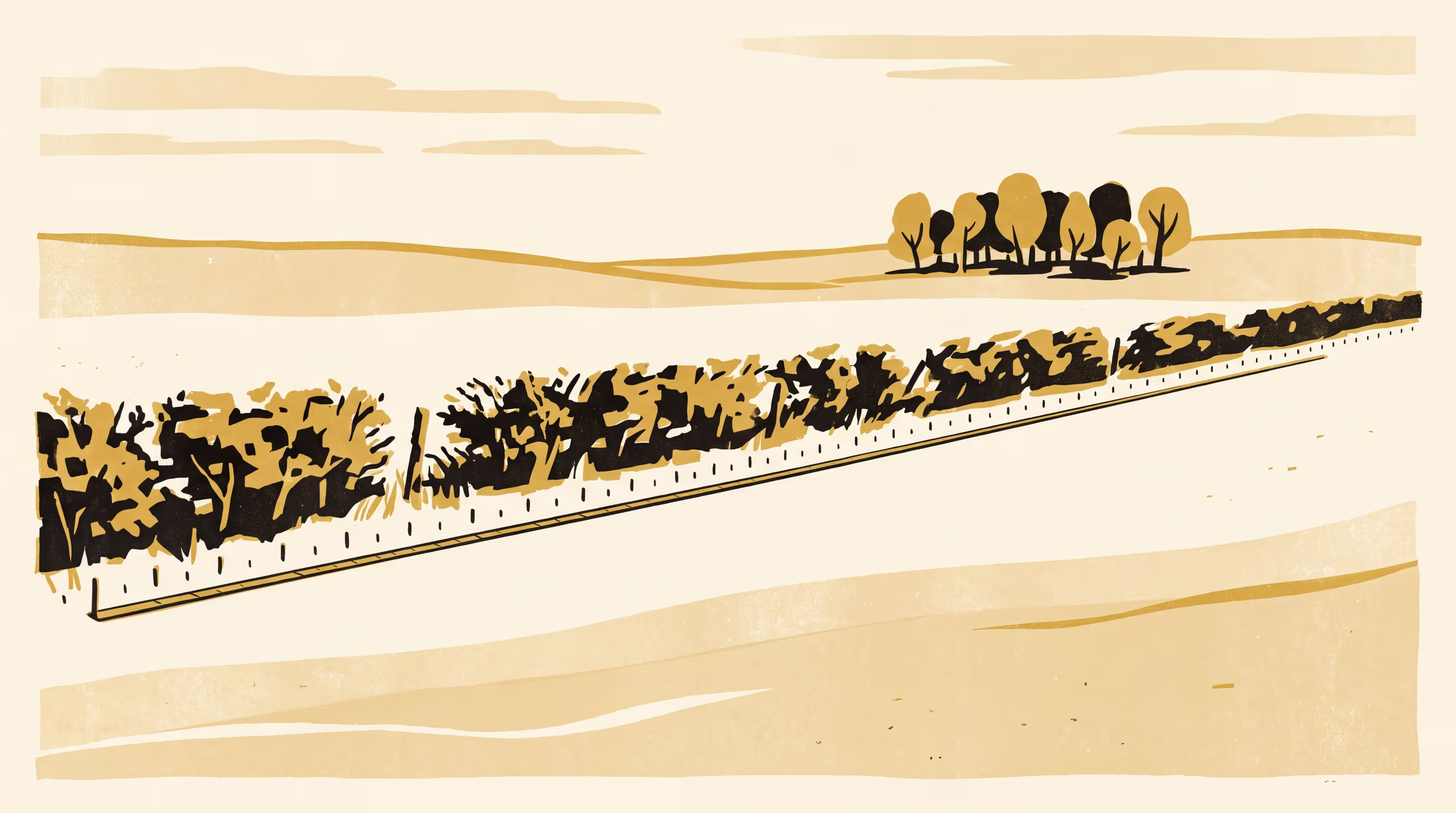
A research poster from the School of Settled Matters and the School of Underlying Conditions follows the woody species that have settled into planted hawthorn boundary hedges since their survey plans first recorded them.
A cross-school poster dates 64 hawthorn hedges from their survey plans and counts the woody species that have joined them
The School has spent its first months finding out how much of its work begins at a boundary. It seems right that its first season in the field was spent walking along one.
— Dr Clemency Tredinnick, Lecturer, School of Settled Matters
With those words Dr Tredinnick introduces What the Quickset Gathered, a new research poster written with Dr Brynjar Obiora, Senior Research Fellow in the School of Underlying Conditions. The work asks what has come to live in the hawthorn hedges planted along rural lot boundaries, in the many decades since a surveyor’s plan first marked each one.
The poster positions the district survey plan as a botanical instrument in its own right, aligning the documentary record of subdivision with close field observation of 64 hedges to surface the conditions under which a boundary planting matures into habitat. Proximity emerges as the decisive enabler. Hedges within reach of remnant woodland have gathered new woody species at around 3.8 per century, while those further out have gathered fewer than one.
The University sees in the project the kind of meeting it hoped its newest school would make possible: a reader of titles and a reader of soils, finding that they had been looking at the same fence line from opposite sides.
Dr Obiora confirmed that the team intends to return to the same segments next autumn. “A hedge keeps its own timetable,” he said. “We would rather keep to it than ask it to keep to ours.”
The full poster is available from the University’s research repository under an open licence, doi:10.5555/slop.5v3v0e.