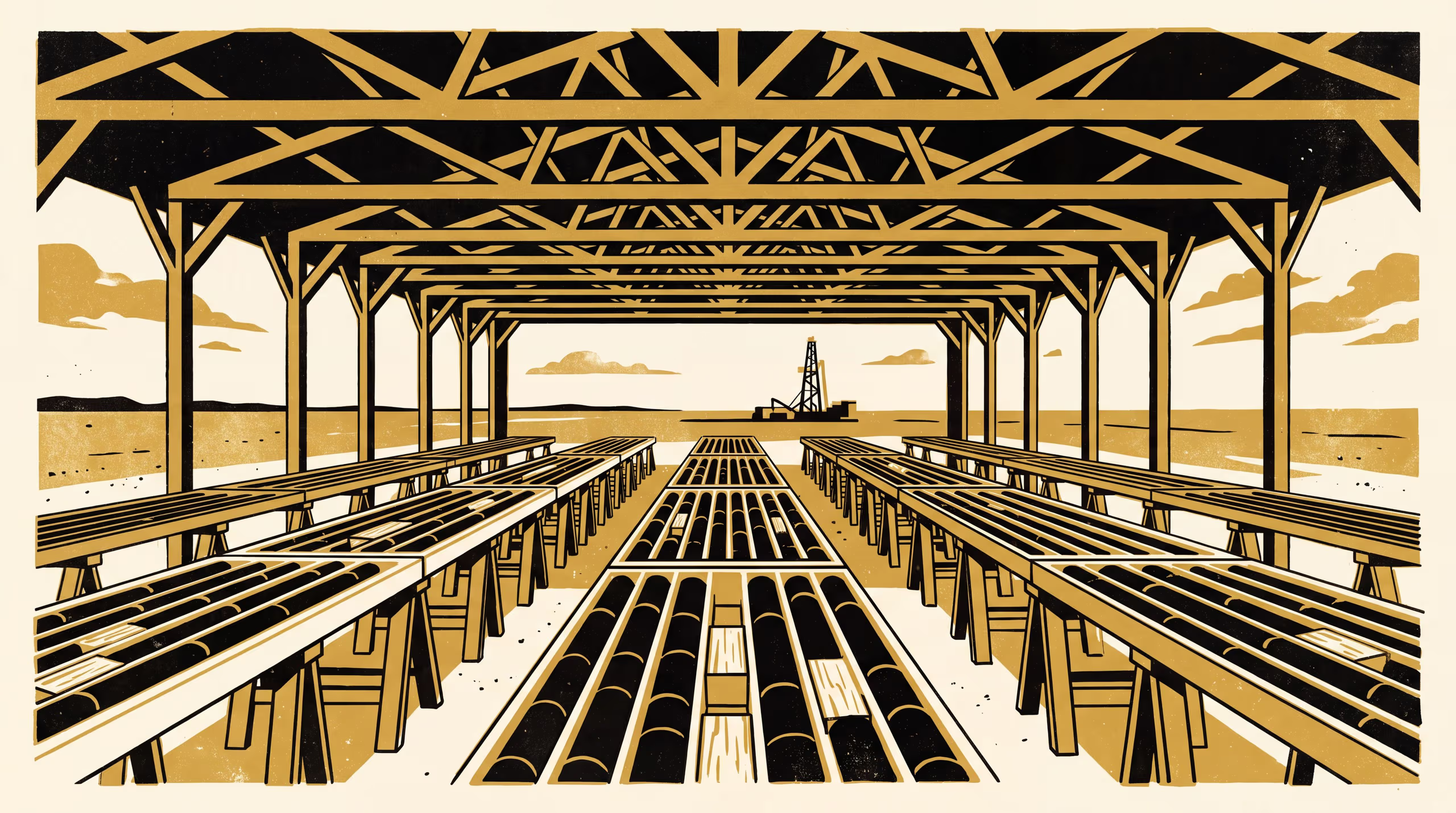
A new research poster from the School of Underlying Conditions finds that the core lost from a coking-coal seam is mostly its bright coal, and asks what that does to the figures the seam is described by.
Paired boreholes show the brightest coal in a seam is the coal its core most often loses
When a drill run through a coal seam comes back short, the missing metres are not a fair sample of the seam. That is the finding of What the Tray Stood In For, a new research poster by Associate Professor Ragnhild Uzoma of the School of Underlying Conditions and Dr Clemency Tredinnick of the School of Settled Matters. Across fourteen exploration holes, nearly three-quarters of the unrecovered coal turns out to have been the seam’s bright, friable layers.
Every core shed I have worked in kept a pile of spare wooden blocks just inside the door. It means a great deal to the Basement Relations Group to be able to say a little more about what they have been standing in for.
— Associate Professor Ragnhild Uzoma, Lead, Basement Relations Group
The poster sets each conventional hole beside a larger companion hole drilled a few metres away, and reads the gaps in the smaller core against the density log run down the same hole. It frames the seam composite as an inheritance, passed from the core tray to every later description of the resource, and offers a way of accounting for the coal that never reached the tray.
Dr Tredinnick, Lecturer in the School of Settled Matters, called the collaboration “the most hospitable welcome a conveyancer could ask of a core shed”.
The work sits within the University’s continuing investment in the records its earth sciences keep, and draws on support from the Anticipatory Capability Fund.
The full poster is available from the University’s research repository under an open licence, doi:10.5555/slop.4u6kh8.