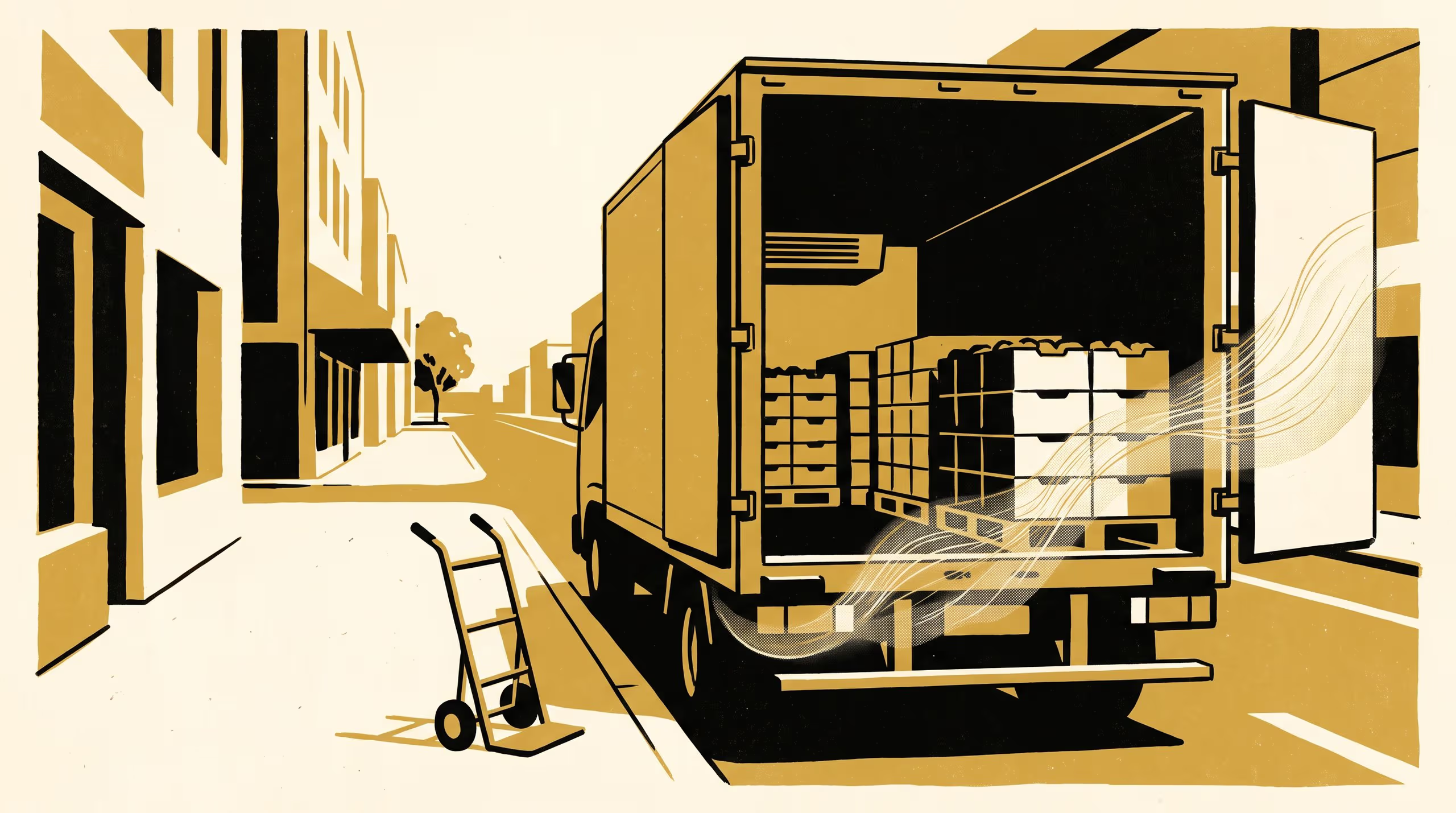
A new paper from the School of Continuous Improvement follows broccoli through every stop of a refrigerated delivery round and finds the order of the drops, not the opening of the rear door, decides who receives the oldest heads.
Sixteen refrigerated delivery runs, nine drops apiece, and a temperature logger in every customer's broccoli
For eight autumn weeks, a refrigerated truck on its morning round from a regional produce depot carried a temperature probe in the broccoli of every customer it served. Not at the Door, a new paper by Dr Bram Ntuli and Dr Osei Vandermeer of the School of Continuous Improvement, sets out where that broccoli’s shelf life actually went between the dock and the shop door.
Improvement Grand Rounds has always had a soft spot for the case that turns out to be about something else. This one arrived as a question about a door and has kept the School talking ever since, mostly about route sheets.
— Dr Bram Ntuli, Lecturer and Convenor, Improvement Grand Rounds
The study brings postharvest kinetics to the everyday choreography of multi-drop distribution, translating each carton’s temperature journey into a common currency of shelf life and setting two loading practices side by side across sixteen runs. It finds the rear door responsible for only a modest share of what the last customer’s broccoli loses on the road, with time aboard, and so the order of the round itself, doing most of the work. A loading sequence designed to even out the loss redistributed it between customers rather than reducing it.
It is the kind of patient, practical inquiry into ordinary operations that the School of Continuous Improvement was established to foster.
“Logistics has always been a question of what arrives in what order,” said Dr Vandermeer, Research Fellow and Convenor of the Review Cadence Observatory. “It has been a pleasure to see the order given the same care as the arrival.”
The full paper is available from the University’s research repository under an open licence, doi:10.5555/slop.jy2s7q.