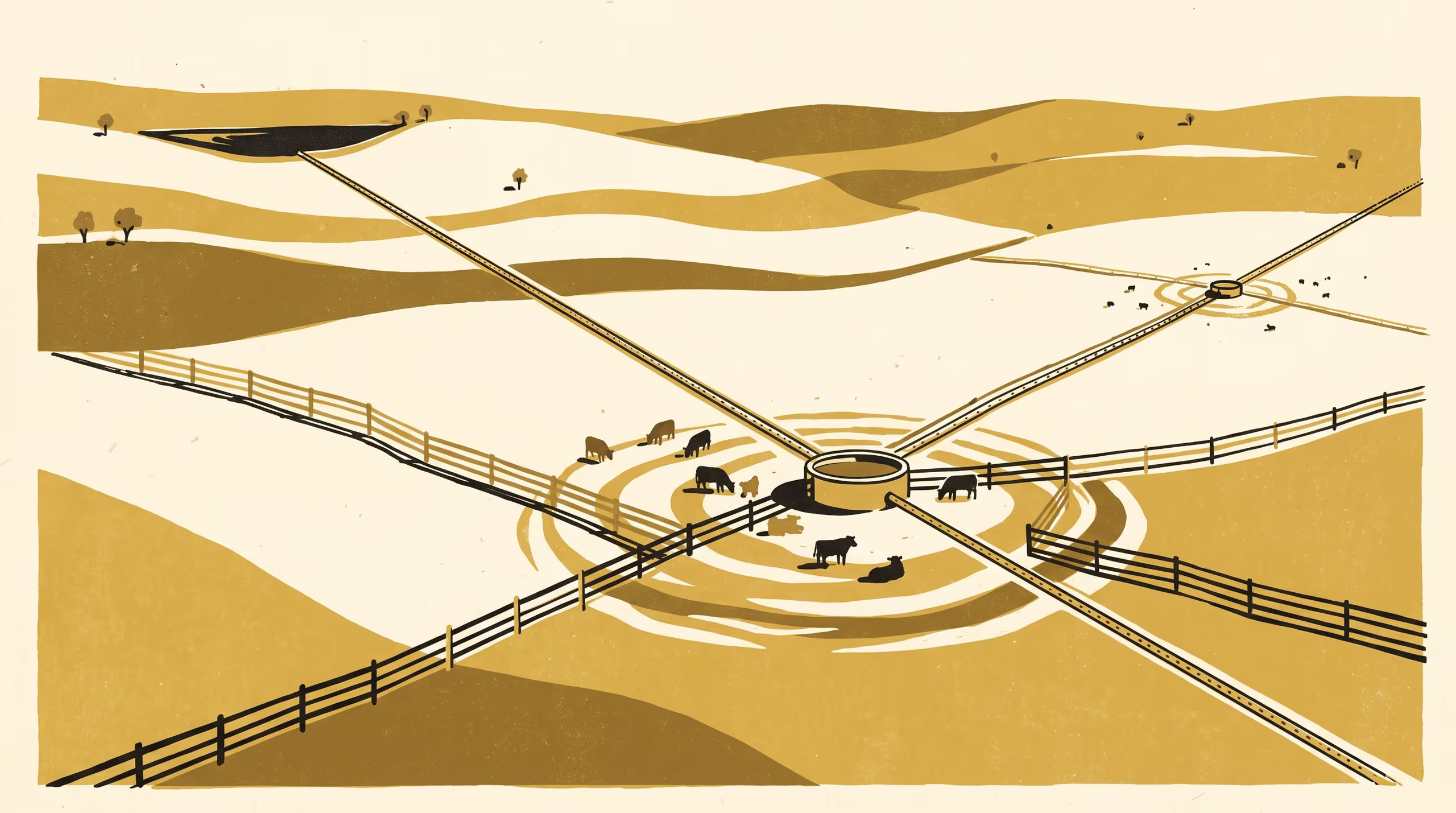
A new paper from the School of Settled Matters and the School of Underlying Conditions follows phosphorus to the troughs of a shared stock-water easement and models what moving them would change.
Soil phosphorus around the fourteen troughs of a stock-water easement shared by seven grazing holdings
Close to a third of the phosphorus that cattle return to the land on seven neighbouring beef holdings ends up within a hundred metres of a water trough, and where those troughs stand was settled on a plan registered in 1927. That is the finding at the centre of Where the Plan Put the Water, a new paper from Dr Clemency Tredinnick of the School of Settled Matters and Dr Brynjar Obiora of the School of Underlying Conditions.
The study brings soil survey, livestock behaviour and the reading of registered instruments into a single systems perspective, aligning field evidence from around every trough on a shared pipeline with a whole-of-easement model of where nutrients travel and what alternative layouts might enable. It positions the easement, rather than the individual farm, as the natural frame for decisions about water.
Soil keeps very careful minutes. We expect to be reading these ones for a good while yet, and the paper is best taken as an early entry in a long conversation with the ground and with the people who farm it.
— Dr Brynjar Obiora, Senior Research Fellow, School of Underlying Conditions
The collaboration sits comfortably within the University’s practice of sending its lawyers and its soil scientists out along the same fence line, and the School of Settled Matters regards it as a natural extension of its interest in the arrangements that outlast the people who made them.
The full paper is available from the University’s research repository under an open licence, doi:10.5555/slop.jfu51p.