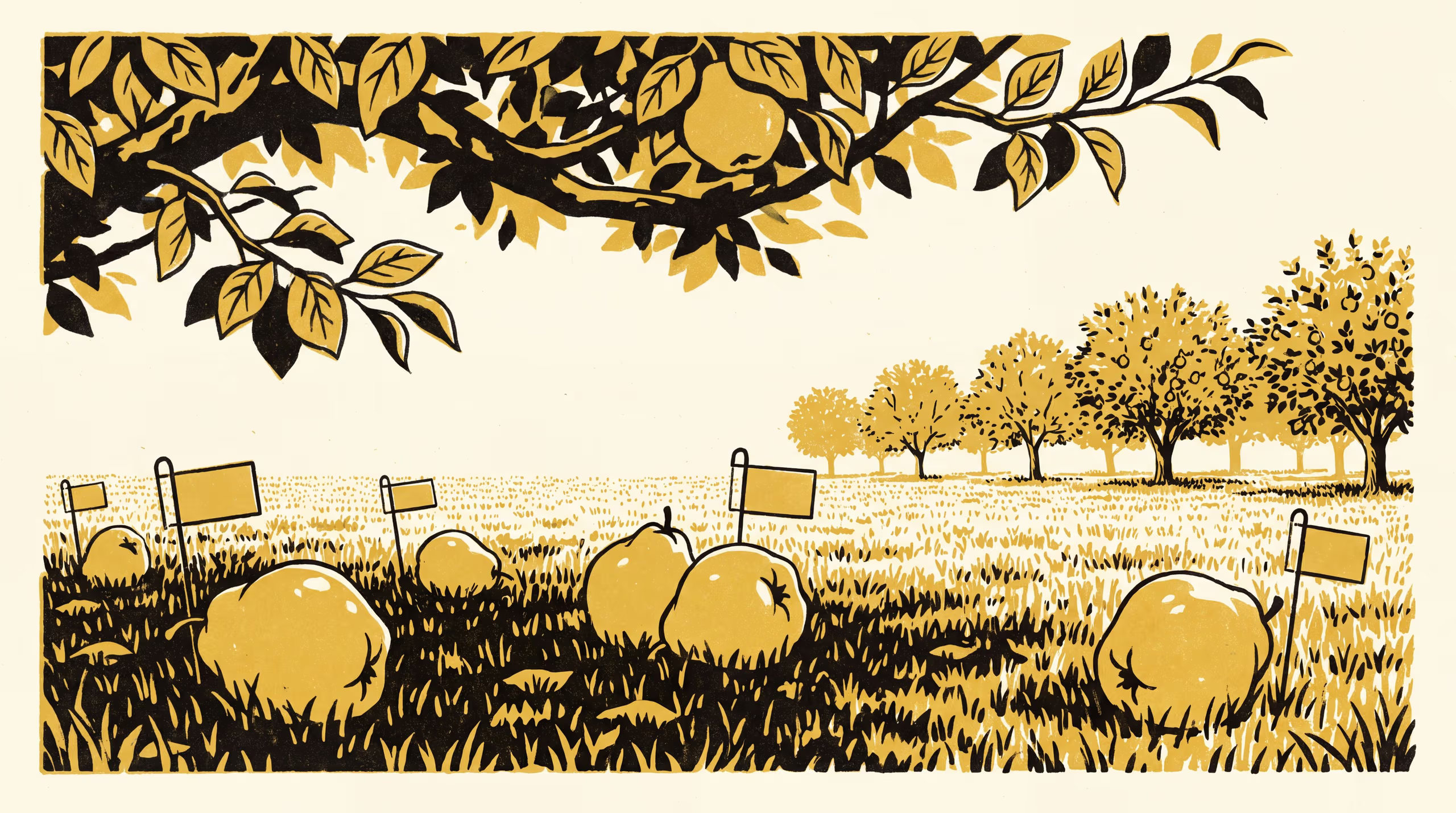
A new research poster from the School of Settled Matters tags 84 fallen quinces and finds that the face resting on the ground changes its pectin, and how it sets, well before the face turned to the sky.
Fallen fruit followed across nine days on one orchard floor, upper face against the face on the soil
A quince that has lain on the orchard floor for a week is, by the measure of its pectin, two fruit: the side turned to the sky, and the side pressed against the soil. That is the central finding of Days on the Ground, a new research poster led by Associate Professor Anselm Threlkeld of the School of Settled Matters, with Dr Brynjar Obiora, Senior Research Fellow in the School of Underlying Conditions.
Most of what we know about a fruit we learn from the side it chooses to show us. It has been a quiet pleasure to spend a season turning things over.
— Associate Professor Anselm Threlkeld, School of Settled Matters
The study follows 84 windfalls from the day each one fell, bringing field staking, cell-wall chemistry and a structured programme of set testing together into a single account of how a fallen fruit’s chemistry responds to time and to the ground beneath it. By the fifth day the two faces of the same fruit had begun to answer to different gelling conditions, a result the authors present as a foundation for further work across the post-harvest landscape.
“For once the soil was not the sample,” said Dr Obiora. “It was the bench, and I am grateful to have been invited to sit at it.”
The poster extends the University’s growing attention to the places where its disciplines quietly overlap, and adds an orchard floor to the sites its researchers now return to each season.
The full poster is available from the University’s research repository under an open licence, doi:10.5555/slop.z3hvb0.