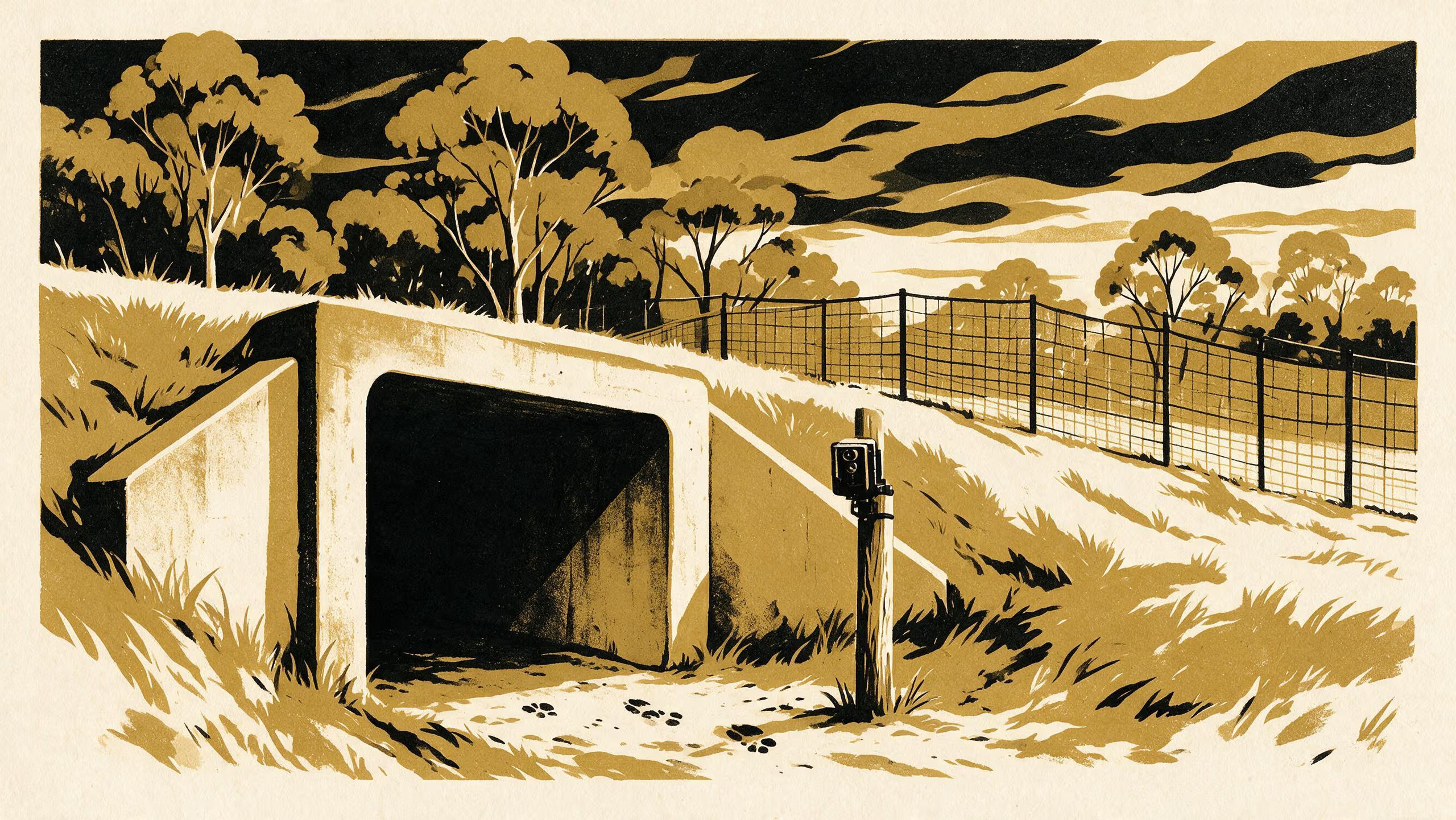
A new paper from the Schools of Settled Matters and Underlying Conditions returns to eighteen wildlife crossing structures two decades after they were built, and asks whether each still carries the species its approval named.
A year of camera traps beneath a duplicated rural highway, set beside the conditions of approval that named each structure's target
Fifty-four cameras spent a year at the entrances to eighteen wildlife underpasses beneath a rural highway, on behalf of a question nobody had put to the structures since they opened: are they carrying the animals they were approved for?
The Species in the Condition, by Associate Professor Anselm Threlkeld of the School of Settled Matters and Dr Vigdis Emenike of the School of Underlying Conditions, finds that the named species passed through eleven of the eighteen. Where a structure’s approval had named a species and specified its dimensions, the species was still using it.
We are used to reading provisions on behalf of people who arrive long after the drafters have gone. It was a useful discipline to read them, for once, beside the animals they were written for.
— Associate Professor Anselm Threlkeld, School of Settled Matters
Methodologically, the study pairs portal and habitat camera trapping with a structured reading of the road’s approval schedules, enabling each structure’s present-day performance to be aligned with the intent recorded at the moment of its approval. The result is an evidence base that connects field ecology, fencing condition and regulatory text across the full life of an asset.
“Every answer the cameras gave us arrived with a further question attached, and the School is glad to have them,” said Dr Emenike, Senior Lecturer.
The University counts the paper among its clearest demonstrations that a schedule of conditions can repay the same patient fieldwork as a stand of woodland.
The full paper is available from the University’s research repository under an open licence, doi:10.5555/slop.skdxd9.