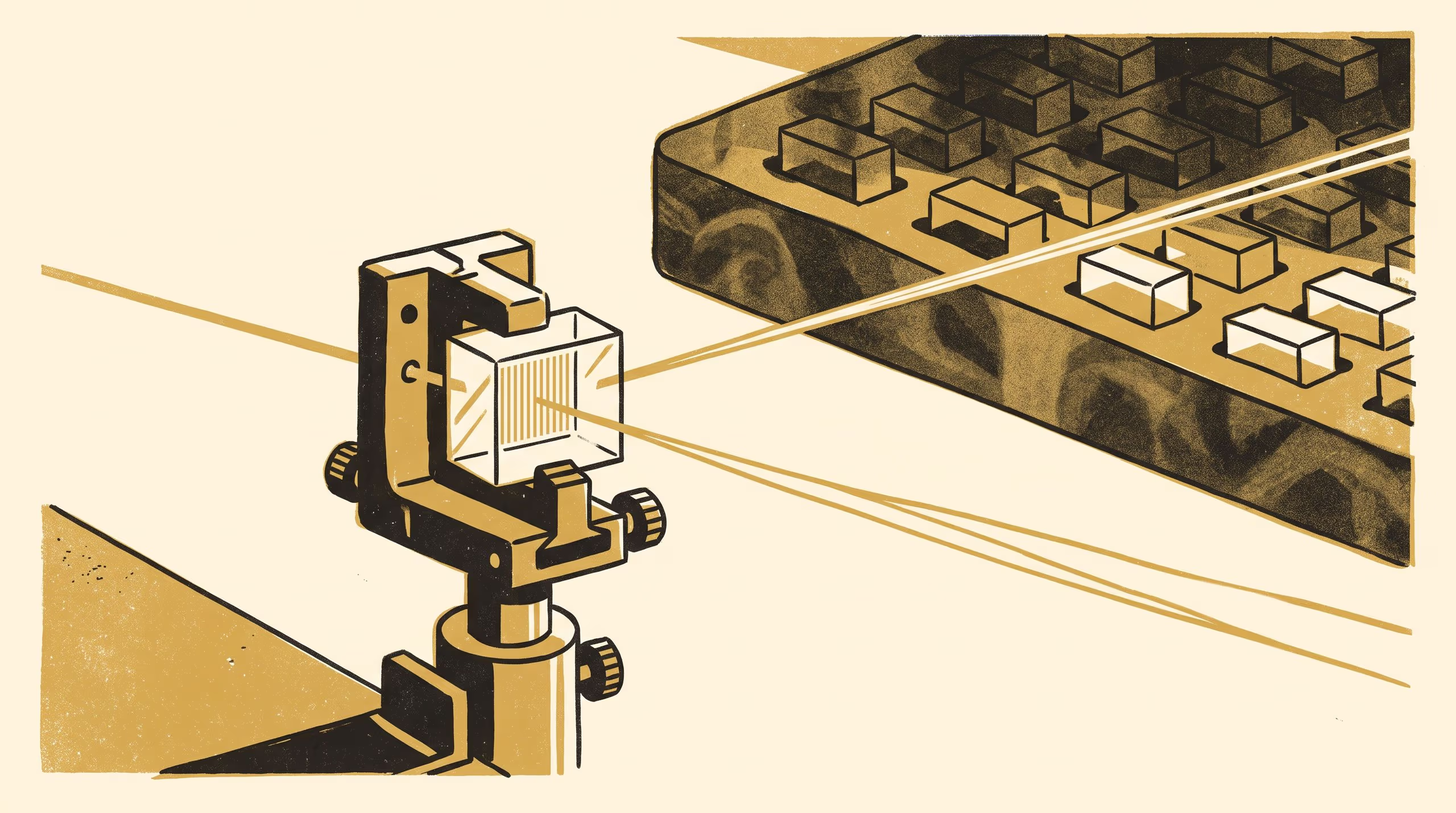
A new research poster from the School of Settled Matters reads twelve archived holographic gratings to a plateau and finds that eleven settle within a few dozen reads.
Twelve thermally fixed gratings in iron-doped lithium niobate, read one ten-second exposure at a time
The University’s care for the collections it keeps has reached a quieter and more luminous corner of the basement. What Survives the Reading, a research poster from the School of Settled Matters, returns to twelve crystal blocks holding thermally fixed holograms and asks how many times each can be read before it stops changing.
The work is led by Dr Odalys Penhallow, Senior Lecturer in the School, with Associate Professor Ragnhild Uzoma, Lead of the Basement Relations Group in the School of Underlying Conditions, and Dr Clemency Tredinnick, Lecturer in the School of Settled Matters.
The team brought a patient, read-by-read methodology to a legacy optical asset, pairing repeated laser exposure with a structured model of what each reading leaves behind. The approach distinguishes the durable layer of every stored grating from the more provisional one resting on top of it, and positions the archive for continued use well beyond the programme that first created it. Eleven of the twelve gratings reached a stable reading, most within a few dozen passes.
The drawer came to us in good order, and that is a credit to everyone who has opened it over the years. We have tried to hand it back the same way, with a little more written down about what it holds.
— Associate Professor Ragnhild Uzoma, Lead, Basement Relations Group, School of Underlying Conditions
Dr Penhallow said the School was “grateful for the chance to spend time with material that rewards being looked at slowly, and repeatedly”.
The full poster is available from the University’s research repository under an open licence, doi:10.5555/slop.8q9ti4.