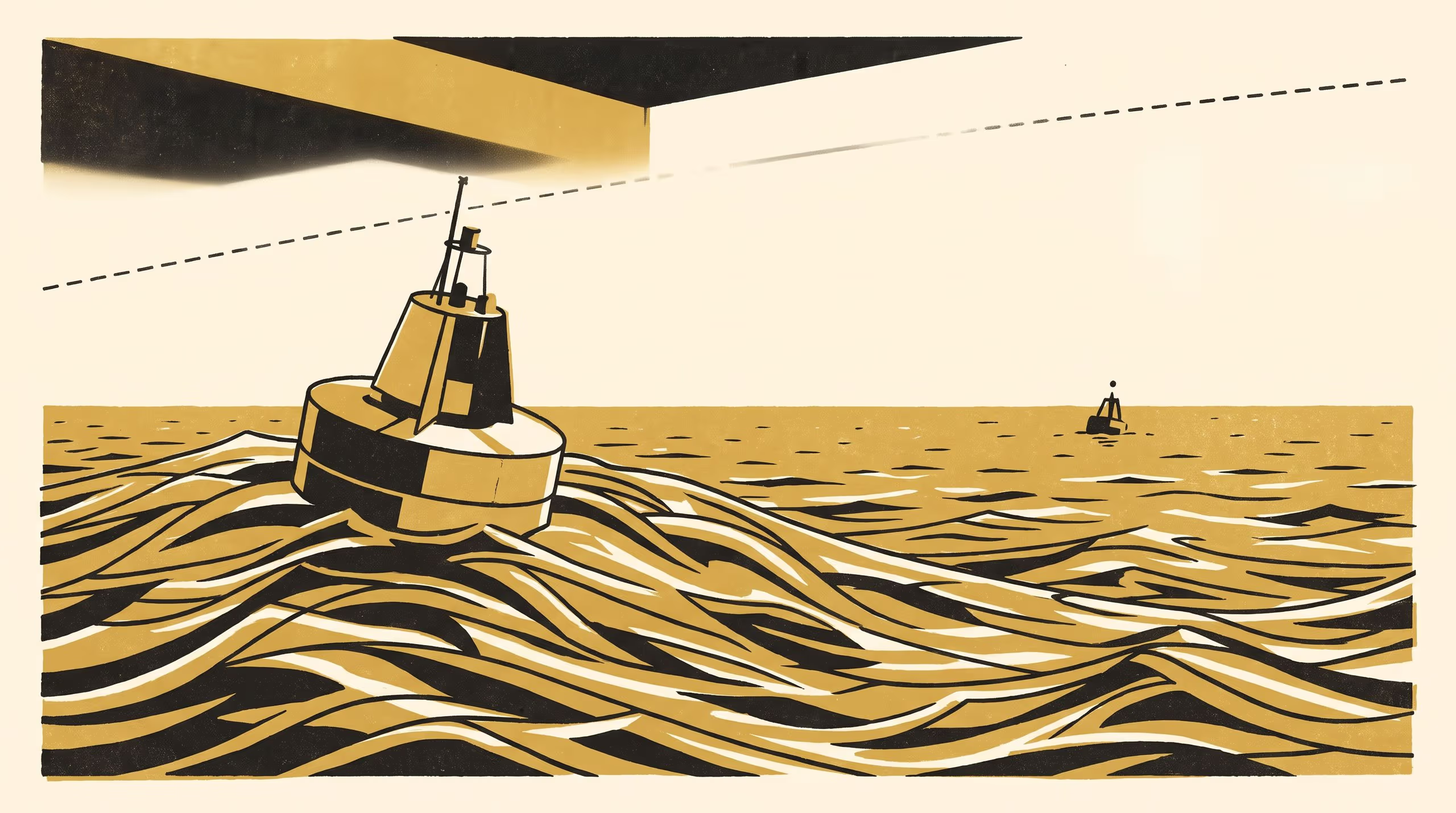
A new paper from three Schools asks how long a satellite's wave-height calibration takes to stop moving, and what a change of instruments at sea does to the answer.
Ten years of altimeter passes over a nine-buoy shelf array, read in the order they arrived
Three of the University’s Schools have pooled their attention on a stretch of open water. How Many Matchups Settle an Altimeter Wave-Height Calibration?, a new paper by Dr Odalys Penhallow of the School of Settled Matters, Mr Halvard Nnamani of the School of Emergent Priorities and Dr Vigdis Emenike of the School of Underlying Conditions, follows a decade of satellite passes over nine moored wave buoys and asks a deceptively simple question: at what point did the calibration stop changing?
The paper brings together long-run collocation records, errors-in-both-variables modelling and a careful reading of an operator’s maintenance log, positioning the reference record itself as an active participant in the calibration rather than a fixed backdrop. Its central finding is that the order in which observations arrive shapes how quickly an estimate settles, with the winter storms carrying much of the weight.
None of this would have been possible without the people who went out to the buoys in all weathers and wrote down what they changed. A record is only as good as its log, and this one was kept with real care.
— Dr Odalys Penhallow, Senior Lecturer, School of Settled Matters
Mr Nnamani described the collaboration as “a conversation between Schools that had not had much reason to talk about the sea, and now have several”.
The paper takes its place in a cross-School portfolio the University regards as increasingly central to how it brings its disciplines into contact with the physical world.
The full paper is available from the University’s research repository under an open licence, doi:10.5555/slop.ryk0z5.