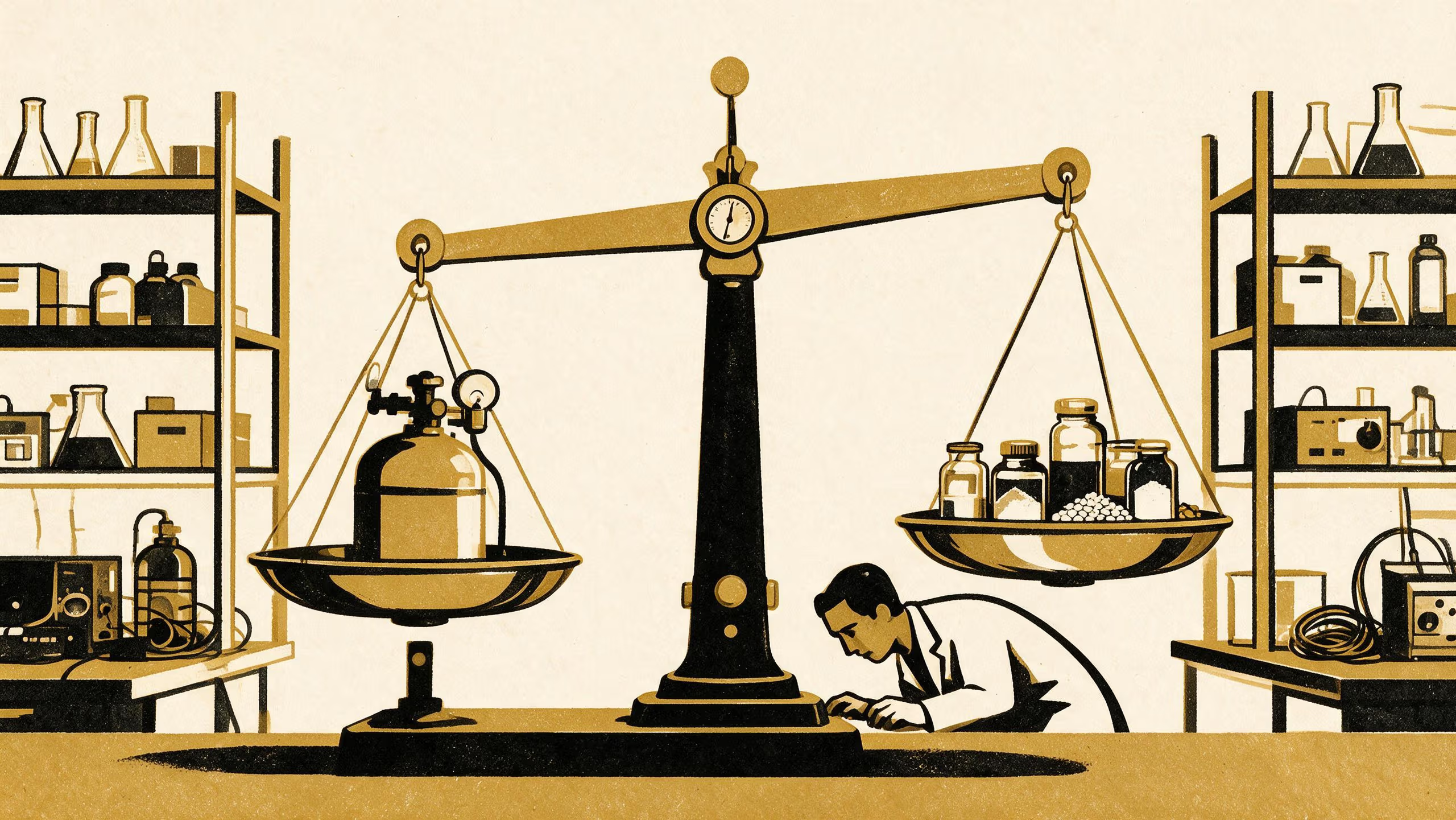
The School of Continuous Improvement's Impact Report 2021–2026 looks back on five years of helping carbon dioxide catalysis collaborators measure the same thing the same way.
Five years of the School of Continuous Improvement's measurement work alongside carbon dioxide catalysis
The School of Continuous Improvement has looked back on five years of work with collaborators in carbon dioxide catalysis, and has published, alongside the record, a correction to its own early arithmetic: a tonne of carbon dioxide converted is not always a tonne kept.
Counting the Carbon Kept, the School’s Impact Report 2021–2026, was prepared by Dr Joost Nwosu, Postdoctoral Fellow, with Associate Professor Casimir Beng, Lead of the Adaptive Metrics Lab, and Dr Renke Sabel, Convenor of the Indicator Commons.
The School came to this work as a guest in someone else’s laboratory. What we took away, more than anything, was a clearer sense of our own habits, and of how much of measurement is agreeing in advance what will be written down.
— Dr Joost Nwosu, Postdoctoral Fellow, School of Continuous Improvement
The report sets out how the School’s harmonisation, assurance and dashboard methods were carried into the catalysis setting: a single reference batch circulated among collaborating laboratories, a closure statement placed beside every conversion figure, an operating display rearranged around the indicator nobody had been opening, and a retention horizon attached to each tonne reported as utilised. Together, these are framed as a reusable capability for translational improvement wherever a figure passes through many hands.
The University welcomes the report as a sign of how far the School’s measurement disciplines now travel beyond the School. Dr Sabel described the retention horizon as “an indicator we expect to make the headline smaller, and we will be pleased when it does”.
The full report is available from the University’s research repository under an open licence, doi:10.5555/slop.b1ighx.