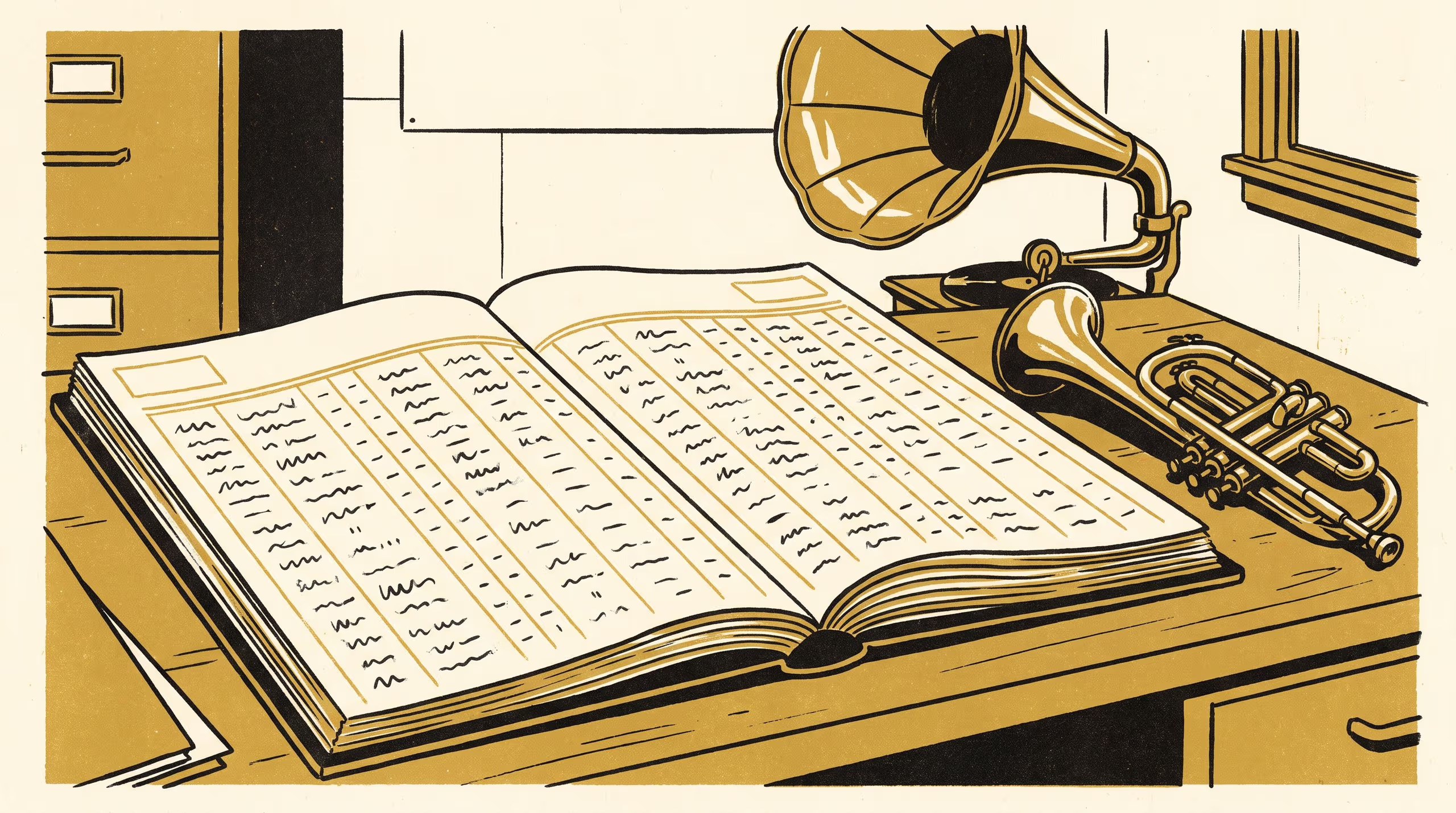
A paper from the School of Settled Matters reads a provincial magistrates' court register's prosecutions for street music and gramophone noise as an accidental form of musical notation.
Four decades of nuisance prosecutions that wrote down the instrument, the hour and the volume, but never the tune
In the register of one provincial magistrates’ court, a man who switched on a wireless set late at night was charged with playing a musical instrument. That entry is one of 417 at the heart of To Wit a Cornet, a new paper by Dr Odalys Penhallow, Senior Lecturer in the School of Settled Matters, which brings the methods of musicology to the everyday paperwork of local justice.
The paper approaches the court’s handwritten particulars of offence as a kind of score. Working across forty years of entries and the witness statements that survive for part of the period, it maps what the clerks chose to set down about each performance, from the instrument to the hour and the volume, and what they left out. It then follows the wording of the charge as it settled into a single fixed form, and considers what that settling meant for the sounds a court was able to hear.
A register is written to be consulted rather than read, and it rewards reading all the same. There are a great many such books on a great many shelves, and the questions they hold are ones a School of Settled Matters is well placed to keep asking.
— Dr Odalys Penhallow, Senior Lecturer, School of Settled Matters
The work carries the School’s continuing interest in how open questions come to be closed into a field where it has not worked before, and the University welcomes the conversation between law and music that it begins.
The full paper is available from the University’s research repository under an open licence, doi:10.5555/slop.nsrnq9.