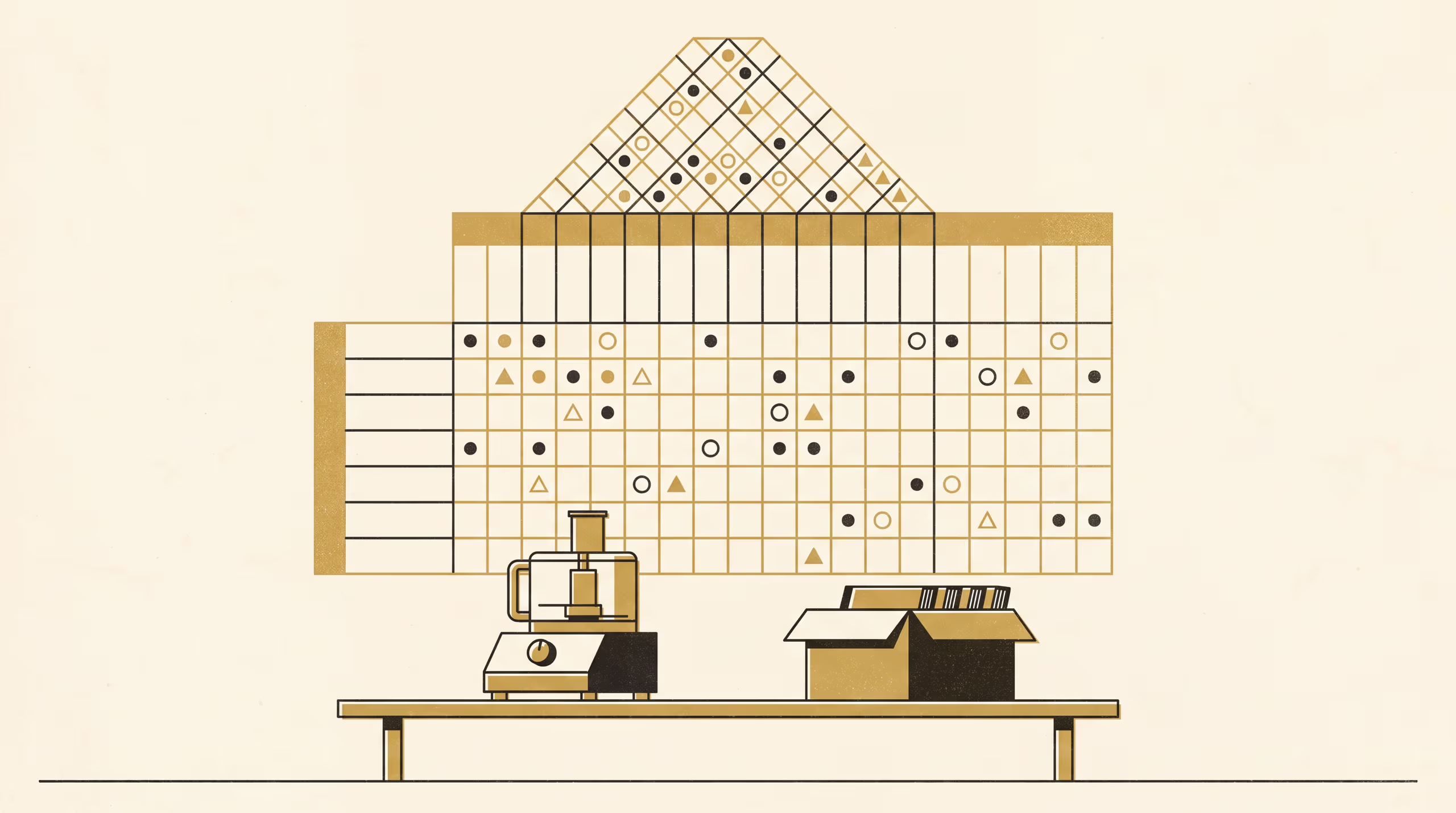
A research poster from the School of Settled Matters follows the customer requirements in a product design matrix as five successive design teams inherit them and decide what they mean.
One appliance maker's House of Quality, carried across five product generations without the customer interviews behind it
The Received Readings Group has turned its attention from the courtroom to the design review. Reading an Inherited House of Quality, a new research poster by Associate Professor Anselm Threlkeld of the School of Settled Matters, with Dr Ingeborg Nwachukwu, Lecturer and Convenor of Capability Sprints, and Dr Thandiwe Solberg, Senior Lecturer and Convenor of Demo Quarter, examines the matrix product designers use to turn what customers say into what engineers build, and asks what happens to its short phrases once the people who wrote them down have moved on.
Every School keeps a few documents it reads far more often than it rewrites. Watching a design team live with one of its own has given us good reason to look again at ours.
— Associate Professor Anselm Threlkeld, School of Settled Matters
The study aligns the School’s close reading of inherited text with the design-review record of a single product line, mapping each customer requirement against the successive engineering decisions it has informed and surfacing the pathways by which a provisional reading consolidates into established practice. By the fifth generation, 26 of the 34 inherited requirements were being read through the previous team’s decisions, and the original interview notes were consulted for two. One requirement, recorded as “feels solid”, has governed the thickness of the appliance’s housing for four generations, although the customers behind it were describing the sound of the lid closing.
The poster proposes a modest remedy and reports it already under trial. “We expect the reading note to find a place on a good many walls beyond this one,” said Dr Solberg.
The poster joins the University’s repository at a moment of considerable momentum in its study of how organisations remember.
The full poster is available from the University’s research repository under an open licence, doi:10.5555/slop.965vny.