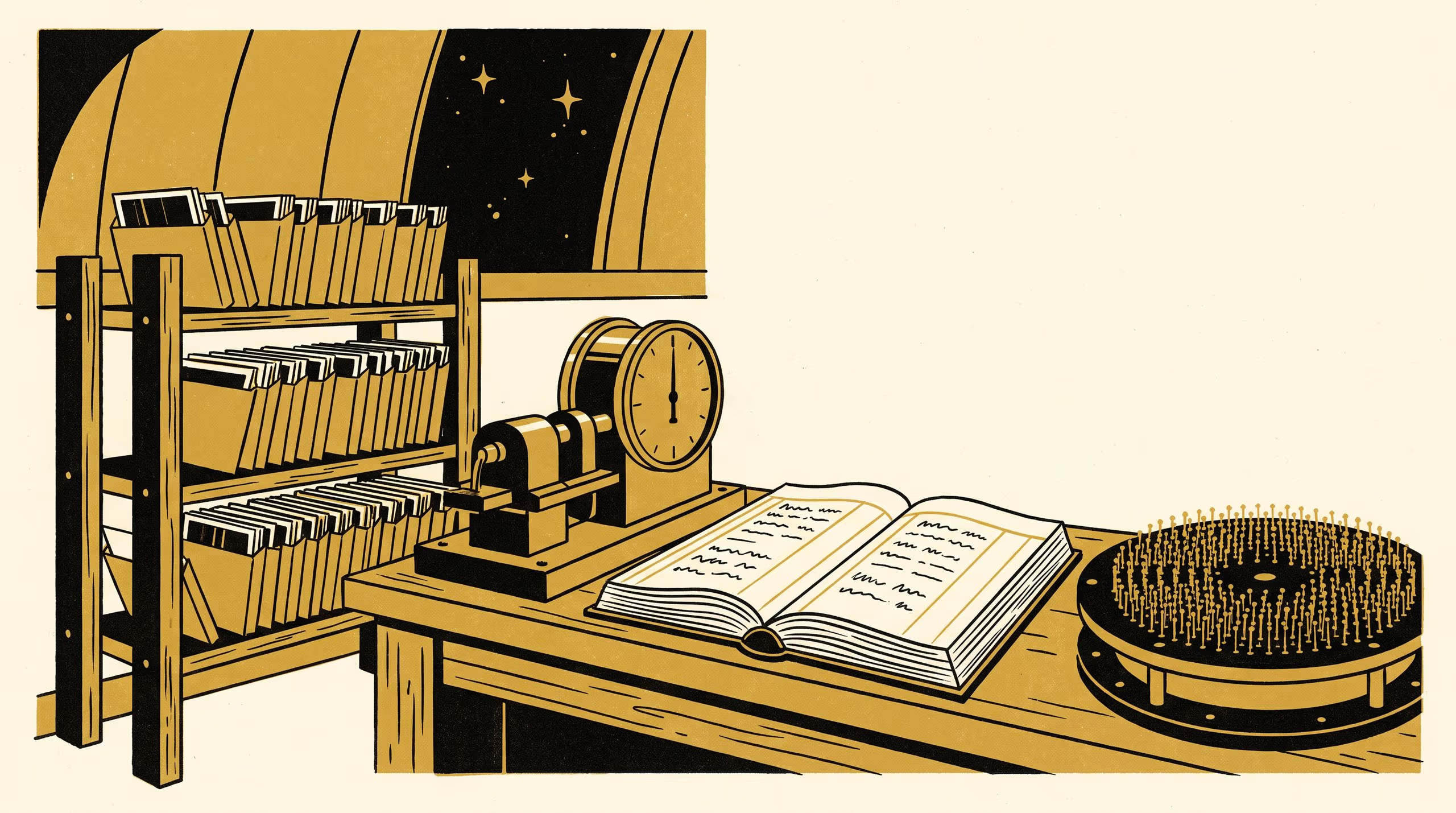
A paper from the School of Settled Matters follows what one observatory paid for each galaxy redshift it measured between 1958 and 2004, and finds the price falling in sudden steps.
A cost history of galaxy spectroscopy at one southern observatory, from the photographic plate to the optical fibre
For most of the second half of the twentieth century, the price an observatory paid to learn how fast a galaxy was moving away from us hardly moved at all, and then, several times over, it dropped at once.
That is the central finding of Nights per Galaxy, a new paper by Dr Odalys Penhallow, Senior Lecturer in the School of Settled Matters, and Sunniva Balogun, Doctoral Candidate in the School of Emergent Priorities.
The School has only just begun to read beyond the law reports, and it seems right that one of its first stops should be somewhere as patient as an observatory’s archive.
— Dr Odalys Penhallow, Senior Lecturer, School of Settled Matters
Reading an observatory’s night ledgers alongside its plate-store accounts and the minutes of its time-allocation committee, the authors align four generations of instrumentation with the institution’s evolving stewardship of the night sky, and trace how a committee’s rules kept pace with an instrument that could observe hundreds of galaxies at a time.
Ms Balogun said that her months among the Observatory’s old price lists had felt “like a homecoming, with better views”.
The University is glad to see a law school’s habits of reading turned towards the sky, and expects them to travel further still.
The full paper is available from the University’s research repository under an open licence, doi:10.5555/slop.3fnaq8.