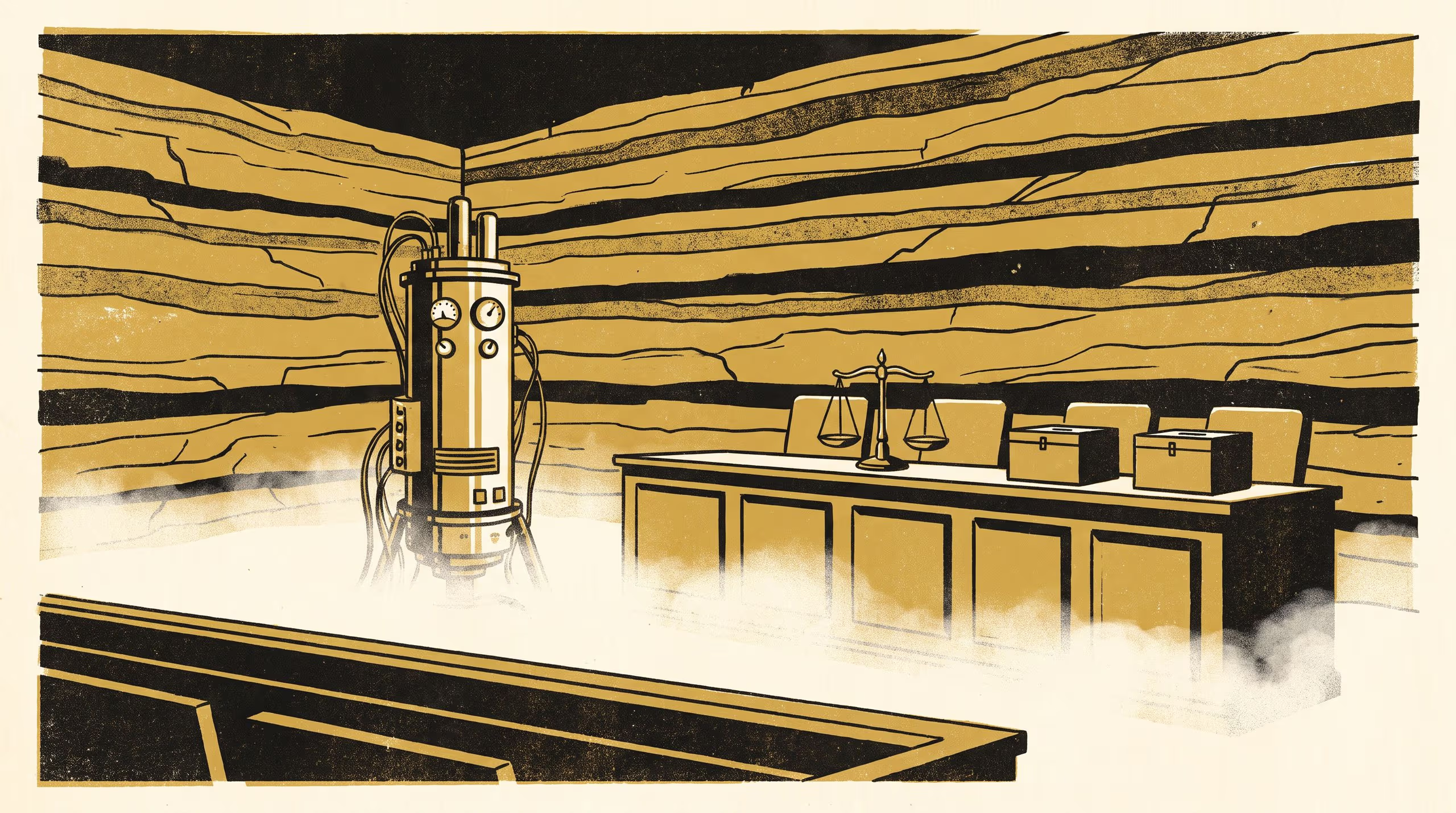
A jurisprudence paper from the School of Continuous Improvement reads a dark-matter collaboration's publication charter as a law of evidence and proposes a third verdict for the region where its exclusions lose their footing.
A jurisprudential reading of a dark-matter collaboration's rulebook finds the one region where its null results should settle nothing
When a dark-matter search finds nothing, the rules that govern what its scientists may say have come to record that nothing as settled. A new paper from the School of Continuous Improvement argues that, in one corner of the search, those rules should say something more modest.
Not Proven Below the Fog, by Dr Marit Osayande, takes the written charter of a large physics collaboration and reads it the way a lawyer reads a law of evidence. Across four editions, the paper traces a burden of proof, a tribunal, a rule of finality and a short list of verdicts, and follows one of those verdicts out of the text altogether. Its proposal is to bring a version of it back, for the region where the signal the collaboration hopes for and an ordinary neutrino background become hard to tell apart.
The Living Dashboard spends most of its time with readings that go on being reported long after anyone has asked what they mean. It has been instructive to spend some of it with a rulebook whose authors once wrote down the difference between not seeing something and seeing that it is not there.
— Dr Marit Osayande, Lecturer and Convenor, Living Dashboard, School of Continuous Improvement
The work carries the School’s long interest in what becomes of a record once it is written, out into the procedures of a scientific community far from campus, and the University is pleased to count the governance of evidence, alongside its measurement, among the questions its Schools return to.
Dr Osayande said she was grateful to have been given “a document patient enough to be read four times over, and a field generous enough to have left its earlier drafts in plain view.”
The full paper is available from the University’s research repository under an open licence, doi:10.5555/slop.tigbr9.