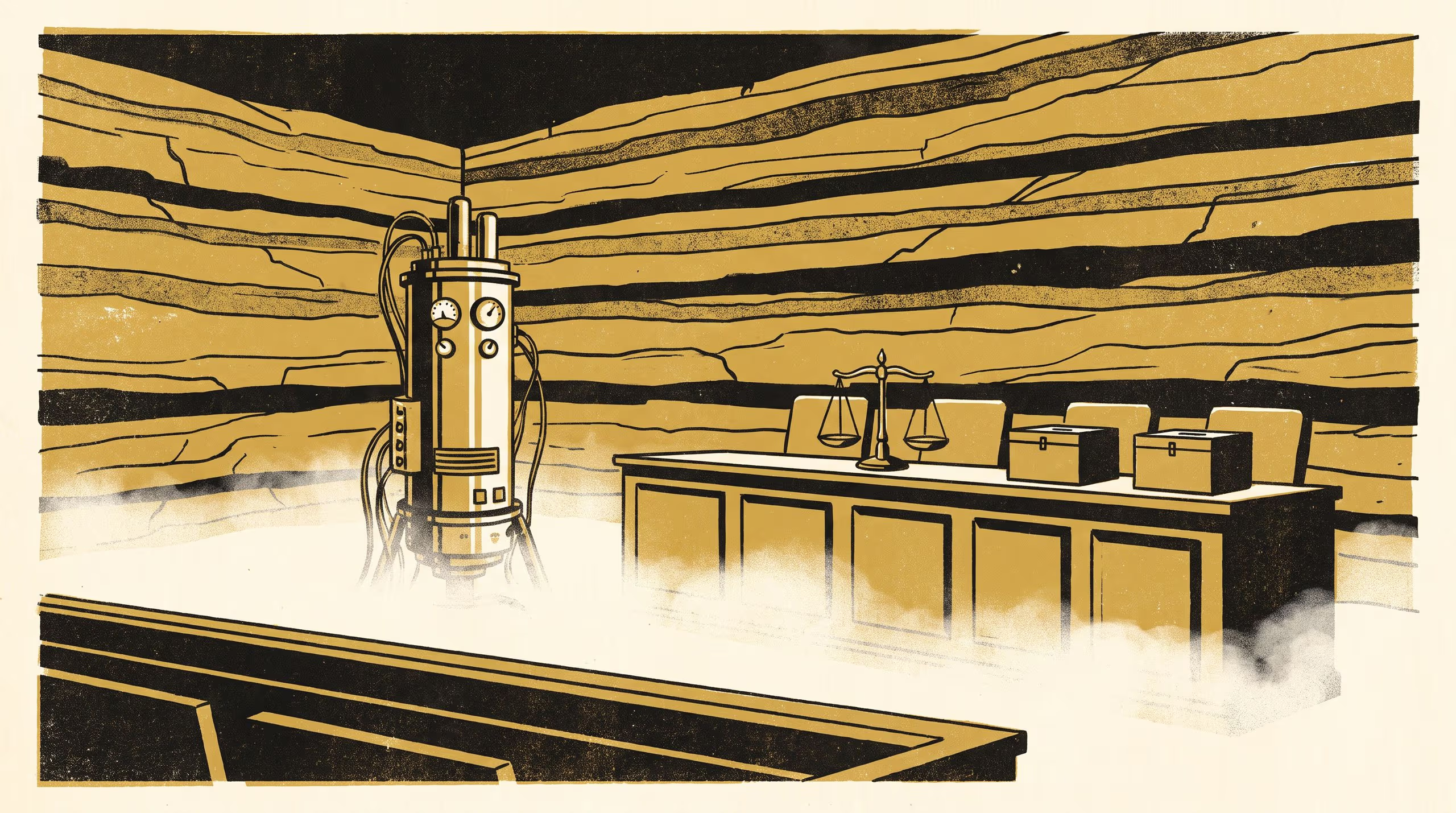
The Publication Charter of an Underground Dark-Matter Collaboration, Read as a Law of Evidence
A jurisprudence paper from the School of Continuous Improvement reads the four editions of the publication charter governing a dark-matter detector collaboration as a law of evidence, with a presumption of absence, graded standards of proof, a tribunal and a rule of finality. It argues that the charter's third edition, by abolishing its verdict of indeterminacy, made every null run an exclusion that settles the parameter space it covers, and that in the region where a dark-matter signal becomes hard to tell from coherent neutrino scattering those exclusions are acquittals by a tribunal that could not have convicted. It proposes restoring a third verdict, confined to that region, that leaves the exposure open and records no finding either way.
| Authors | Marit Osayande |
|---|---|
| School | School of Continuous Improvement |
| Output type | Research paper |
| Published | |
| DOI | 10.5555/slop.tigbr9 |
| Pages | 7 |
| Cited by | 1 output |
| Version | 1.0 |
| Licence | CC BY 4.0 |
Cites
Cited by
Cite as
@misc{slop_tigbr9,
  author       = {Marit Osayande},
  title        = {Not Proven Below the Fog: The Publication Charter of an Underground Dark-Matter Collaboration, Read as a Law of Evidence},
  year         = {2026},
  publisher    = {Slop University},
  doi          = {10.5555/slop.tigbr9},
  url          = {https://slop.university/outputs/slop-paper-not-proven-below-tigbr9/},
  version      = {1.0},
  note         = {Research paper},
}