A new display campaign from the School of Underlying Conditions marks the arrival of the University's enterprise system at the bores its groundwater fieldwork reads.
A portrait campaign for the University's screens gives each bore in the School of Underlying Conditions' network an owner and a cost centre
Somewhere in the University’s new enterprise system, between the laboratory freezers and the lecture-theatre projectors, there is now a line for every groundwater monitoring bore the School of Underlying Conditions reads. Master Data, All the Way Down, a display campaign prepared by Dr Vigdis Emenike, Senior Lecturer in the School, brings that arrival to the University’s portrait screens.
Some of our bores have been read every quarter for longer than anyone can say why. Giving each of them a named owner has been a chance to make that care official, and to share it with colleagues who have never stood in a paddock.
— Dr Vigdis Emenike, Senior Lecturer, School of Underlying Conditions
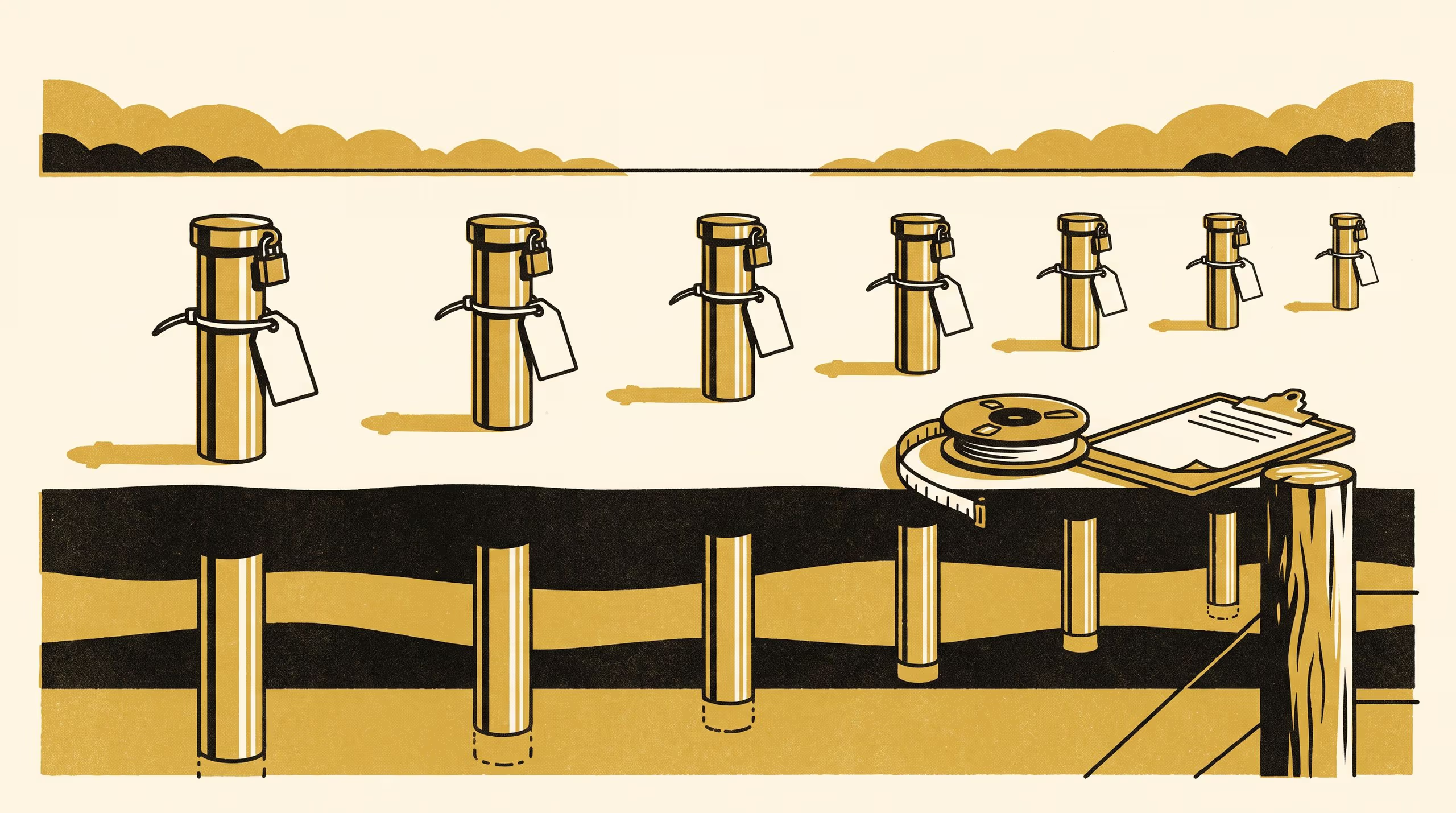
The poster sets a single standpipe in a dry paddock, a tag tied to its casing and a dip-meter reel resting on its cap, above a cutaway of the strata the casing passes through on its way to the water table. Its small print directs readers to three works from the University’s record: on when a monitoring bore should be retired, on resting the bores of a small field so their levels recover, and on how a laboratory’s internal codes survive their passage from one system to the next.
The campaign forms part of the University’s wider effort to bring its research estate and its administrative estate into a single, continuing conversation, one in which fieldwork and finance increasingly share a vocabulary. Dr Emenike described the poster as “a small acknowledgement that the ground has always been part of the institution, whether or not it had a cost centre.”
The full poster is available from the University’s research repository under an open licence, doi:10.5555/slop.ovqckz.