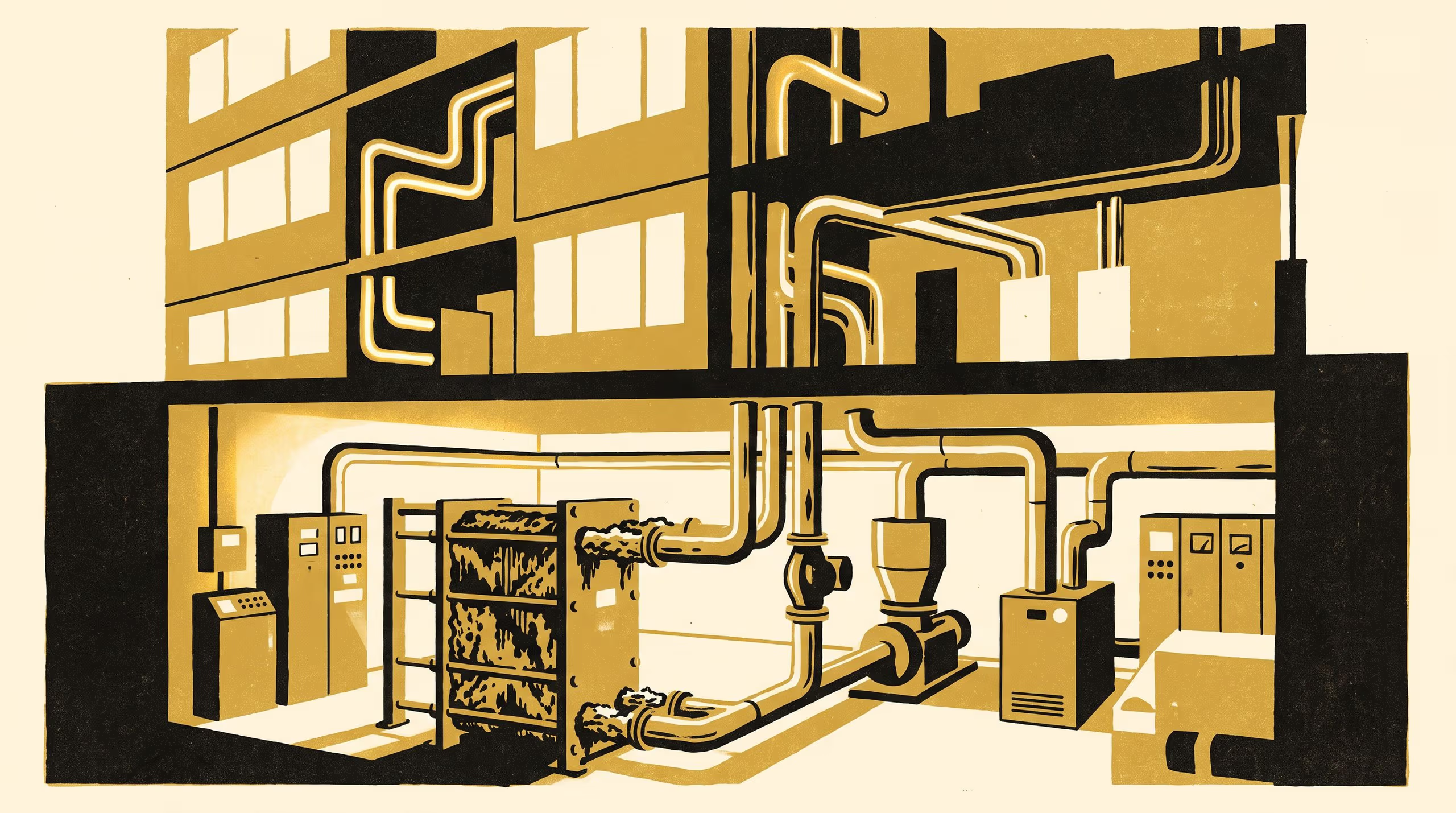
A research poster from the School of Emergent Priorities finds that the calcite collecting in apartment buildings' shared hot-water plants answers to the temperature of the heat-exchanger plate rather than the storage setting their owners corporations decide.
A doctoral poster weighs three years of scale from the shared plant rooms of twelve buildings on one hard supply
Ylva Onyekwere has taken her doctoral attention to how residential committees arrive at a decision down a flight of stairs, into the basement plant rooms where those decisions are carried out. Hotter at the Wall, her new research poster with Associate Professor Casimir Beng and Dr Vigdis Emenike, follows hard water through the shared hot-water systems of twelve apartment buildings and asks why some of them scale so much faster than others.
For eight years I wrote down what owners corporations resolved about their hot water. It has been a privilege to spend three of them seeing what the water made of it.
— Ms Ylva Onyekwere, Doctoral Candidate, School of Emergent Priorities
Pairing maintenance-day measurements with the governance records each building already keeps, the team brings water chemistry, plant-room practice and the everyday life of residential strata into one conversation. The poster finds that the scale tracks the temperature at the heat-exchanger plate, and that the storage setting each committee resolves has little bearing on how much of it forms.
Associate Professor Beng, Lead of the Adaptive Metrics Lab, described the collaboration as “a homecoming of sorts for anyone who started out keeping a process inside tolerance”, and said the Lab was pleased to lend its instruments to a question that began in a set of minutes.
The poster marks a considered turn toward the building services that quietly underpin residential life, an area in which the School of Emergent Priorities expects its interest in how decisions are recorded to keep finding new ground.
The full poster is available from the University’s research repository under an open licence, doi:10.5555/slop.h6j5wj.