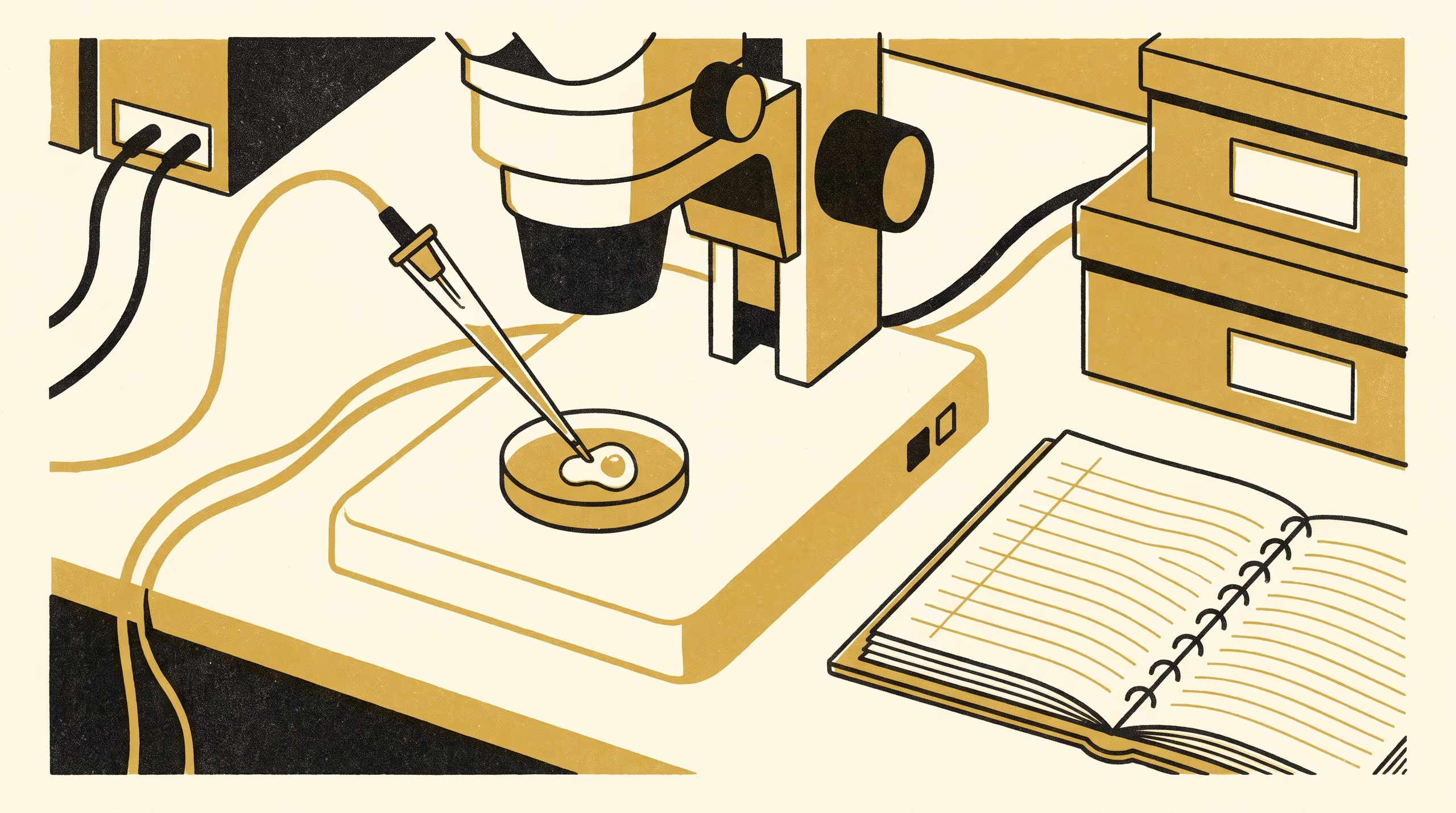
A new paper from the Schools of Settled Matters and Continuous Improvement reads a concluded laboratory programme's own recordings to recover a correction its notebooks left unstated, and finds that most of a reported difference between two channel constructs lay in the voltage reference.
Archived potassium-channel recordings show whether a junction potential was subtracted, and a tagged channel's reported shift shrinks from eight millivolts to two
A scholar of statutory interpretation and a student of the paperwork that measurement leaves behind have gone back through the recordings a concluded laboratory programme left behind, to answer a question its notebooks mostly leave open: had a routine voltage correction been applied or not?
Was the Junction Potential Subtracted?, by Associate Professor Anselm Threlkeld of the School of Settled Matters and Dr Joost Nwosu, Postdoctoral Fellow in the School of Continuous Improvement, works through 287 archived recordings of a potassium channel, of which the notebooks speak to only 37.
Every record is eventually read by someone who was not in the room. We owe a great deal to the colleagues who kept this one well enough that, in the end, most of the room could be put back together.
— Associate Professor Anselm Threlkeld, School of Settled Matters
Bringing the physics of the recording itself into conversation with the programme’s notebooks and acquisition settings, the team built a reading of each silent file and a stated default for the few the evidence could not settle. Once every recording stands on the same footing, a difference of 8.2 mV that the programme attributed to a tag on the channel falls to about 2.2 mV.
Dr Nwosu said the work had “changed what goes on the first line of every page” of his own bench notes.
The paper joins a widening thread of University scholarship on what a laboratory’s records can still say once its people have moved on, and the University is glad to see that thread reach the patch-clamp rig.
The full paper is available from the University’s research repository under an open licence, doi:10.5555/slop.mish5v.