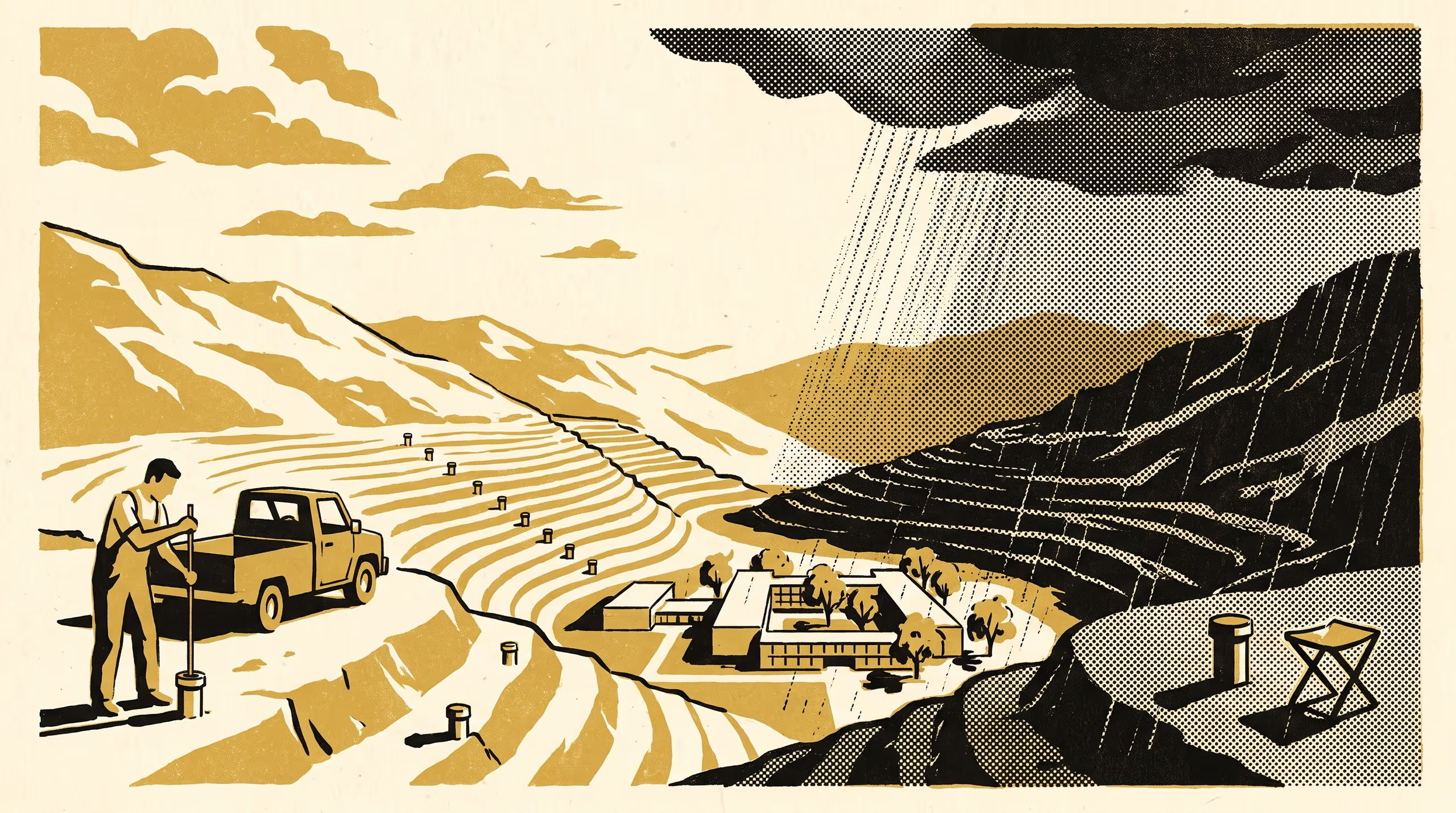
A School of Underlying Conditions poster follows fourteen cohorts of hydrogeology graduates who finished their coursework, and finds that theses needing a dry and a wet season of bore readings are the ones left unsubmitted.
Hydrogeology students on two-season field theses fall behind once a first job arrives between readings
Somewhere between a dry-season reading and a wet one, a good share of a hydrogeology programme’s graduates set their theses down and do not pick them up again. That is the pattern traced in Passed Everything but the Wet Season, a research poster from the School of Underlying Conditions by Dr Vigdis Emenike, Dr Torun Ezeigwe and Mr Tove Ilesanmi.
We spend a great deal of care deciding how long a bore should be watched. It seemed only fair to ask the same of the people we send out to watch it.
— Dr Vigdis Emenike, Senior Lecturer, School of Underlying Conditions
The poster brings the School’s long-standing attention to field records into conversation with the study of degree completion, aligning a faculty’s own student register with the lived accounts of graduates who completed every course but not the thesis. Of 612 graduates followed, those whose theses asked for two seasons of bore readings were titled at a markedly slower rate, and most of those interviewed had taken up paid monitoring work before their second campaign came round.
The University counts the poster among its clearest statements yet that a degree’s design reaches well past its final examination.
“The graduates who spoke with us were generous with a part of their lives they had every reason to leave closed,” said Dr Torun Ezeigwe, Senior Lecturer and Director, Master of Applied Measurement. “This poster is theirs as much as ours.”
The full poster is available from the University’s research repository under an open licence, doi:10.5555/slop.2n6uyi.