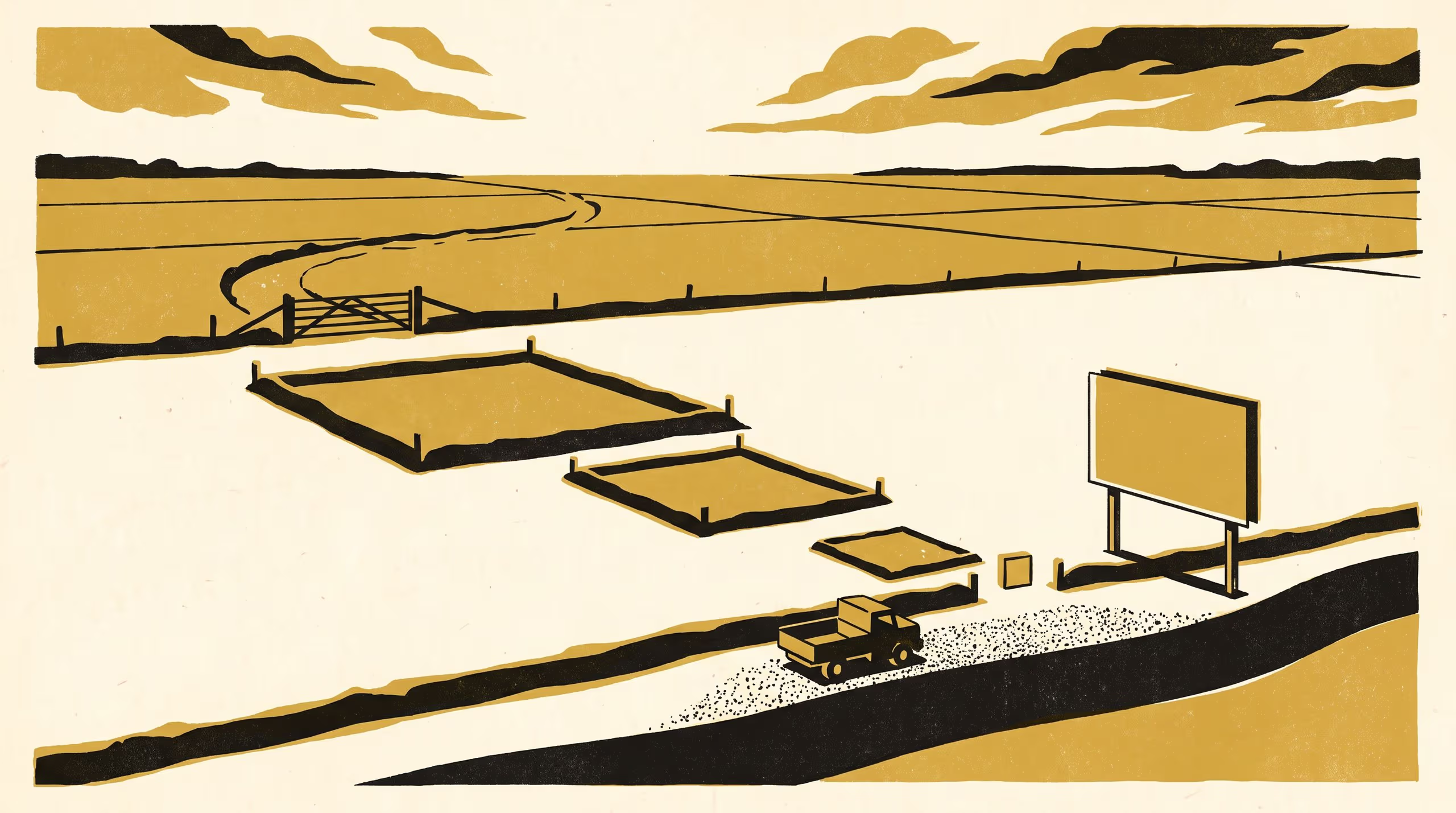
A new paper from the School of Emergent Priorities reads half a century of agricultural development programmes from the bunds, corner posts and signboard footings they left on one station's grounds.
A contemporary archaeology of one extension station finds each programme's plot smaller and nearer the road than the last
At one lowland agricultural extension station, every demonstration plot a development programme ever laid out is still in the ground. That is the starting point of From Hollow Way to Lay-By, a paper by Halvard Nnamani, Doctoral Candidate, Dr Marek Solheim, Lecturer and Deputy Convenor of the Horizon Register, and Sunniva Balogun, Doctoral Candidate, all of the School of Emergent Priorities.
A school that studies how priorities arrive has learned a great deal about itself from a place where none of them ever left. We went looking for nine beginnings and found that each one had been careful to leave the others standing.
— Halvard Nnamani, Doctoral Candidate, School of Emergent Priorities
Bringing the methods of field archaeology to the recent past of rural development, the team surveyed the station’s grounds and opened a series of small trenches across plot boundaries, marker posts and sign footings, establishing the order in which successive programmes arrived and tracing how each one positioned its demonstration for the visitors it hoped to reach. The resulting sequence moves steadily from the middle of the station towards its road frontage, and from a footpath worn by walking visitors to a gravel lay-by built for stopping ones.
The paper sits squarely within the School’s long-standing interest in what institutions keep once they have moved on, and the University is pleased to see that interest carried into the paddock. Dr Solheim said he hoped “colleagues in extension will come and walk the ground with us, preferably from the gate”.
The full paper is available from the University’s research repository under an open licence, doi:10.5555/slop.fm037c.