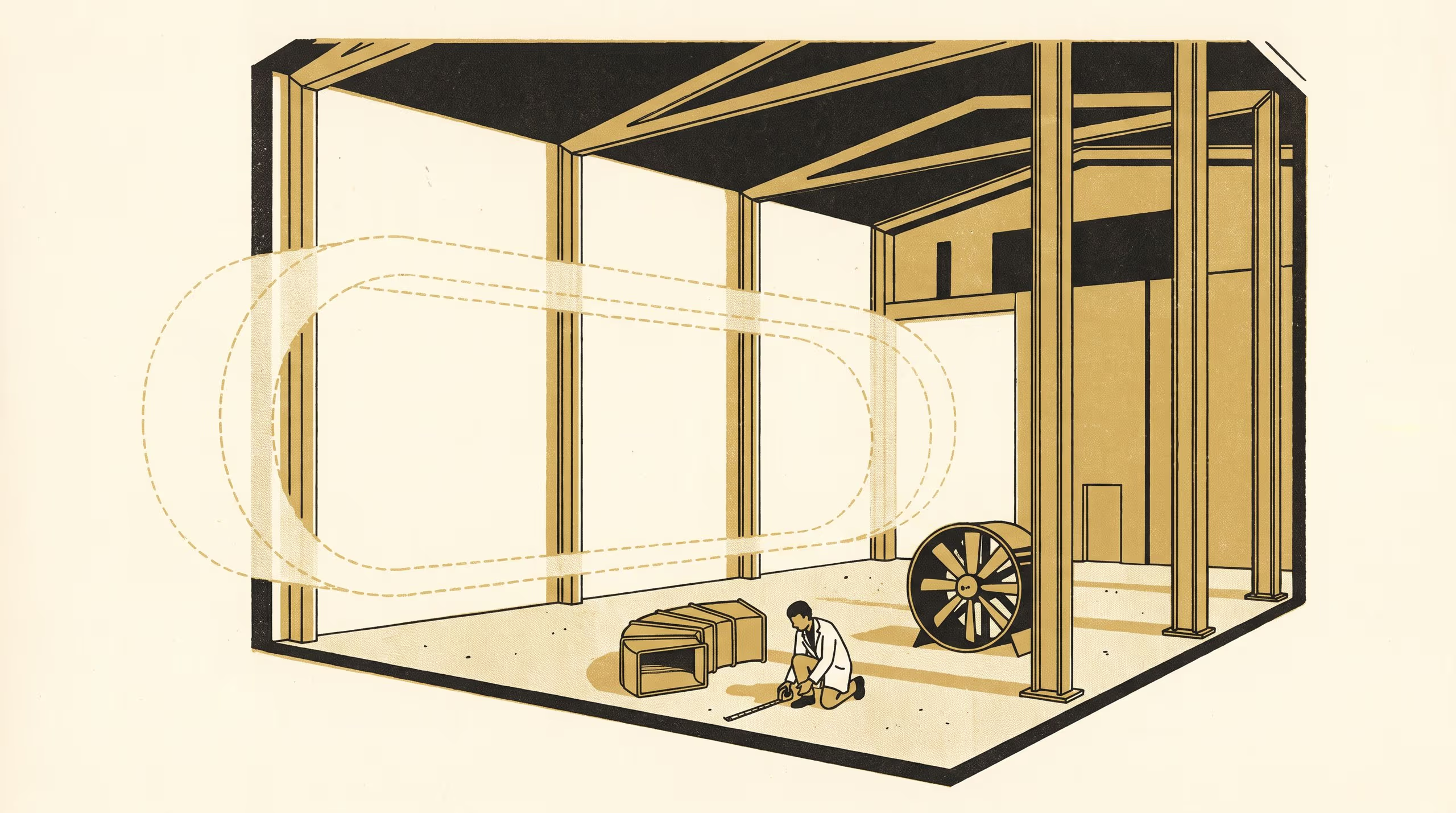
A School of Emergent Priorities paper re-values a research institute's decision to build a wind-tunnel hall before choosing the tunnel, and finds the finished shell left 61 of 412 candidate designs in play.
A staged build kept the right to choose later, but the width of the shell had already settled most of the choice
What a building leaves open once it has been built is the question at the centre of What the Shell Already Decided, a new paper from the School of Emergent Priorities. Written by Associate Professor Kwame Lindqvist, Director of the Master of Priority Studies, with Dr Fenna Okoro, Senior Lecturer and Convenor of the Horizon Register, it follows a research institute that put up the hall for a wind tunnel first and planned to decide on the tunnel later.
Every capital plan we read from now on, we expect to read twice: once for what it promises to keep open, and once with a tape measure.
— Associate Professor Kwame Lindqvist, Director, Master of Priority Studies
The paper sets the institute’s design catalogue against the dimensions of the finished hall, then revisits the value its capital case placed on waiting, connecting option valuation, facility planning and the sequencing of commitments into a single account of how a first decision frames the ones that follow. Of 412 candidate configurations, 61 fit the shell, and the flexibility that remains turns out to rest mostly on the choice of fan drive.
The University regards the work as a timely contribution to the way it thinks about planning, building and growing in stages. “The Horizon Register keeps rows open for things nobody has named yet,” said Dr Okoro. “Until this year we had not given much thought to how wide those rows are.”
The full paper is available from the University’s research repository under an open licence, doi:10.5555/slop.cwr262.