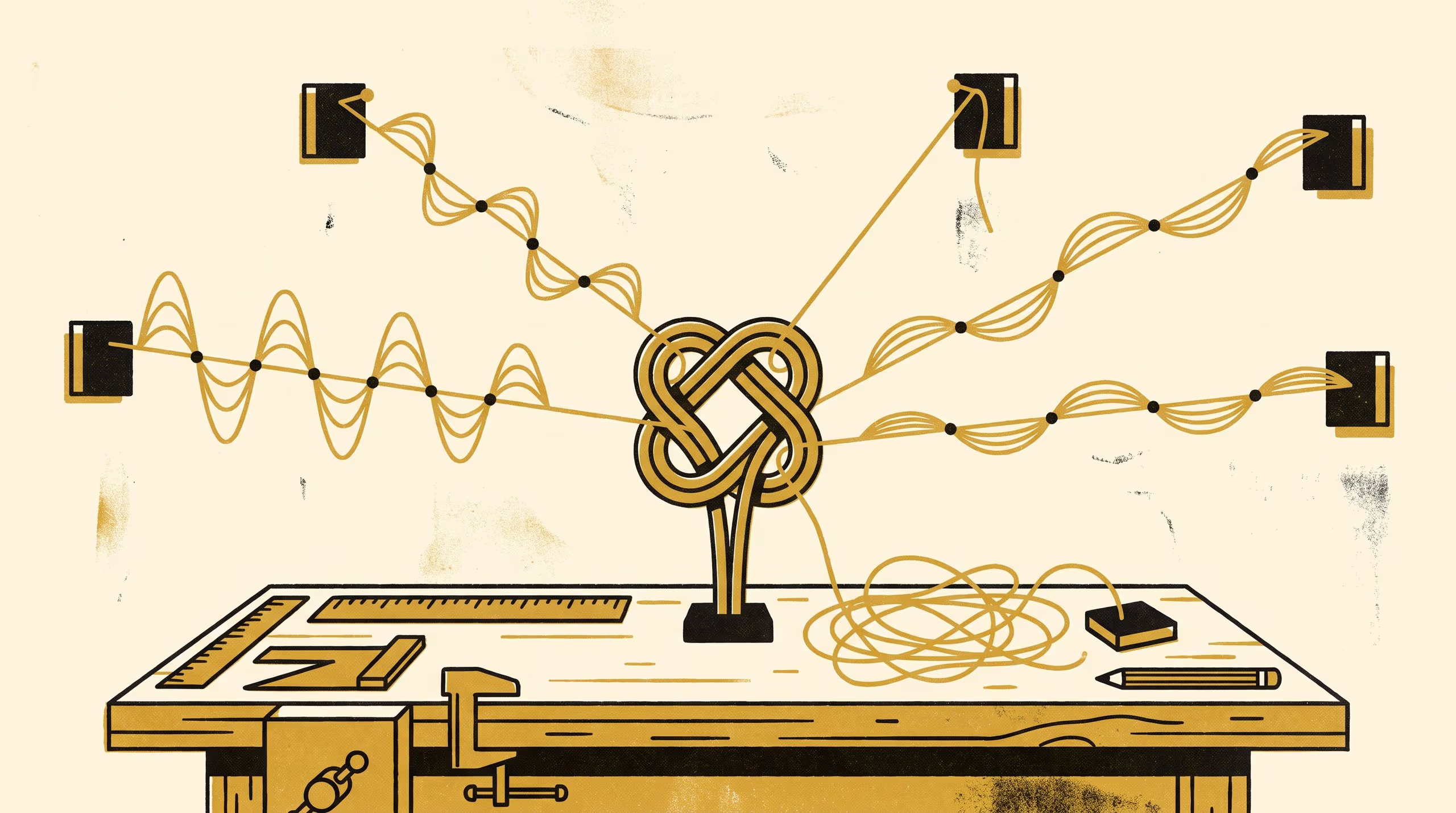
A School of Continuous Improvement paper proves that retiring an edge from a vibrating star-shaped network takes away almost exactly that edge's own share of its frequencies.
What a Retired Edge Takes With It shows that a deleted edge removes its own share of a star graph's spectrum, give or take a single eigenvalue
The School of Continuous Improvement has spent much of its short life asking what happens to a thing after it is retired. With What a Retired Edge Takes With It, a sole-authored paper by Dr Joost Nwosu, Postdoctoral Fellow, the School puts that question to mathematical physics.
I came to this problem from the side of the ledger, and it has been a good season spent with an object that keeps its own accounts. I hope it is the first of several conversations between the School and the people who work on these questions every day.
— Dr Joost Nwosu, Postdoctoral Fellow, School of Continuous Improvement
The paper takes a star-shaped network of vibrating strands, removes one strand at a time, and follows how the network’s spectrum responds. Moving between exact counting results, an argument from symmetry and a worked five-strand example, it brings rigorous spectral reasoning into alignment with the School’s wider agenda of stewardship, retirement and institutional memory, and finds that a retired strand takes its own share of the network’s frequencies with it, never more than one out either way.
The University sees the work as part of a broader widening of the School’s methods, one in which proof sits comfortably beside audit. Welcoming the paper, Marek Solheim, Lecturer and Deputy Convenor of the Horizon Register in the School of Emergent Priorities, said it was “a pleasure to see a colleague take up a question I had only ever approached from the random side, and to find it so well kept.”
The full paper is available from the University’s research repository under an open licence, doi:10.5555/slop.ywtonf.