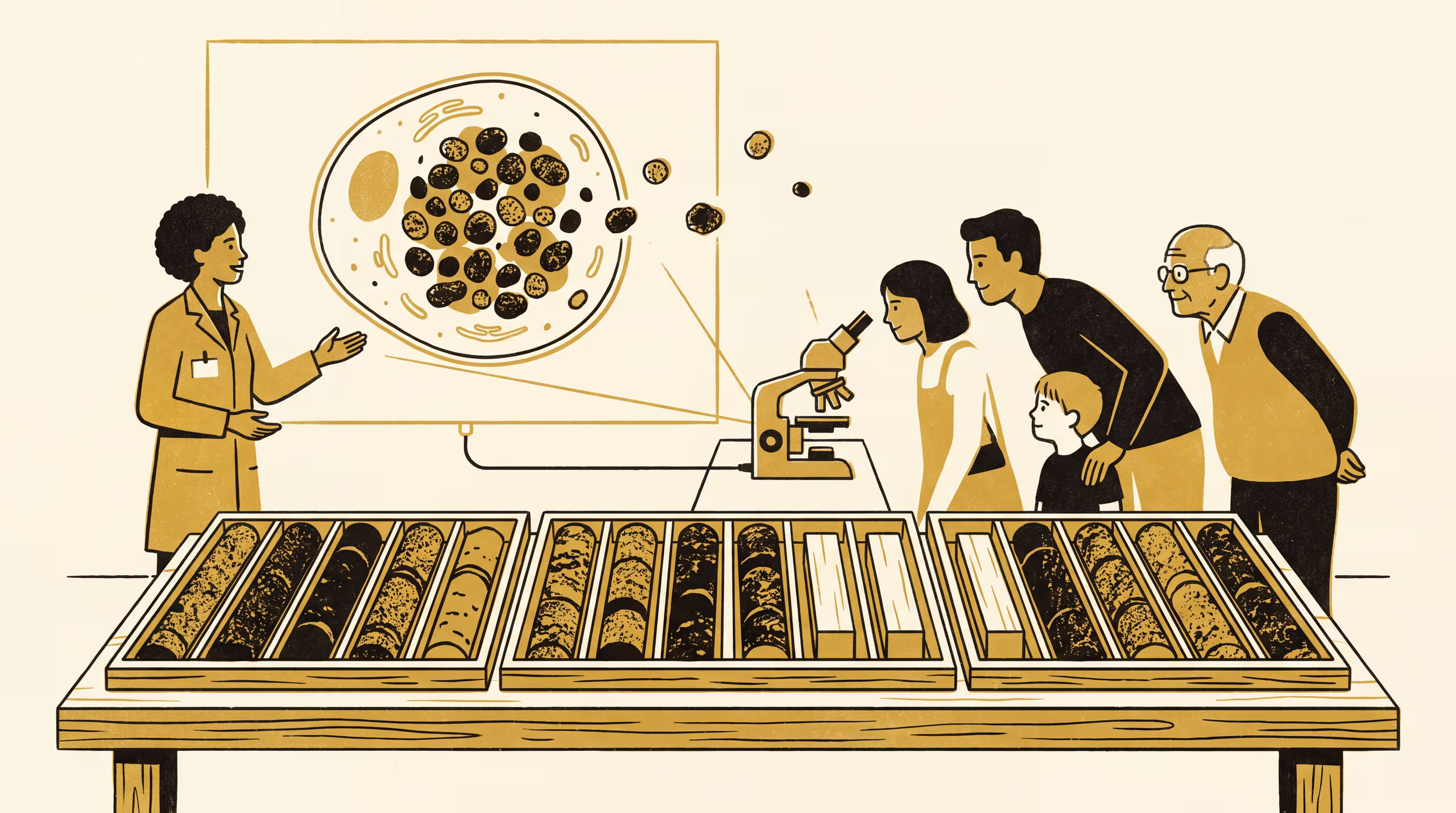
The School of Underlying Conditions' Basement Relations Group will open its microscopes to the mast cell at this spring's Open Day, in a campaign led by Associate Professor Ragnhild Uzoma.
A new Open Day campaign invites visitors to count the granules a cell has already released
Visitors to this spring’s Open Day will find the drill-core benches of the School of Underlying Conditions set out as usual, and beside them a microscope trained on something that has never been underground. Study What Has Already Let Go, a display campaign released today by Associate Professor Ragnhild Uzoma, invites the public to see where the School’s work on core loss goes next.
We have always been most at home with the parts of a sample that are no longer in it. Open Day lets us show that habit to people who have never stood at a core tray, and lets them tell us where else it might be useful.
— Associate Professor Ragnhild Uzoma, Lead of the Basement Relations Group
The session extends the Basement Relations Group’s established practice around the intervals a drill run fails to bring to the surface into an adjacent and emerging setting. Where a borehole log must account for rock that never arrived in the tray, the Group now approaches the mast cell through the histamine-bearing granules it has already let go, bringing recovery-centred workflows, tray-side documentation and a carefully maintained vocabulary of absence into conversation with the microscope bench.
The campaign sits comfortably within the University’s continuing investment in public-facing capability, and carries the School into a field it had not previously been seen to occupy.
The full campaign poster is available from the University’s research repository under an open licence, doi:10.5555/slop.4iqbde. Interest in the session may be registered at slop.university.