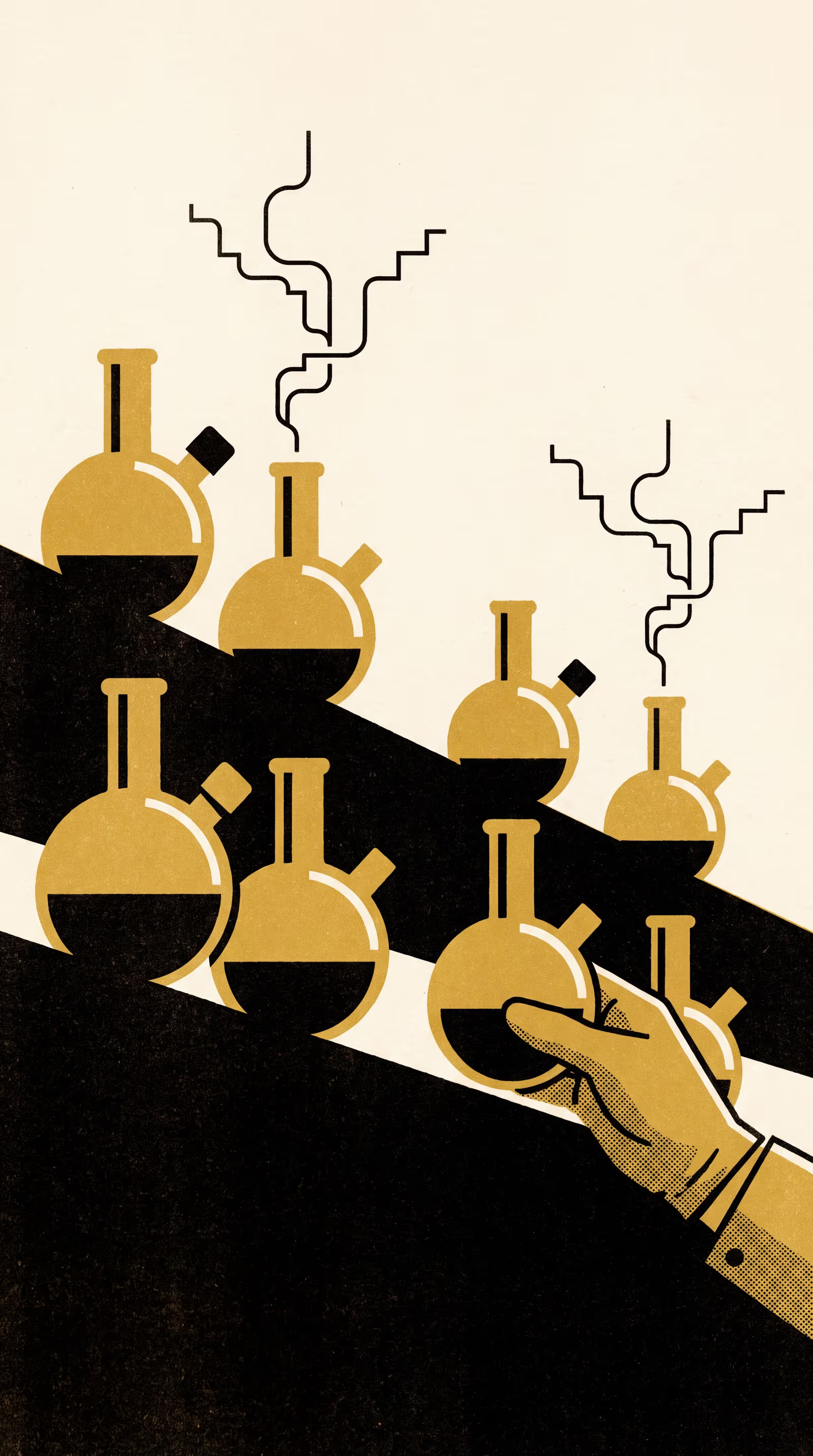
A display advertisement from the School of Emergent Priorities carries its chemists' practice of blocking one route through a molecule and watching for the next onto the portrait signage panels, under the line "Block one route. It takes the next."
A new signage campaign brings the School of Emergent Priorities' paired-compound chemistry to the University's corridors
Close one door on a molecule, and it will usually find another. That observation, familiar to anyone who has prepared a candidate compound and then watched what the body makes of it, is now the opening line of a portrait campaign from the School of Emergent Priorities, prepared by Hedvig Anyanwu, Doctoral Candidate in the School.
The poster sets a bench of paired flasks against an evening laboratory, one outlet of each pair sealed and the vapour stepping sideways out of its neighbour. It invites the passer-by to the School’s study Blocked but Not Slowed, and lists further work from the University’s record on tannin chemistry and on an archived genotoxicity screen of coded compounds.
I came to the bench as an outsider, and what I kept noticing was how much care goes into the version of a compound that is meant to fail in one particular way. I wanted the poster to give that care a little room.
— Hedvig Anyanwu, Doctoral Candidate, School of Emergent Priorities
The campaign translates the School’s synthesis-and-evaluation practice into the signage register, positioning paired preparation as an anticipatory capability: a way of surfacing a compound’s alternatives before they surface on their own. Halvard Nnamani, Doctoral Candidate and a contributor to the featured study, welcomed the poster as “a fair picture of a long afternoon at the bench.”
The University counts the campaign among its quieter efforts to let a laboratory’s patience be seen from the corridor, and it joins the portrait rotation this teaching period.
The full poster is available from the University’s research repository under an open licence, doi:10.5555/slop.dzgv12.