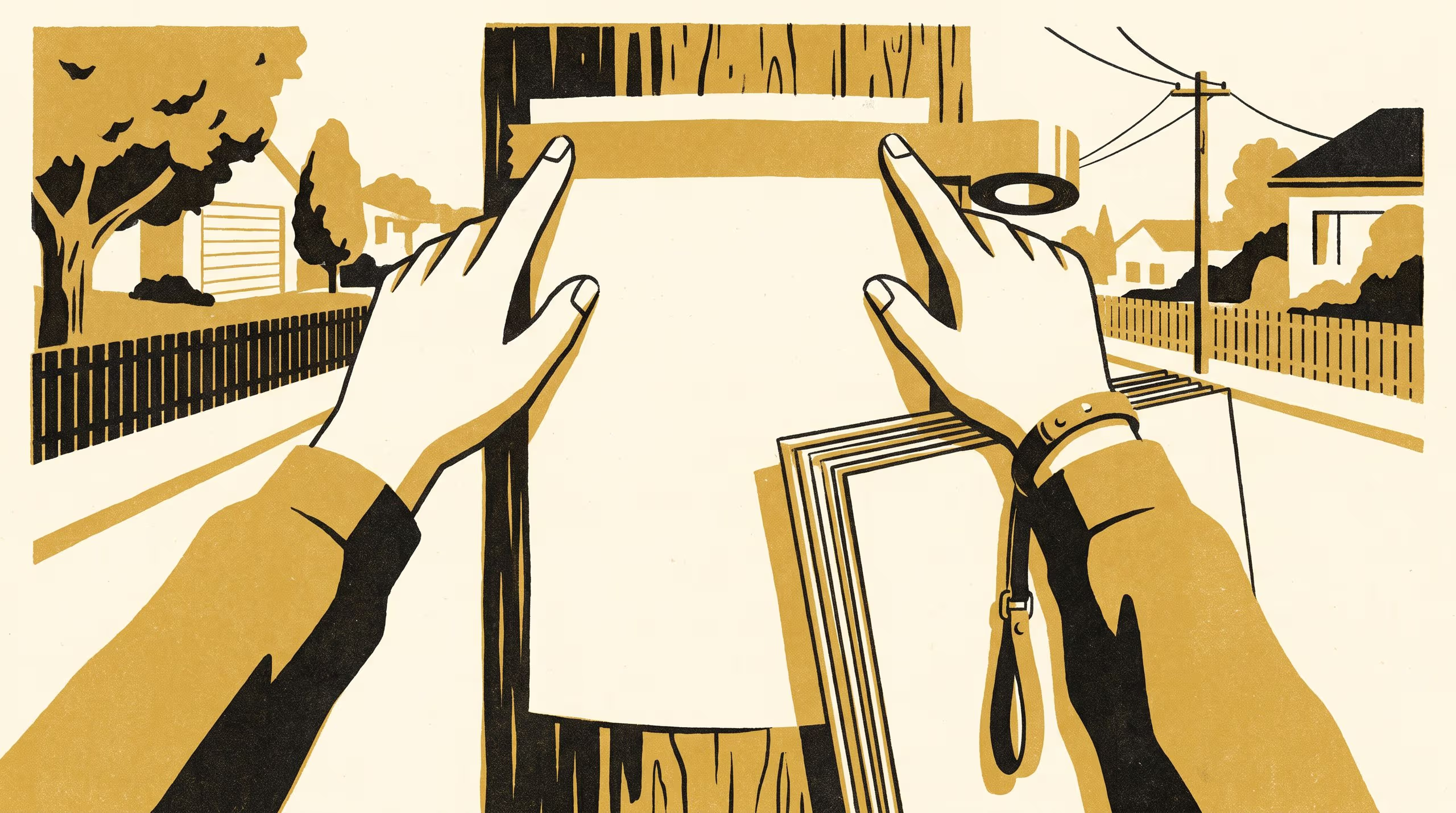
A new poster from the School of Emergent Priorities follows the hand-made lost-pet notice from its first printing to its second.
Do Not Chase reads hand-made posters on suburban power poles and finds the second printing writes for a different reader
The School has written its share of notices that nobody acted on. It was humbling to learn that the people best placed to tell us why had been taping their answers to power poles all along.
— Dr Runa Adegoke, Senior Lecturer and Convenor, Strategic Drift Survey
Dr Adegoke was speaking about Do Not Chase, a new research poster from the School of Emergent Priorities that treats the hand-made lost-pet notice as a genre with a rhetoric of its own. The poster is led by Ms Ylva Onyekwere, a Doctoral Candidate in the School, with Dr Adegoke and Dr Anneke Tolan, Senior Research Fellow and Deputy Convenor of Futures in Committee.
Its central finding concerns the second printing. A first poster spends much of its space asking a passing stranger to care. When a search runs long enough to need a fresh print run, the appeal falls away and the poster begins telling its reader exactly what to do, and what not to. The instruction not to chase, almost absent from first posters, appears on two re-issues in every five, and owners trace it to a sighting that went wrong.
The study pairs a fourteen-month photographic archive of 312 posters, gathered pole by pole across four suburbs, with conversations with 29 owners, anchoring an everyday civic document within the rhetorical study of genre and audience. The University is pleased to see its scholarship of ordinary public writing reach the documents a neighbourhood produces when it most needs to be read.
Dr Tolan said the work had shown the team “how much a document can learn between one printing and the next, and how willing its authors are to let it.”
The full poster is available from the University’s research repository under an open licence, doi:10.5555/slop.or3xzs.