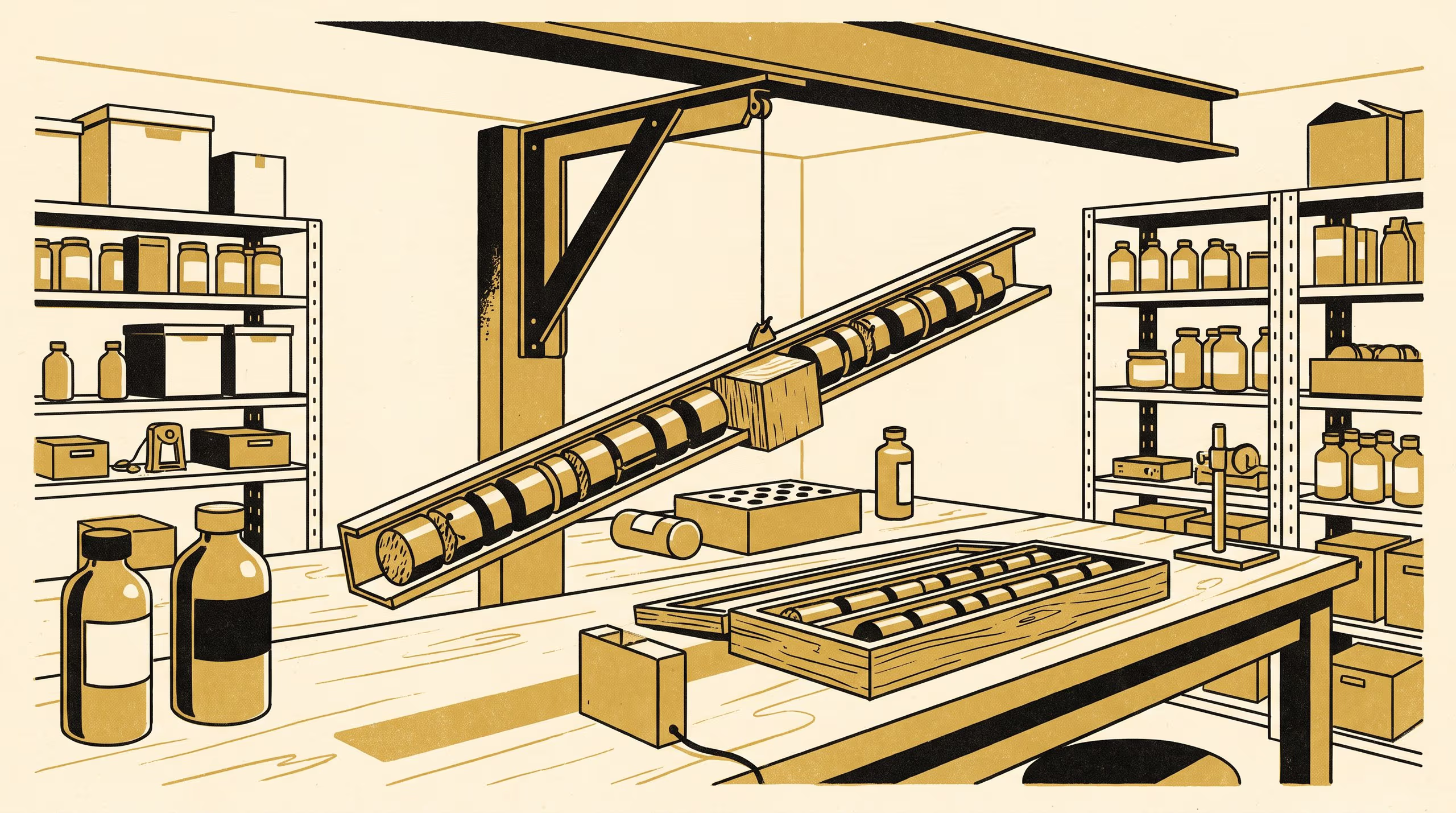
A new paper from the School of Underlying Conditions hangs rows of archived drill core from knife edges and asks students to find, from two periods and a weighing, the interval the drill failed to recover.
A second-year mechanics exercise turns the reversible pendulum into a way of locating lost intervals
Pairing one of the teaching laboratory’s oldest instruments with one of the core shed’s most familiar absences, Where the Core Went sets out how a reversible pendulum, run the other way, can say where in a row of drill core the missing rock should have been. The paper is the work of Associate Professor Ragnhild Uzoma, Lead of the Basement Relations Group in the School of Underlying Conditions.
The students who took this exercise did most of its thinking for us. We are grateful to every pair who measured patiently and waited to cut the sleeve before they knew whether they were right.
— Associate Professor Ragnhild Uzoma, Lead, Basement Relations Group
Over two teaching periods, 23 pairs of second-year students weighed and swung 46 sealed rows from a single archived borehole, then opened each row to compare their answer with the wooden block inside. The work brings classical mechanics into conversation with the practice of core logging, positioning the humble weighing as a second, quieter record of what a borehole yields, and it surfaced broken stretches of core that the tray’s own accounting had never flagged.
The University counts the paper among the clearest demonstrations yet of its teaching laboratories doing research in plain sight, and of a School prepared to let its undergraduates check its trays.
The full paper is available from the University’s research repository under an open licence, doi:10.5555/slop.z2zx42.