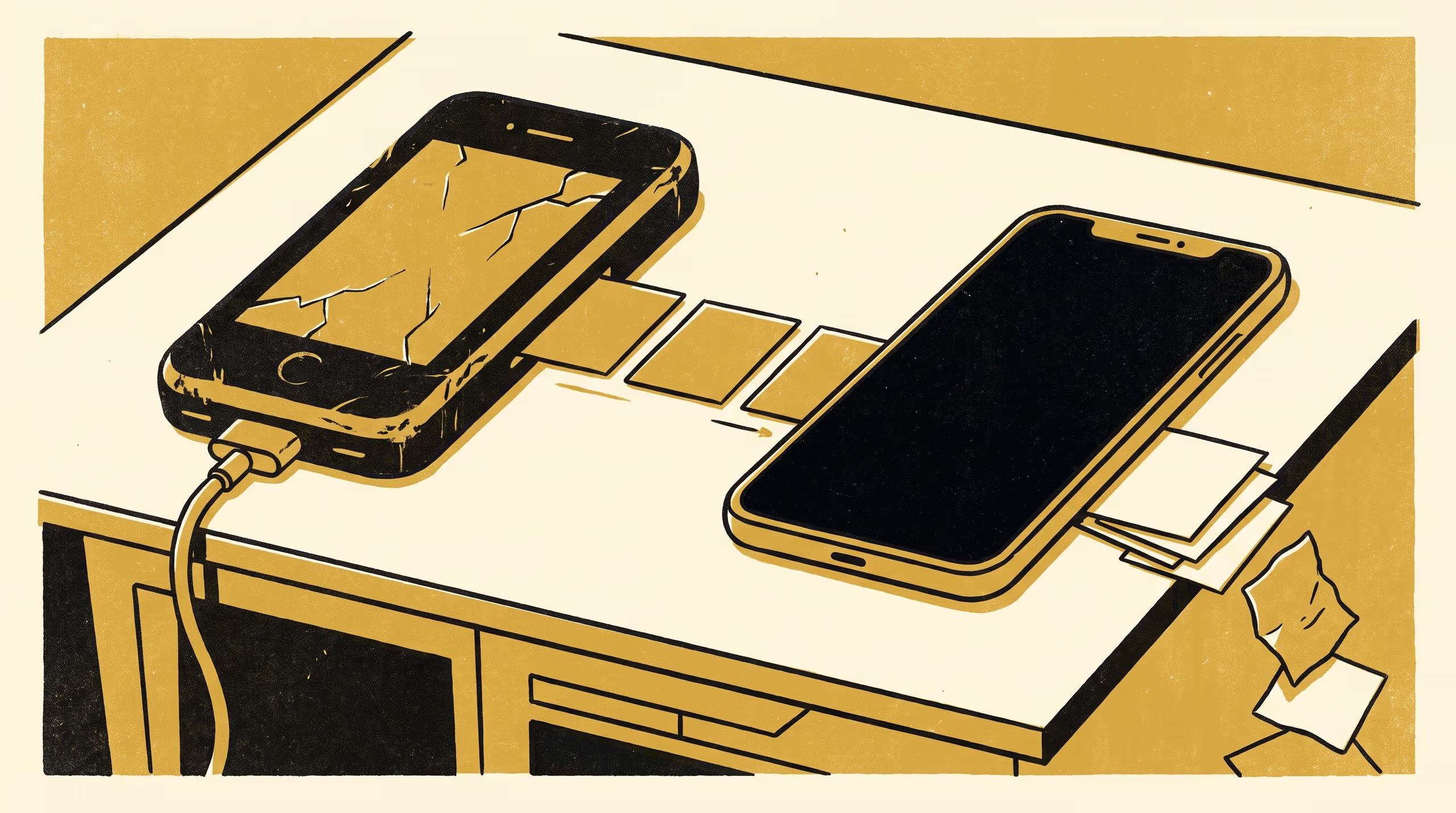
A new paper from the School of Emergent Priorities asks what a contact-tracing app's encounter log should carry to a replacement phone, and what it must still forget.
What the New Phone Remembers shows that restoring a saved copy of a contact-tracing app's encounter log keeps its size and shifts its window
The School of Emergent Priorities has long asked what a role keeps once its occupant moves on. In What the New Phone Remembers, a new paper, it puts the same question to a smaller successor: the phone that replaces another partway through a contact-tracing app’s fourteen-day memory.
The paper is led by Dr Iben Chikere, Lecturer in the School, with Dr Mirela Hanke, Postdoctoral Fellow and Deputy Convenor of the Living Dashboard in the School of Continuous Improvement. Its central finding is that the most natural way to move such a log, restoring a saved copy, leaves the log the right size and the wrong fortnight: each day the copy waits costs a day of recent records and returns a day that should already have gone.
Most of the handover notes I read are complete in every respect but one, and the missing item is nearly always a date. A phone, it turns out, writes the same note.
— Dr Iben Chikere, Lecturer, School of Emergent Priorities
Working across the two Schools, the authors developed a formal account of the migration lifecycle, setting backup, restore and retention side by side within a single reference model and pairing it with simulation at scale to locate the point where completeness and forgetting part company. The result is a proposed protocol that lets each record’s original deadline travel with it.
The University regards the paper as a natural extension of its continuity agenda into the devices its community carries every day. Dr Hanke described the collaboration as “a welcome chance for the Living Dashboard to think about what a screen is never shown”.
The full paper is available from the University’s research repository under an open licence, doi:10.5555/slop.uxkq3f.